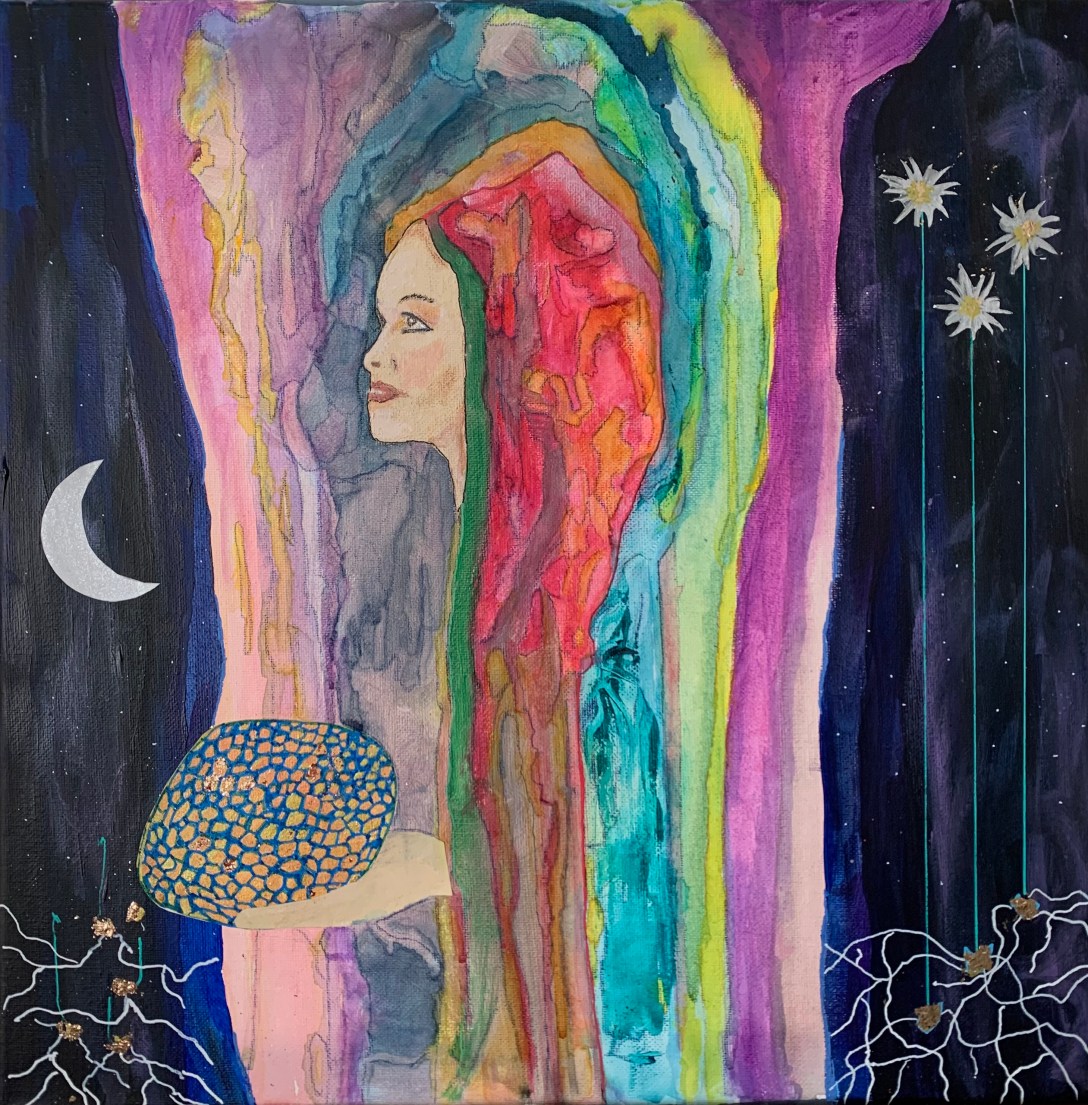
‘Tis the season…of darkness and waiting but not of desolation. There is a richness in this darkness which gestates the brightness of hope. This painting is about planting seeds of love deep in the earth to rise into the heaven to become stars that light the path to the archetype of the Divine Child, Jesus, yes, but also new life in all its forms, the creative sparks from the unconscious that implant in the womb of mind to become a painting, a poem, a new idea, a vision of peace.
She knows in whose boredom the sun sleeps. She studies space, fixes images in their absence, hangs portraits the masters never saw in their crafty light. Interrupts the talk of dragonflies attending all creation. She is the holder of pain, the unmoved target.
I wonder who this woman is who moves as separately as silence, who pauses to applaud a renegade dogwood, red in still-green autumn, understands the bloody revolution of ticking clocks, the second-hand arrows that pierce the flesh but leave it whole.
I hear her coming. She whispers between the folds of perception: you will believe: there is nothing left
but love. -Kitty Yanson
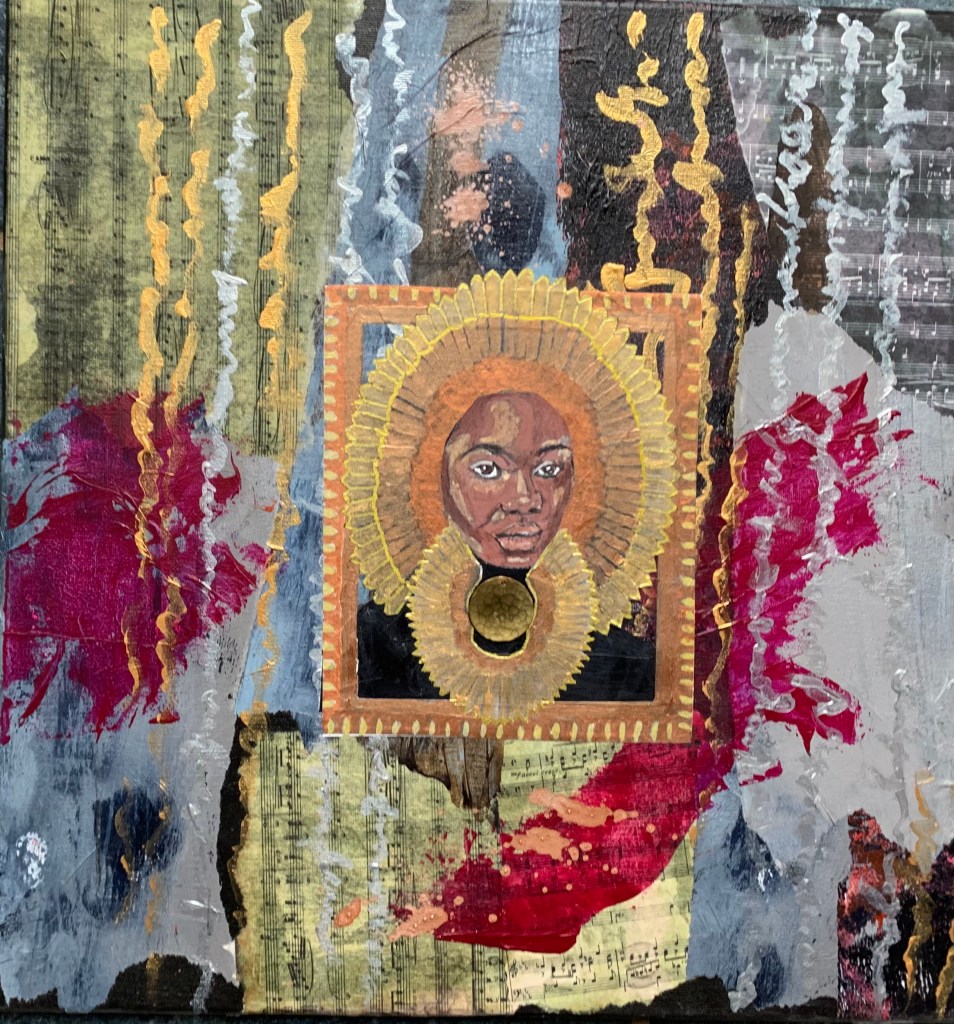
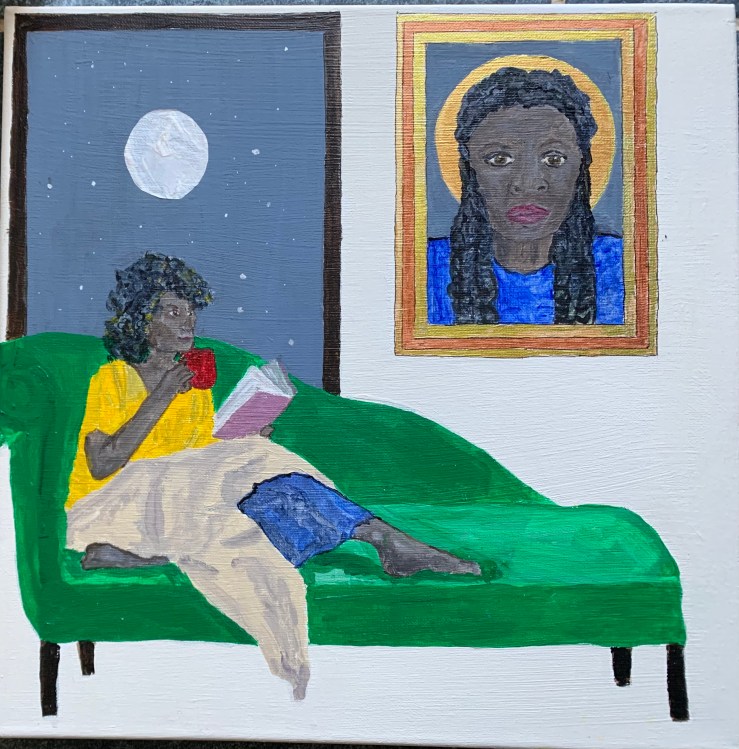
I first became acquainted with the Black Madonna sometime in the early 1980s after getting sober, after my divorce, when I was trying to get through depressive episodes without the liquid medication I had used to try to treat them. First, it was a picture of Our Lady of Czestochowa in my ancestral Poland which drew me toward her, then I searched out others, the Dark Madonnas of Spain, and the one enthroned in Chartres Cathedral. Eventually, I found that she was indeed an archetypal presence in the psyche, a sister of the Hindu Kali, the apocryphal Lilith, and the Egyptian Isis. In all of these forms, she embodies the union of opposites: life and death, spirit and matter, the conscious and the unconscious, body and soul. For me back then, she was the hope I had for healing and wholeness, and so she remains with me today, as I continue to find new ways to create while my body, beginning its 77th year this week, reminds me with a new ache every morning that mortality is destiny, a part of life. This image of this Great Mother, both womb and tomb, comforts me, sings me awake and to sleep in endless cycle of God. These three paintings are my way of exploring her great truth without words.
Hagia Sophia is often seen as the feminine of God; Lady Wisdom is how I’ve come to know her in my own spiritual path, a friend who has stuck by me whether I wanted her to or not in the moment. In this painting she invites us to tea and has included hazelnuts; I am often overwhelmed by the immensity of God in this incomprehensible universe. Julian of Norwich in her mystical text speaks to this. She reminds me in my hazelnut smallness that Love in its hugeness has a place for me as well:
“And in this he showed me a little thing, the quantity of a hazel nut, lying in the palm of my hand, as it seemed. And it was as round as any ball. I looked upon it with the eye of my understanding, and thought, ‘What may this be?’ And it was answered generally thus, ‘It is all that is made.’ I marveled how it might last, for I thought it might suddenly have fallen to nothing for littleness.
“And I was answered in my understanding: It lasts and ever shall, for God loves it. And so have all things their beginning by the love of God. In this little thing I saw three properties. The first is that God made it. The second that God loves it. And the third, that God keeps it.
“But what is this to me? Truly, the Creator, the Keeper, the Lover. For until I am substantially “oned” to him, I may never have full rest nor true bliss. That is to say, until I be so fastened to him that there is nothing that is made between my God and me. This little thing which is created seemed to me as if it could have fallen into nothing because of its littleness. We need to have knowledge of this, so that we may delight in despising as nothing everything created, so as to love and have uncreated God. For this is the reason why our hearts and souls are not in perfect ease, because here we seek rest in this thing which is so little, in which there is no rest, and we do not know our God who is almighty, all wise and all good, for he is true rest. God wishes to be known, and it pleases him that we should rest in him; for everything which is beneath him is not sufficient for us. And this is the reason why no soul is at rest until it has despised as nothing all things which are created. When it by its will has become nothing for love, to have him who is everything, then is it able to receive spiritual rest.” (1st Revelation)
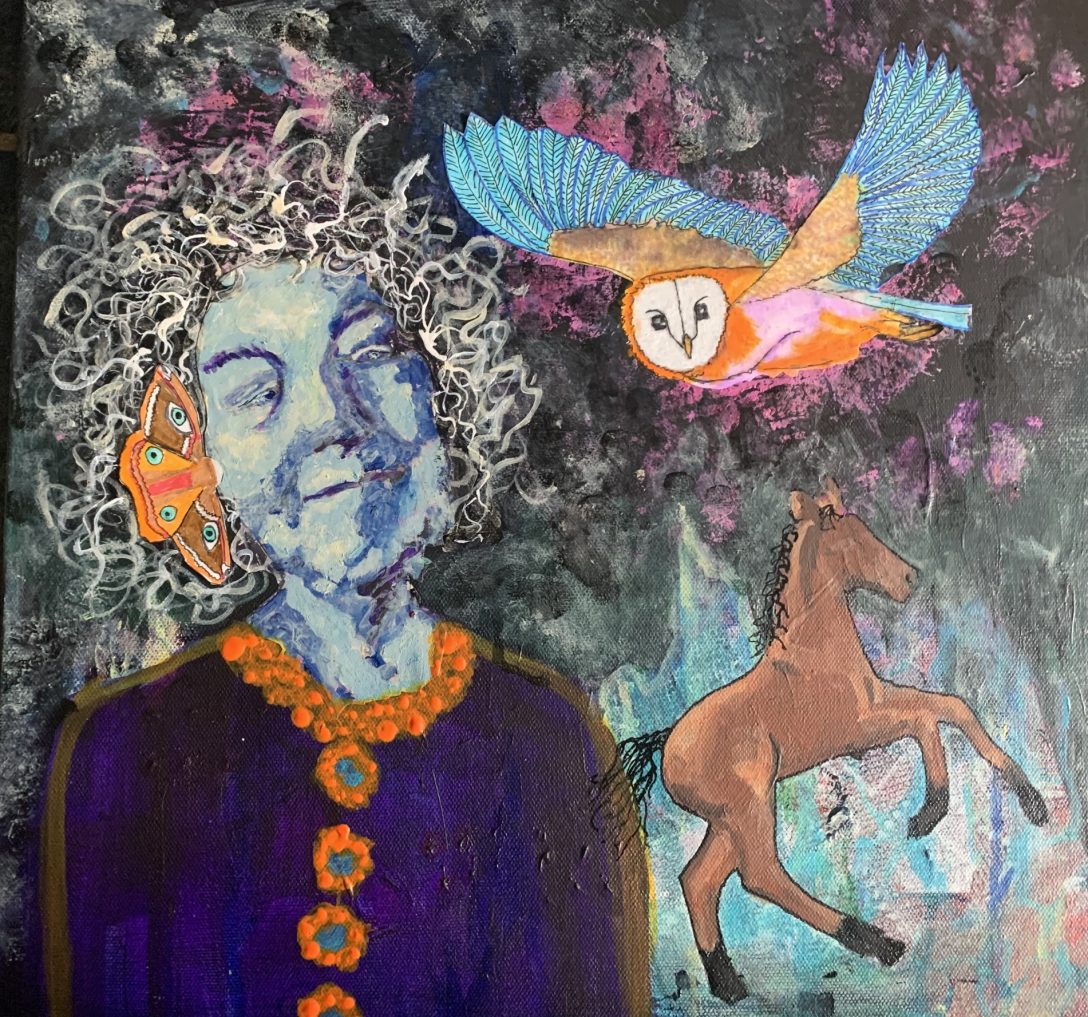
Sometimes doing art is a kind of healing. This painting, in particular, began with a memory of a moment many, many years ago, my earliest memory, I think. My not-yet-huge family was standing on a hill watching an itinerant carnival spinning a ferris wheel and merry-go-round on a lot in Northwood. A very small me, little more than a toddler, was circling my father, round and round, my hand self-tethered to his knees. But when I looked up, my father’s face wasn’t there. A strange man stared down at me. Of course, I was terrified by my father’s seeming disappearance. It was a momentary separation, but one that carved a missingness that has lived all these years in me.
During my meditation practice recently, I saw the idea of this painting: What if I sat with God on that hill of my imagination looking at horses freed from the merry-go-round and a ferris wheel turning in the stars? What if we looked together at the missingness that lives in the center of all relationships to see there the longing for completeness as a holy quest. I think that my own father, now in heaven living in perfect love, understands this now. I feel him scooping me up to look at the stars he loved so much. “Look, Kitty, that is Orion the Hunter and that bright one in his belt is Betelgeuse, one of the great navigational stars.” It brought him home when he flew rescue missions in the South Pacific during World War II. It guides me home today.
This month has brought images in my sketchbook–paintings of the ladies who live with me in the little world of my head and heart. The first began using a Chagall portrait as my inspiration. My black cat Francis (who is growing purple with age and irritation) sat next to her, then a goldfish plopped in a bowl. I call this woman Lady C for Lady Creativity.
Then I had a dream that above a Gothic doorway was inscribed “Vocatus atque non vocatus Deus aderit” (Called or uncalled, God will be present), the inscription that C.G. Jung had above the doorway to his home and the office where he saw his patients. So Lady Creativity in the next painting stormed that door, mirroring my daily prayer that I borrowed from Darius Bashar, a meditation teacher on The Artist Morning website (https://www.artistmorning.com/.
Dear God, it goes, Please use me as a vessel for your divine expression. Use me as an instrument for your love. Give me the strength to go into the depths of my heart to find my truth and the courage to speak my truth in my own authentic voice. Whatever happens from there, I let go and let God.
In his approach to meditation, Darius uses Julia Cameron’s The Artist’s Way, a book I highly recommend to all creatives to help to feed their souls.
Then, I revisited my old friend Lady Wisdom, to me both a representation of Sophia, the feminine aspect of God, and an embodiment of the Great Mother Archetype. Francis my cat and the goldfish return again, but as I was painting, I saw skulls with flowers bloom while Lady W prayed the rosary of years. She became Baba Yaga, a Slavic fairytale figure with the characteristic doubleness of all archetypes: the benevolent grandmom and the witch who lives in a hut in the forest and terrifies children (which was, perhaps, the hidden reason why I thought 70 some years was the age when I would begin to terrify my students–though some of my former would say that I started much earlier than that). So Baba Yaga is here:
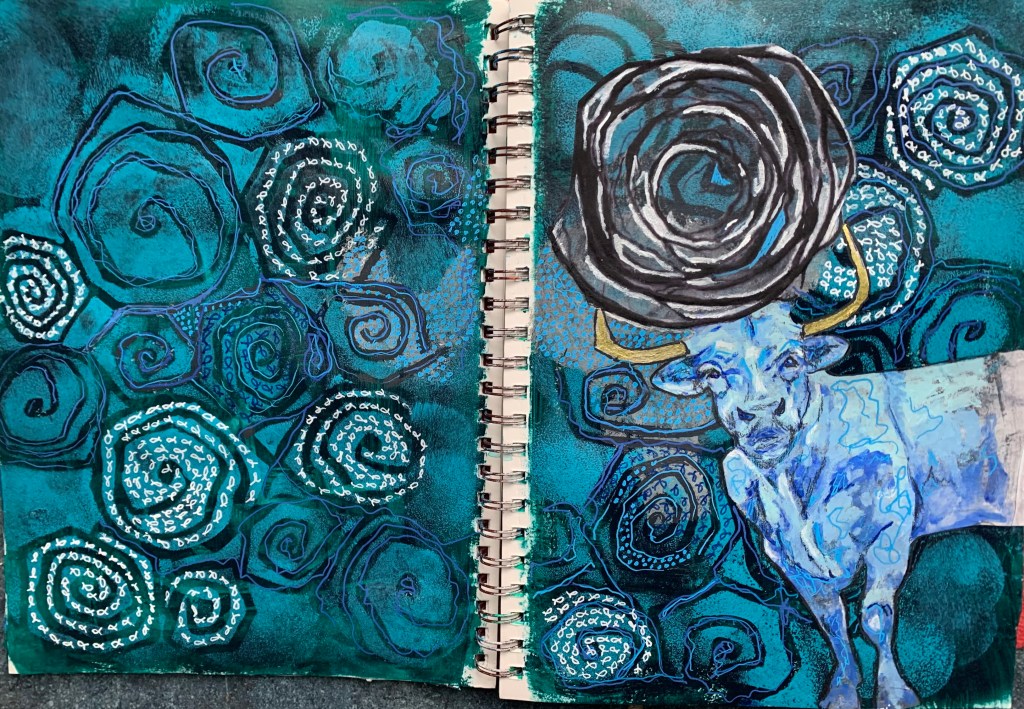
Finally, I had to render another Lady W, standing before the triple trees of life, representing, perhaps, the triple lives of women: maiden, mother, and crone. She wears a cloak of spirals and the moon in her hands. Someone once told me that living was like moving up a continuous spiral up the core of ignorance; when you start up the climb, you are flat up against the core of ignorance, so you cannot see what you do not know, the bricks of the core blind you in their proximinty. But as you ascend farther up and farther away from that core, you begin to see how much you do not know, and when you get to this age, it’s a heck of a lot. But at the same time, you can see the layers of circles you have traveled, the mistakes made over and over again, the former selves that have transformed and reshaped who you are today: the lady of wisdom, of knowledge and ignorance.
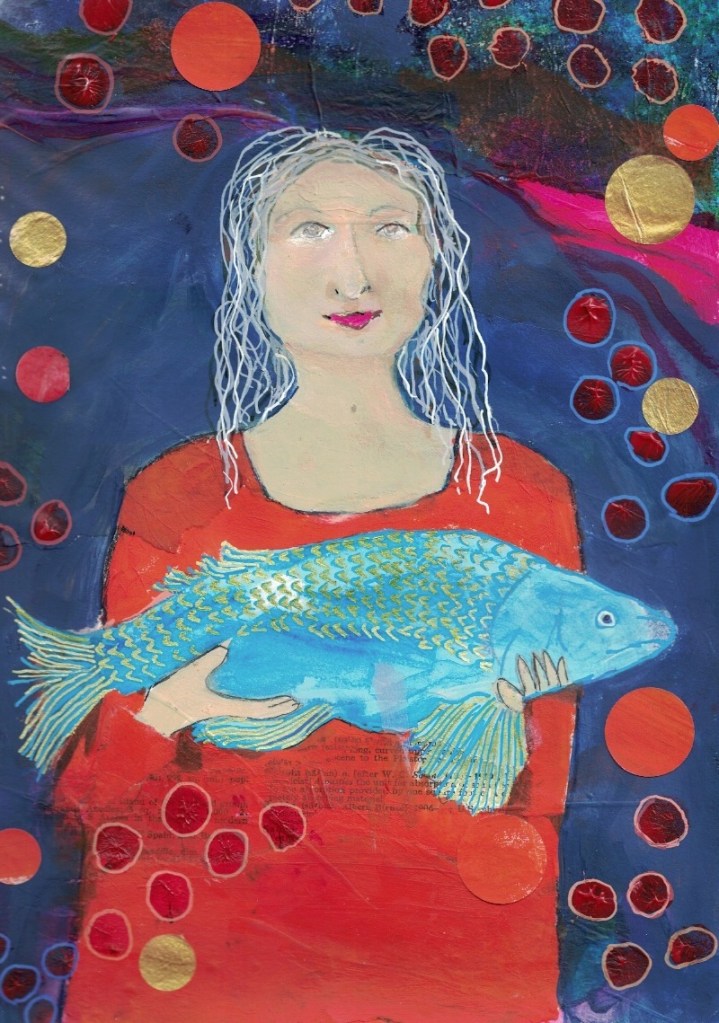
This past December I had a dream of a man standing with a very-pregnant woman. Her water breaks, and in this gushing river fish swim–many fish splashing in this prelude to birth. It was a simple dream, but one stocked with archetypal symbols and meanings of the Advent season. Then came the urge to paint in my sketch book, one image, then another. I’d go to sleep and wake up with yet another image. Another followed, then again, another. Finally, I thought I was through all the fish painting and then, in a session of unplanned intuitive art making, music notes on a piece of collage paper reminded me of a woman’s eyes. Fish Lady emerged. A fish jumped into her arms, a glorious fish with golden fins and scales. I asked her what all this was about, and she told me. This blog post is a storybook of images and lessons learned.
Yesterday, I started another painting…of a train from my childhood, the Little Engine that Could. Next to the track there is a stream. I was getting ready to pack up my paints for the day…a fish breached tissue-paper water.
Fish Lady Speaks
Fish Lady: I stand at the crossing between what you know and what you don’t. Don’t you like the gift I am bringing to you? It is a beautiful fish, at first pencil drawn then all blue, the color of the sky and the sea, all the fluidity of the outer and the inner, your daily mind in retirement that flows from one thing to the next without plan or methodology unless you are cooking a new recipe or learning a new lesson about how to paint shadows. Because the fish’s scales are gold tells that it is from God and needs to be eaten and consumed, digested and made part of your wholeness.
Me: But it is beautiful, Fish Lady! If I cook and eat it, it will be destroyed. I do not like that. I want to watch its beauty swim in my awareness.
Fish Lady: That is your need to keep things certain and in one form. But this gift allows all that beauty to go into your core, just as it is now hugged against my heart. I know that the physical act of eating no longer brings you the pleasure that it once did now that your taste buds are dull and confused, but maybe this is a call to eat of the spirit.
Me: I am aware that Jesus and fish are associated; if this is a call to buy the Jesus of religion and eat it completely, I am afraid that the bones will stick in my throat. It has always silenced me.
Fish Lady: You are stuck in the old stories and need to digest the beauty to become the beauty. The stories of Jesus you remember from childhood when he was all goodness and light even in the face of death, these are stories that float like beautiful clouds in the sky that produce the rain that becomes the sea that you find yourself in swimming with the fish that are now the gifts of mystery. Watching childhood stories, like watching the action in an aquarium, may calm but not sustain you in what you are doing now. You must slit the fish in its belly, pull out its innards, filet it, throw it into the fire, and eat it. That means finding Jesus in the missingness of taste you used to revel in, the pains in your face and joints, the cake you bring to your new neighbors, the squirrel on the back deck you fed with peanut butter, the conversation with the kid down the street who shoveled your walk who looks like a linebacker and wants to become a clothes designer, a visual, walking contradiction whose dreams you can support. You see God through curious attending to both mundanity and magnificence.
Me: And like the initial dream of the fish swimming in the water breaking before the pain of labor and the joy of birth, the work of dailiness is the catching, gutting, cooking, eating and digesting, avoiding the bones when I can. I am not sure I can.
Fish Lady: Yet you also dreamt one night of can openers. But can is not just a noun; it is a verb too. You are being invited to open your fears and have dinner…Take another look at my image. Did you notice that the only piece of collage visible still beneath the paint is the dictionary page. Dictionaries give definitions and meaning. Definition and meaning. There is more here to look for. Pay attention!
My first AA job forty years ago was to make coffee, hauling plastic pitchers of water to the silver coffee maker that wheezed when it got going like a bad asthma attack or dry heaves after a bad drunk. I set out the sugar packets and jars of powdered creamer filled with trans-fat that would get us eventually but maybe slower than the alcohol, the stirrers, the napkins the tin foil tart shells to serve as ash trays. We were all on the water wagon, striking up our agency a day at a time. Our lives had been paralyzed by addiction, but here we were, laughing our shared shame away in a bubbling pool of humor sweetened with the intensity of metanoia. The chalices were Styrofoam, the coffee sacramental, celebrating the shift in perspective when “I drink because of my problems” becomes “my problem is that I drink.” If I had lacked power over my addiction and needed to find a power greater than myself to recover, then sharing this communion of caffeine helped to show me how to heal.
After the meeting, we could walk outside in the evening cool and look into the sky to watch the constellations line up in different forms: There was the horse that Mac had talked of when he spoke of horses that have more sense than humans; when one of their herd was ill, the others gathered and pressed their warm bodies against it, to heal and give strength. There was Hermione the Trashcan talked about by a delicately made woman with pinch-nose glasses who spoke of taking her empty bottles to her neighbor’s trash can because she didn’t want the trash men to know how much she drank. To its right in the autumn sky was the Forest of Words which kept our minds occupied while the real healing of propinquity took place. Finally, where the Big Dipper transformed into the coffee cup in its imaginary clouds of Styrofoam pointing in the heavens to the North Star, Polaris, the navigational beacon that we could rediscover if we lost our way and kept our sight sober and true. This North Star, the power greater than ourselves, the God of our understanding that some saw in the religion of their upbringing, some saw in whatever…a doorknob, and some saw in the group.
Many an evening, our cars filed the familiar path up Charles Street to go the meeting after the meeting at the Towson Howard Johnsons, the orange-roofed HoJos that some may remember, where we cemented our friendships and dedication to the 12 steps with French fries, and hot fudge sundaes washed down with even more coffee. On the way home, I passed a familiar friend, a beautiful, old weeping willow across the street from the entrance to Sheppard Pratt Psychiatric Hospital with its fairytale stone Gate House. This willow took one’s breath in the spring when it leafed out before any of the other trees, weeping gold first, then green. It reminded me of the willow my father had planted in the backyard of our Northwood row house that that grew with the vigor that only proximity to the sewer lines could give it in its incredible thirst for water
Weeping willows are greedy flora. Their roots spread fast and far to suck up any form of water in the nearby soil. God help the homeowner who plants one in a backyard that also holds the water and sewer pipes in terra cotta pipes. Well, my father did, and after many plumber visits and roto-rooterings, he finally had to admit defeat and take the darned beautiful tree down, digging up any remaining roots that could sprout a sapling to begin its cycle of destruction all over again while it leafed out toward the sun in beauty. I loved that tree. I loved the way the hanging branches stirred in the breeze to tickle your face. I loved how you could cut a long branch and tie your brothers’ hands together, an older sister torture technique. I loved how the fully leafed curtain of withes made all the weather theatrical: the August lightening, wind whipping from the west, the curtain parting for the curtains of rain, the air thundering with anticipation, my grandmother, afraid of lightning , calling us away from the willow to go into the basement to pray the rosary until the storm passed. But I had already been struck…with wonder as this tree grew more beautiful by day, its roots sucking in the dirty bath water and stinking excrement from the sewer pipe, converting our waste into juices of life for new leaves burgeoning like our ever-expanding family, this tree, itself a meditation on living, the tree growing taller and taller with each inhalation and then raining to the ground an exhalation of branches.
Early in my sobriety, my sponsor suggested that I begin a meditation practice, I think because my mind in post-acute withdrawal was racing around in circles like clothes in the spin cycle, only with peanut butter (of course, all that coffee didn’t help). My beginning practice was sporadic; only in the last 20 years or so have I settled into a regular sitting routine. Recently, however, I have been studying the Christian mystics because I’ve come to understand that this longing for something, for something more that I have felt all my life is really a longing for God. One practice is that of Centering Prayer, a method of contemplation named and popularized by the late Trappist monk and priest, Thomas Keating. In this, the prayer is instructed to choose a word meaningful to them to repeat as an anchor, much like a mantra or breath counting in Zazen, to help still the mind enough to hear the breath of God in the inward ear. I am particularly fond of the way James Finley in the podcast Turning to the Mystics describes the use of the word: look at the birds, he says, the eagles, vultures, even gulls that ride motionlessly upon the pillars of heat that rise from the earth called thermals.
They just fly. And then every so often, as they lose a little altitude, they flap their wings a few times. So, you’re sitting in this presence, and you realize there’s distractions. And so, you say “Jesus, Jesus, Jesus[your word],” like you flap your wings a few times to maintain altitude, but you’re really trying to use the word to get beyond all words. And I think it comes full circle. We use the word to get beyond words to discover the holiness of words, how God’s present, and the way we talk to each other and so forth. (Finley)
The word I chose is Bethesda.
There is a story that many, many years ago, an angel came to Jerusalem. Where its heel struck the ground, a fountain sprang and the pool that formed from it healed all those who bathed in it. This healing pool became know as Bethesda a name that means House of Mercy or House of Grace for the healing that occurred. Yet the place also became called the Place of Shame or Disgrace for the people who hung out at the pool, all suffering the shame and disgrace of disease-wracked bodies, a multi-denominational leper colony, so to speak, unspeakingly shouting, “Unclean! Unclean!” to those who came near.
But this is just the kind of place that always attracts Jesus. Traveling to Jerusalem for some sabbath or another, Jesus passes the crowd of those waiting by the pool, waiting for the angel to stir the waters, waiting to be the first in the pool and get healed. He sees a man who had been paralyzed for thirty-eight years. Jesus asks him if he wants to get well, and the man answers that he has no one to help him into the healing waters. Jesus then tells him to take up his mat and walk. Which he does. And is healed. Later Jesus tells the guy to go and sin no more so he doesn’t have worse things happen to him. Of course, no good gesture ever goes unpunished, and our man J catches grief for healing on the sabbath and the healed guy also is hassled for working on the sabbath by carrying his mat. Apparently, there were legal hair-splitters then too who enforced the old Blue Laws in Jerusalem (am I dating myself talking about Blue Laws when one couldn’t buy or sell stuff on Sundays?).
But the part of the story that interests me is the answer that Jesus gets when he asks the man, do you want to get well. The guy says that there is nobody to get his ass into the water. Jesus ignores his declared lack of agency and tells him YOU get up off the mat and walk as if he is making the man aware that the healing is already hiding within him. No one can do it for him. But someone can do it with him by reminding him of who he truly is, or, as the Zen koan suggests, showing the man his original face before he was born, his Buddha nature, his child of God-ness. I think the man sees this in Jesus’ face. So the man, made pliant as a willow by his thirty-eight years of suffering, chooses to take up his mat and to walk into his life.
That’s kind of the way healing worked for me in AA. I got sober at a meeting place called Agape that was held in an old classroom out-building on the grounds of the motherhouse for the School Sisters of Notre Dame. I met the woman who had answered the phone at AA, and we walked into the building with the words Alcoholics Anonymous shamelessly painted on the wall with an arrow pointing to the two rooms where the meetings were held. To me, that sign could have read, Disgusting People’s Entrance or Weird Wackos’ Cattle Call, so great was my apprehension. But after a few meetings, I took my last drink and I picked up my metaphorical mat and walked (well, drove, actually, in a falling-apart Honda) to more meetings where the folks there showed me that there was a true self beyond the person who drank and got drunk, whose life was filled with the waste and whose marriage was crumbling. And I picked up my agency by not picking up a first drink. A few meetings later, someone asked if I would help make the coffee.
That angel who stirred the waters in Jerusalem, the Bethesda Angel has a central place in Tony Kushner’s Angels in America, a play set during the AIDS scourge in the 1980s gay community in New York. It’s an extraordinary commentary on disease and healing, grace and shame, paralysis and agency, as the protagonist Prior Walter discovers the lesions that herald the infection and loses his lover and his belief in certainty. An Angel, hallucinatory or not, crashes through his ceiling at the end of the first play to tell him that he is called to be the prophet of paralysis, of stasis of the way things used to be even though they are crumbling in decay. God has walked out on them and taken the force of Creation with him. In the end, Prior, refuses this role by becoming, instead, the herald of creative energy, by declaring desire to the Angels of Immobility sitting in a derelict heaven. “We just can’t stop. We’re not rocks—progress, migration, motion is modernity. It’s animate, it’s what living things do. We desire. Even if all we desire is stillness, it’s still desire for. Even if we go faster than we should. We can’t wait” (Kushner 264). And Prior takes up his desire and walks into the final scene of the play, set five years later at the Bethesda statue of the Angel of the Waters. He and his friends, all of whose character arcs reveal healing and action and transformation, talk about Peristroika, the fall of the Soviet state and the thaw of the cold war into a spring of uncertainty. Prior, leaves their conversation to deliver his final words to the audience: “The world only spins forward. We will be citizens. The time has come. Bye now. You are fabulous creatures, each and every one. And I bless you: More life. The Great Work Begins” (Kushner 280). And the four walk up the stairs from the fountain. In the excellent HBO adaptation of the play (starring the likes of Meryl Streep, Al Pacino, and Emma Thompson in multiple roles), one hears their animated conversation into the fade-out. But in the movie remake that lives in my head, I imagine them drinking coffee from white Styrofoam cups.
The year I got sober was 1983, and as I’ve said before, my life was a mess, as was my marriage. I was running to AA meetings as many times as I could and reconciling and re-reconciling with my husband, moving out, moving in. During the summer of that year, we decided that I would move back into the big cedar-shake house that we had been living in and try again. Ten days after, he told me that he just didn’t think he could do it, and we decided that we would remain together through the summer and then get legally separated. I am not going to get into why we broke up because I’ve found that most relationship ruptures are overdetermined in causality and much too complicated to explain simply, and now I count my ex-husband as a dear friend. Yet there I was for the rest of that summer, mourning the end of the marriage while living it still together and mourning the end of dependence on alcohol.
The backyard of that house had a spot in it where the drainage was just terrible. Every time it rained, one could feel the lawn get soft and spongy making the squishing, sucking sound where your tennis shoe hit the grass. For years I had suggested that we plant a weeping willow there because that area was a place so soggy a willow could weep for joy in it. But that summer, my husband suggested we do it then, the summer we were splitting up, and I found myself sinking into an emotional morass: planting a tree is about the future and for him and me, there seemed none, so we never planted that tree. But I did. Inside.
We all have inner worlds, landscapes that we have built and gardened, a place to go where the soul can breathe and rest especially when the world is unraveling which it always seems to be doing a lot of now. This inner space is a place for stillness and reflection to pull back into awareness with the massive help of faith that things come apart so that they can be put together anew. Like the constellations in the night changing shapes and meanings. Like the seeming death in winter. Like the creation of new metaphor from cliches that lie around in one’s writing, worn out and drained of energy. Inside in my imagination I built a house of light to live in a towering a-frame with two storied windows that rise to a peak piercing the sun that warmed the slate tiles of its living room. There I watched the sun rise and fall and the stars at night. One day I found a high ladder and climbed to the top to pour translucent paints down the window’s face. Red and blue and gold and green washes of tear-like color. My inner living room became glass stained with the palette of the earth and sky: sea and forest and sun and moon. I have lived in that house for many years now, and just outside my inner house of light, I planted a weeping willow that has been nourished by the things that have hurt me, the shame and guilts that I have brought to this ground. It lives next to my Bethesda pool, the lake of forgiveness, that deep reservoir for compassion that living has carved into my heart.
Lady Wisdom sometimes visits me there, more often nowadays because both of us have old bones that slow us down, especially when it rains. She has become a good friend, and we chuckle at my younger self who wrote her off as a silly old lady. That’s the way the young are, she tells me, but she knows I loved her even then. Some days we just sit in silence weeping for the latest school shooting or the latest civil injustice or my latest blindness to another person’s pain or my own loneliness. But most days we weep with this beauty of the healing cycle and the gift of the waters as we sit quietly drinking coffee from Styrofoam cups, watching sunsets through the willow’s rain. I say the word Bethesda, my wings awaken, and I am once again borne upon the warm pillars of love rising from people of the earth and the God who lives in the love we share.
The angel stirs the waters here for everyone.
All are welcome. Bring your bathing suits: Coffee will be served: The Great Work Begins. -Kitty Yanson 7/20/22
Consider the source: She is a person who has never considered herself “normal,” has come to realize that her concept of “normal” is most likely wacko, and currently has the sneaking suspicion that she just might be “it.” She is the type of individual who leads a rather quiet life externally but gets into rather bizarre situations between her two ears. There, she is in continual training for the Baltimore mind races, practices daily, and like other devotees of this reckless sport, often mistakes speed for quality. Many times she has pushed her brain’s motor well over 180 miles per hour, internal instruments indicating that the velocity and and direction were well in conformity with the logic of its own system, then crashed bloodily into reality.
During one of her convalescent periods, she decided to take the advice of some well-meaning friends and try meditation. How hard could it be? The breath goes in, the breath goes out, just focus the awareness on the breath and let your intruding thoughts just float peacefully away like a leaf on a stream. But her leaves carried on their backs brass marching bands, and she surfed after them downstream looking for the big waves to the tune of “The Stars and Stripes Forever.”
Then she tried a guided imagery exercise she found on YouTube of some woman leading her through an imaginary journey to consult her inner wisdom figure. She enjoyed it well enough. The path through the pine forest smelled like pine. She saw the appropriate pool of water. She entered the building where the figure lived and met a marvelous woman with a face like a pared-down Polish babushka. The woman even wore a modified Grecian wisdom-giving dress. The YouTube woman told her she could ask the figure’s name. She did.
“I’m your mother,” the answer came.
“The hell you’re not,” she replied.
Consider the source.
Now that that is established, let me slip from under the third person into something a little more comfortable. (It was getting a tad warm in there anyway.)
In the early stages of my recovery from alcoholism, I had a friend, Mac, who became a kind of father-confessor and reality check-point for me. He looked a little like a seventy-year-old, bald, and wiry extra from the town scene in Moby Dick, and sounded like, while he may have been in recovery from alcoholism, he had overdosed on a lethal combination of Rousseau, episodes of The Wild Kingdom, and The Tao of Pooh.
Now, I loved Mac a lot, but I was never really sure of what reality I had checked into. I would go to see him when I was in the middle of an attack of terminal angst, usually triggered by something with the metaphysical significance of why my ’77 Honda had appointed itself as my personal guru for tolerance training or what I was going to eat for dinner. He never gave me answers or concrete explanations. He just talked, and talked…and talked: about how his truck full of capture Calvados kegs got blown up by the Germans in the Normandy Invasion; about the mating habits of various ape species; about how the Monarch Butterflies manage to find those Mexican trees in the fall. Then he would show me pages from Henry Miller’s autobiography.
Much, much later, with me half asleep on the sofa, he finally came out with his advice: “Avoid perfection at all costs.”
Now, I had been waiting three hours for this gem, and I’d heard the story before with less brandy and fewer Germans; this was the third go-round for the apes. “Aw, Mac, come on. What’s the alternative–no one ever aims to be run of the mill. That’s not in our training. We live in a country that’s in search of excellence, where winning is everything (and the only thing), where there exists such an animal that can produce 150% without exploding. What about “The thrill of victory, the agony of defeat”; “Any job worth doing is worth doing well”; “No pain, no gain”? What would poor sainted Vince Lombardi say?
That’s just the problem, Mac said, misinformation; we’ve go too much of it. They start out early. You’re still in the cradle and you catch your parents’ expectations like some kind of a virus. This is the way you go to the bathroom—don’t forget to pull your pants down first. This is the way little girls play. This is the way little boys play. Don’t touch yourself; you’ll go blind. Then you go to school and you are good or bad by your A’s or F’s. Then they throw religion at you and give you a big parent in the sky who tells you that if you do like you like to do, you’ll go to your room forever. You get a little older and they tell you that if you work harder than hard, you’ll make it to the top (where ever that is). Then it turns out that if you don’t invest more than full time energy and anxiety in your work, you become a strange kind of abomination–a sinner, a social retrovert, and your own sweet mother’s heartbreak. You don’t make vice-president either. No wonder we drink. What it’s like to be a perfect human being has gotten so tangled up with misinformation that it’s impossible to sort it out.
Maybe Mac had a point: perfectionism is a dubious virtue at best. Those 1940’s movies I saw on TV when I was a kid starring some pre-adolescent girl whose beloved horse has a heart attack from the strain of his winning surge of effort at the finish line I saw from the viewpoint of my own pre-adolescence. The horse DIED. What’s so virtuous about that? Those same screenwriters who canonized the poor horse portray the hard-driving cop, the I-want-it-all superperson and even the artist chasing their vision as scornful of the limits of average humans. They are impatient, highly competitive, deadline preoccupied, time pressured, achievement oriented. Their standards are high above reach or reason…or their peers’. Characters on fire with their own potential are somehow forgivable, even at their worst, because their goals are so lofty. They either go out with a blaze of glory or go out in a blaze, and we, as spectators, love a good fireworks show.
Off the movie set, however, we don’t tend to gloss over the pitfalls of perfectionism. Its darker side is seen in the person whose self-worth is completely measured in terms of success and productivity, the individual who is paralyzed in the face of self-set, impossible goals, the student whose fear freezes her at exam time, the office worker who procrastinates the report until the night before or it is assigned to someone else. Perfection has to be faultless, without error, so the person tied to perfection is always vulnerable to being “found out,” to be found inadequate, is defensive to criticism, super-sensitive to disapproval. Often, “the best defense is offense,” and unreasonable performance standards are projected onto others, returning annoyance and more disapproval to the perfection-sick soul.
Within the past few years there has been a glut of self-help books on the market to help folks to employ cognitive behavioral therapy techniques to alleviate the self-persecutory aspects of perfectionism, but this dichotomous win or lose framework is deeply embedded in the epistemology of our Western civilization. It doesn’t allow for anything in between. One mistake equals total failure. One mistake is ALL mistake because it must follow the logic of its own system: if perfect is not perfect is not perfect is not perfect until your self-talk begins to sound like the demented computer, Hal, in 2001: A Space Odyssey.
This two pigeon-hole perceptual grid–perfect/imperfect leads to a rather rigid view of the way the world should be. I used to tell the kids I taught that our perceptual grid controls how we see the world. Picture this: you are walking around with a set of those cubby-style mailboxes in front of you. Someone throws an apple or a banana at you and you can experience dessert. If they throw a watermelon, however, you get a smushed mess or nothing. As a morality frame, this is a pretty judgmental (and besides, nobody wants a smushed watermelon living next door or, god forbid, married to your daughter). So everyone is saint or sinner, madonna or whore, democrat or republican (duck), and yourself an ego-maniac with an inferiority complex. This can make you pretty unpopular with yourself and/or other people unless, you can find others with the same perceptual grid as you and form your own religion.
My own Catholic upbringing called this way of thinking scrupulosity (although I don’t remember any of the nuns ever saying one could be too good–they usually didn’t bother you in that direction unless you kept leaving class to go to confession every two hours). Scrupulosity swings two ways. For example, I am old enough to remember when it was a mortal sin to eat meat on Fridays. OK. You’ve gone to the home of a non-Catholic friend (we called them publics) for dinner and your fiend’s mother served you a hot dog. You’ve forgotten it’s Friday and you take a bite. All of a sudden Divine Intervention did its thing: OH MY GOD, IT’S FRIDAY and you’re caught on the crest of a moral dilemma . You can a) spit the bite of hot dog disgustedly onto your plate or at your friend’s dog (while praying hard that your friend’s pet would not become the hot dog of hell); or b) swallow the hot dog, and, since you have already been condemned, finish the bite and run out to the nearest steak house for the biggest prime cut you can find.
The scrupulous self-evaluator will, of course, find it difficult to achieve any goal that requires protracted, daily effort. The runner will be torn between inertia and shin-splints, the dieter between starvation and Godiva deep dives. It takes some major cognitive retraining to even begin to see “progress” over “perfection.”
I don’t know, Mac. Maybe we are too balled up in misinformation to even start to know what real perfection is. I hesitate to throw the concept out completely. I still find it pretty repulsive to “aim for average” and still suffer from PTSD from a graduate school teacher who kept grading my papers B+ (as an incentive to do better, mind you!). And I don’t see anything called TheQuest for Mediocrity on the New York Times best seller list. It still seems too simple, vaguely immoral to do as you implied and please yourself and let it go at that. Perhaps part of my problem lies in the word itself–perfect seems to have a set of self-cancelling meanings, an internal equivocation. On the one hand it is “the state of complete excellence, free from any flaw or imperfections of quality; faultless. That meaning plunges into never-never land, where potential is posited by act, where a touchable reality is only a starting point. Yet, perfect also means “having all its parts, all of its essential characteristics; complete. To be a perfect human being, then, is to be flawed and….
Hold it. The third-person writer wishes to interrupt. She feels as if there is an intrusion dangerously into her territory and this is one of her favorite places to spin out. She is fond of fantasizing about what it would be like to live inside a self-relevant construction–to be perfect is not to be perfect is close enough. To be a perfect human being is to have all its parts. Part of being human is having flaws; to be flawed is not to be perfect. To have all its parts, a human has the ability to abstract a perfection it is not. Or is it? (Isn’t this fun?) She wonders if the Hebrews forbade the utterance of the name of God, Yahweh, I am Who am, because of its self-relevance, back and forth in a spinning mystery. If the writer keeps this up, continually rebounding against the sides of meaning, where would it eventually take her? If she were a computer, would she self-destruct? Would she implode into a black hole? She imagines that it would be like falling down Alice’s rabbit hole with no end. Lines of memory remaining where her thoughts touched the walls of reason, mirroring the shape of the double helix….
I’m sorry. I seem to have lost myself for a moment there. She must have jumped me when I wasn’t looking. Well Mac, if you are listening to me from heaven, we seem to have made a fine mess of this essay. Your thesis, to avoid perfection at all costs, is still fighting in me with Sister Mary Rigida, Theory Z, the old afternoon soaps and the Green Bay Packers, a sad and unreasonable state of affairs. I will not blame the reader one bit for dropping out completely. But we can’t say we didn’t warn you. It seems as though “authorities” on this subject are a little more skewed than we thought: a writer whose judgment cannot be trusted, a self-admitted old fool , and a hopelessly confused “I” in between.











 Memorizing the Laws of Gravity