A young father takes his small daughter’s picture against a bank of floribunda roses that lines the labyrinth called Thanksgiving Place. Portrait done, she grabs handfuls of petals to form balls of floral snow that promptly fall apart; they will not stick as she wishes, falling to the ground, an apricot carpet.
Her father walks away, calling her to follow. She refuses, grabbing another then another handful of petals, squeezing, dropping them, thickening the blanket’s loft, leaving not an inch of ground uncovered.
I walk this circle as my morning prayer along its switchback path to my center, turning, and moving outward from my beginning. I imagine this child walking the labyrinth of life many years hence.
I want to be her and stamp my foot, ignoring again my father’s call as he stands just beyond the vanishing point at the end of my breathing’s path. Stubbornly planted near a bank of flowers, first, I demand, first, this rough earth made deep with beauty.
When Mnemosyne and Zeus got it on, they made daughters who played along edges of streams. Muses. Memory mixed with majesty. From the clear water currents that bubble up through layers of leaf mold, through rocks, through muddy soil and sand, the girls splashed art and science and a soul’s hunger for a glimpse of god in its singular self. Creation rises through the grime of experience and the rot of time, like groundwater for richness of soul.
But I wonder now: will the currents that drive an AI world run electric, the strike of lightning alone from a sky ungrounded in mud, fortify an imitation soul? Will it live in its machine mind ever impatient of contemplation, its pleasure a conflagration that burns a forest down?
Today, my words outdate before they dry upon the page. An eagle shrieks and dives to talon a white perch in a Choptank creek. It will shred this fish into bleeding ribbons to feed its young in the wide nest I cannot see high up in some loblolly pine. This cry is my cry, as is the beauty of the lightning dive, as is the bloody feeding of my gape-beaked longing.
When the Dalai Lama sits in meditation opening his inward eye to blue-sky mind, does a trap door swing open in the clouds for his green-eyed kitty to butt his head through blankness, insisting on being fed? Each passing present brings louder meows: he is, after all, the true ruler of Tibet, refusing exile.
I wonder: for a moment, does the Dalai Lama think about turning this cat into feline art against the purified white of temple walls? Strangely beautiful. Strangely satisfying!
But then, there’s that bodhisattva vow: compassion to all the sentient beings trapped in the stuck door of existence, soothing the bottomless hunger that comes with breathing.
(Even those whom you’ve just fed before you sat to meditate. Always for them who bust the bounds of heaven ever crying more.)
The morning calls, the star, smack dab in my face. Yellow and wide, it drips across the sky like my deepest wound or a broken yolk on a pink china plate. I break my dark fast from joy today.
Today I have no mind for philosophy for dasein or ontology, interstitial sentences, prohibitory fences set up against the sun. I’d rather play with angels AWOL from their allotted choirs. They show me squirrels on the backyard electric wires, their rodent toes embracing the hum, outrunning death. Today. They show me the front-yard oak trees, fast toward and slow from acorns. They show me the counterclockwise morning glory turning in quarter circles toward the sun. One day, its bloom will bond with August light releasing all the hoarded hopes of its assent in one audacious boom of blue.
But today, I live at the center of this same sun: there is nothing I can do to make God love me more; there is nothing I can do to make God love me less.
I imagine because you walked in here through this title, because you are reading this, that even though you don’t know me, you know me. We meet in this place of words of shared longing for something we can’t quite name.
Let the finger that touches this pencil touch the eyes that read these words, gently salving your eyelids with their meanings freed and liquid. We’ll crack open the O of wonder and let the air escape for both of us to breathe. I am reaching out to you right now: can you feel me touching the face that no one knows (even you) in this bright right now?
Together we can enter through the door of our yearning the endless room of love that is built by God, the room of humanhood pooled, so frail and so full of might. Here we might embrace the world and together hold it close as one would to calm an agitated child whose limbs thrash out against fear-of-many-names like the sudden arms of lightning in an April storm.
If you do not want this, stop reading now.
But if you do, follow this line of words into silence, into the stillness of the space of our sameness. (Even though I do not know you/I do. And even though you do not know me/you do.) We live in the might of our longing and hang curtains red in open windows to dance like flames in the wind that fills our room with All with flashing wings or fire or in a quiet sun.
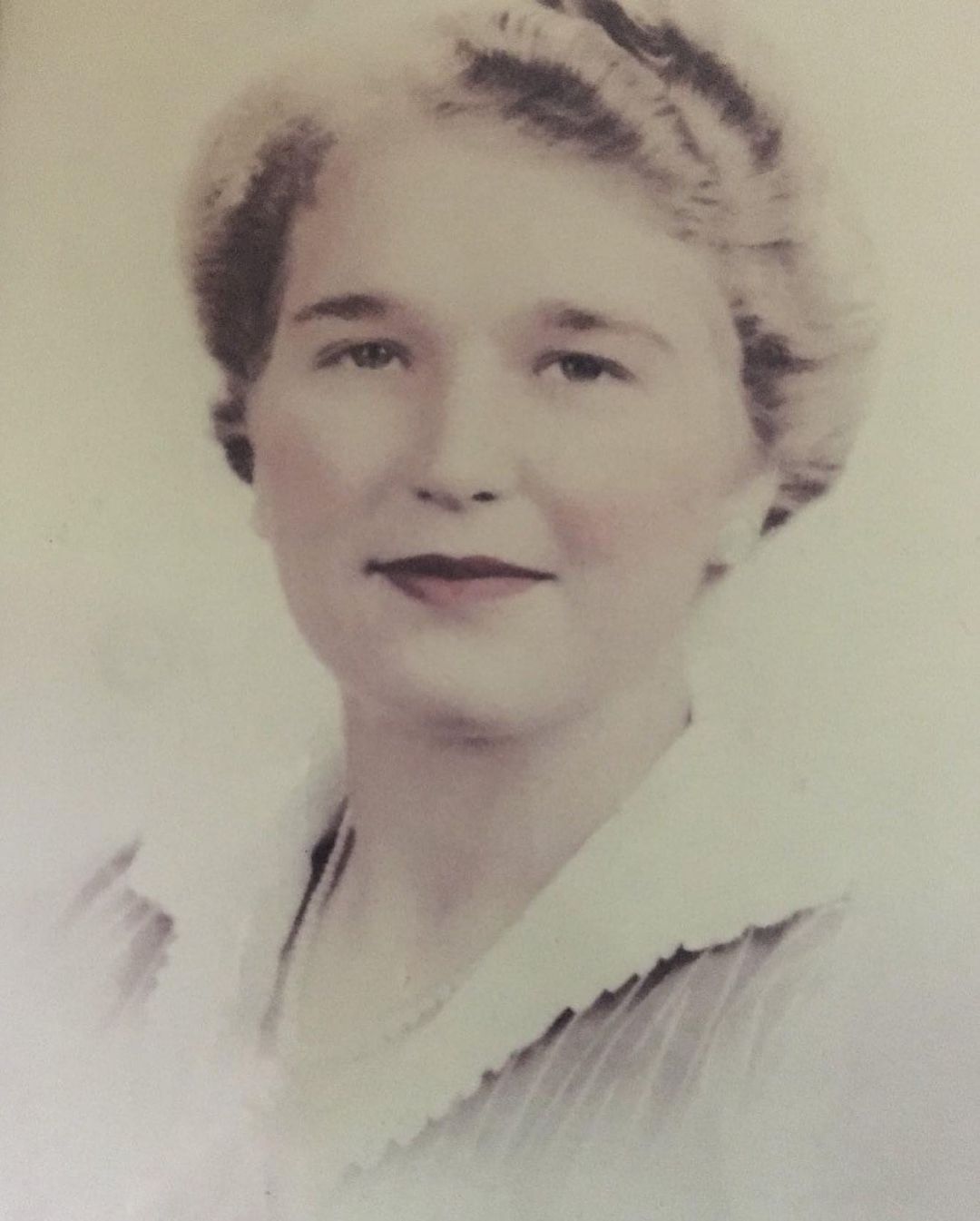
My mother would have been 100 today. Two, two two two two two she tittered when asked her birthday. Back then, all eight of us misbehaved in all directions: Peter tortured Claudia’s hair with scissors; Frogs from the creek found their way into bedsheets; Strangers, reading dog tags momma made Jack wear, returned our wanderer from the last remaining barn In Northwood. Sometimes, strap in hand, face pink as our backyard peonies, she’d grab the nearest, perhaps one with fanny prophylactically padded with philosophy books from the living room shelves. She laughed, trying not to, yet sometimes happy thunder struck, and she could not stop, her laughter winding up like an outboard motor, round and round the circular pond of threadbare chairs until no voice remained, only her breath, like Precious Pup the cartoon dog we watched on Saturday mornings, her laugh went round and round until we were all whirled up in a tornado of mirth, all of us thrown to the floor and holding bellies aching with joy, my brothers rolling around like pups in their punishment of glee.
I got that way too, caught by fun, laughing so hard I lost the sound or, worse yet, sent out waves of cackle that pulled my students into a merry whirlwind. Out of control, I imagined the other teachers said of my class, out of control, such a frivolous fit. I know mom sat with me then, her laughing ghost in my teachers’ chair, as close to me as breathing.
I like to think that some child I taught grows up and laughs so hard that she, in turn, catches her children in a lasso of merriment and all fall out of control for the good of joy.
And in the years ahead, another all-grown-up child releases her always-ready laughter two hundred years after my mother’s two two two two two birth.
She will be there, and I with her, in our legacy of laughter, now nameless and faceless, moving through the years like love.
“Nunc fluens facit tempus, nunc stans facit aeternitatum.” (The now that passes makes time, the now that remains makes eternity.) ― Boethius, The Consolation of Philosophy
I This is the city of air and foam where heat from dunes and metal hoods of cars dulls vision, and lights at night steam up the heavens, and block the stars; where daylight’s ocean muffles cries of children running from moms to sea-froth filagree. When I was young in time, rows of women, lay on beaches, Venuses unearthed and vandalized, with purple scrawl across the backs of thighs in the pre-sun-screen sheen of baby oil and iodine. The nacreous slick of yellow hair dammed the flow of backs, bared and browning in the sun. When I was young in time, I sat at the ocean’s edge in the incoming tide and watched the sea throw itself upon dry sand, again and again and asked it: why life? why death? and why again until the waves and existential whys were one.
II If I spoke to the sea, would it answer? Am I nothing but a minnow in the night, galling the ocean in its vastness, a scratchy sound, like a tin can on its shore rubbing against a rock? Water, I know you, I know you not, hidden in my depths, as invisible as air. You are baptism and blood. I drink you, I wash with you. With your brother wind you can blot out cities yet sing us to sleep in our matching language the throbbing of my heart, the throbbing of your waves as the dumb moon with its tongue-tied force calls me to collude with you in surges of internal tides. Water I know you, I know you not.
III I lecture to this mystery. But like Proteus who counts his flock of seals at night, shifting his shape at every human touch, each concept I pour sea into explodes, becomes another: bearded lion to boar to fountain to towering tree: it will not stay still. Concepts are levees against the unknowable that break and push us under leaving the land inundated with unknowing, becoming rich with dark silt, rife with enigma, pregnant with our hopes. Watching my dreams in combers come, I swim to capture one, to ride it into shore where surf meets text. Most I miss. Most remain in the ineffable turning of waves and the questing whys.
IV One day when I was young in time, my mother woke up early to sit upon the porch that faced the westward bay, waiting for the sunrise to set alight the sea. We sat with her laughing and inhaling coffee. Time right, place wrong.
Now when I am old in time, my sister sits and faces westward waiting for sunsets and eagles, the moment of rightness to snap a pic and applaud each spectacle of eros: each singular repeat of passion in light’s affair with flood. She posts these paparazzi snaps to tack across her Facebook timeline from spring with its spreading arms to grey-eyed winter.
Now when I am old in time, the blowing sand combines with breath to cloud the sky as coldness sharpens sight enough to recognize the final chill. As ice, the sea sets skin on fire; as foam, it is my christ’ning lace, that dressed my birthright carrion carried ever closer even closer in the flowing now.
Yet here nunc stans: Never mind why life, why death. They both live in a single sun that rises each day and sets in an ever-widening circles. It only asks that I be here now: with the taste of the god in the salty air with the roaring of the ocean’s exhalations with the gulls that plead for invisible bread with the mystery, the many fathomed mystery, of love that lives, timeless and deep in my opened heart, more boundless than the sea.
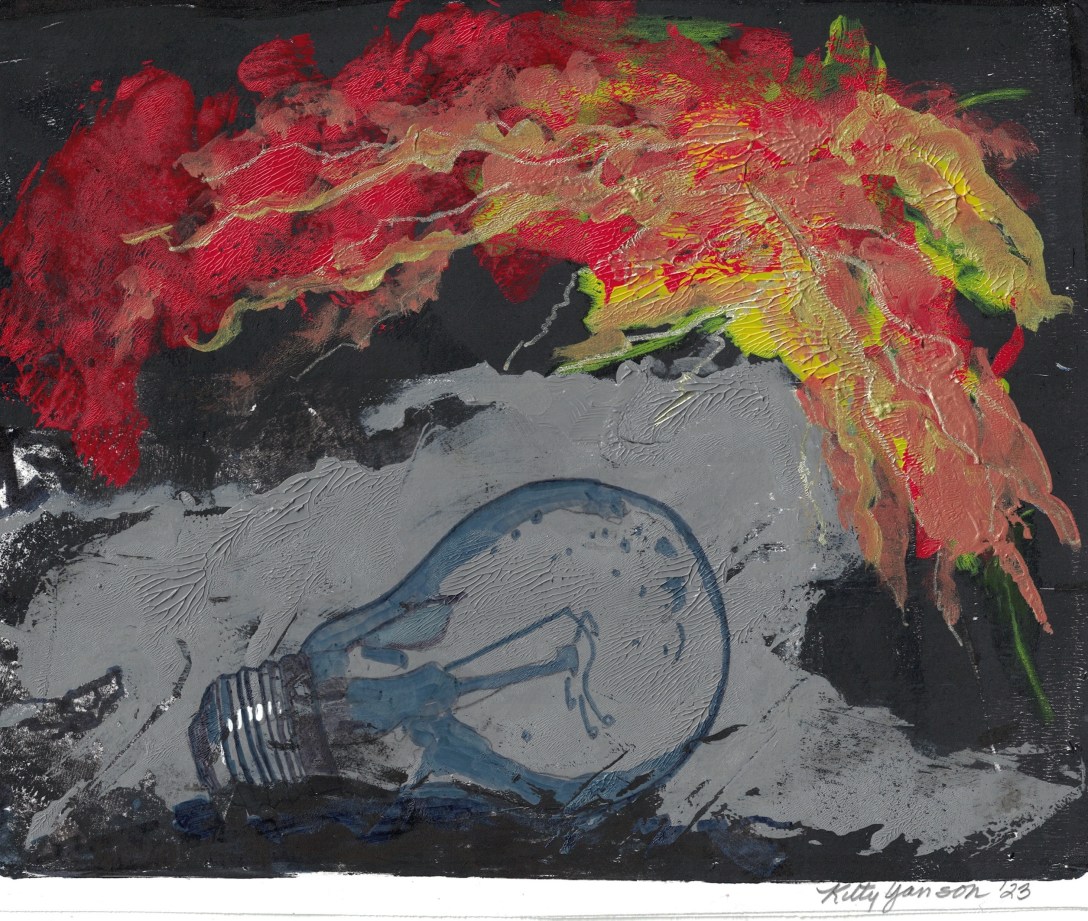
“…Divinity is found in the current that generates the light and not the container of the light….No one I know collects light bulbs after the luminous capacity has left them. We are briefly illumed, and then what is left is the glass receptacle not light.”
-James Hollis. The Broken Mirror: Refracted Visions of Ourselves
A pyracantha bush, burning, by the side of the road, collects in its thorny, painful love, tossed liquor bottles and cellophane wrappers tucked together with incendiary berries like the abandoned resolutions of not-quite-evil sinners. No wonder God gave Moses two stone tablets; it takes a hard head or downright idolatry to break them. Poor calf, shining in the valley like investment accounts in a bull market. Va vitello d’oro!
Or the Old Man River Deity on the Sistine ceiling touching Adam’s outstretched finger, a guy after a guy’s own heart. Yup, you’ll follow Him through the just-cleaned kitchen and litter it with stinky sports clothes and bloody Crusader armor. But he kisses you on the cheek and says he loves you! All is forgiven. Why aren’t there any kitchen lady gods? No Santa jolly either, He, without the toys and Christmas lights unless we include the burning bushes of underwatered pines, the too-dry catastrophic tinder.
And why do we never see a God who laughs? I’m not saying a slapstick guffaw; that would be mean. But maybe a raucous hoot while rocking a hip-hop tukus or conga line kick at a Pascal celebration. God must have a sense of humor, you know, to put up with the rest of us. I mean what does He do when we do the equivalent of peeing on the floor behind the bookcase because the ants need watering?
But seriously now, it’s more convenient to believe in the skinny one who hangs upon the cross than the skinny one we see on Calvert Street with his sign that reads: Homeless Vet, Hungry, with hand outstretched whom we choose to believe …or not.
Yet no one pictures a female God. Her sense is touch. We feel her deep down in subtle skin below our skin, Hidden in the unlit corners of souls. She is the heartbeat that trained your heart to beat, The unmet longing that threads your pulses, a string of perpetual beads, of never-ending feeding. She rocked us into breathing, then retired to the primitive good that lives in ancient parts of the brain, the body’s memory, escaping awareness through cracks in useless concepts. She calls us to love as she did in the early tales of loving, even when we act like an ass and sin. I imagine that she covers her nonexistent mouth with a nonexistent hand to keep from laughing. But, anyway, we hear.
It’s time to ditch the stash of burned-out light bulbs, and look for God in other places: in the jagged fissure of a broken heart, in the untold stories of a dark night’s stars in the purple halleluiah of the Lenten Rose. If Rumi is right, that what you seek seeks you, be still. Wait to be caught. Wait for God to sneak in secretly Between, perhaps, two mundane moments. Or maybe wait for the shock of God, a jolting bolt of love to run joyfully amok through the firing filaments of your longing.
Prologue: This began with a dream: I am teaching a class in a sunken atrium-like classroom. On the way to class I think that I will assign a research project: what is the most important book ever written? When I get there, however, I assign a group research project: what is most important in life? The class breaks into two groups: one says water, and the other says wisdom.
It was clear to me that I should invite Lady Wisdom to speak.
I. I’ve known you. I’ve watched you consume a library book by book, as if it were a pound of chocolates to savor all alone, licking each melted passage off the roof of your mind. You danced with each new idea until its shoes wore out and it clanged back onto its flat metal home. New partners always awaited your curtsy and admiration for a well-argued waltz, a syllogistic samba, a polka for persuasion, a non-fallacious foxtrot, or even the a priori bunny hop hop hop on to the next one. Knowledge is power, you thought, over what you never were sure. Real power, you found out, was not getting what you wanted but getting what you wanted that you had not known you wanted. And there you saw me: The step beyond. The perspective of wait.
II. I am the pattern seer, staring at disparity until I see its sameness, like your forehead’s wide span of skin curling in a wrinkle, given time. Love has a billion forms, each one unique, as does hate and courage and fear and all things human, but I see chords and echoes everywhere in the meter of beating hearts. Listen to the lives of uncountable souls, all taking one breath, then another and another and hear the rhyme of living: people are a boundless poem– neither sonnet nor sestina–pulsing meaning in the rhythm with the kindling stroke of love. In images of un-love even, the daily news, love throbs on, made loud and louder by its absence, the volta between octave and sestet, the midline’s caesura, the stanza break, the punctuation in the verse of being human, created by a poet God.
III. I speak this poem by heart. It is the way to the gem in the lotos, distilled by age and the concentrated sun of close inspection that burns off fluff, excuses, broken resolutions, a crystal rendered from sleep, from loss, from the unbearable borne, hard-pressed by the weight of waiting: Bright diamond! Hagia Sophia! I am not the source or word or spirit. I am she with whom they sit, prudent and still as a mountain.
If you would see me, build a home for your soul of light and glass, warm the stones of your suffering with meaning, attend the stars when you wake at night’s center, find a face for me in your teachers and elders, then look in your mirror. I will be there with your books and your darkness, admiring the fugitive beauty of purple chrysanthemums and the faces of children against a blue morning sky.
-Kitty Yanson 1/2022
To the reader: Thank you for taking the time to read what I have been writing (and now painting). Your time is a generosity! If you are so inclined, I invite you to follow this blog and to comment on what is here. When I was teaching creative writing at Mercy High School, we would read one another’s works and comment on them. A reader’s reactions are the most valuable guide for improvement, and I would value any of yours about content or technique or its affect on you. Even if you hated this piece, knowing why you hated it would help me a lot. So blessings, all!
May you be happy and know the root of happiness. May you be free of suffering and the root of suffering. May you dwell in peace.
Inside this cold is real and white. On the drainboard the iceberg lettuce froze filling the world with absent landlords droning cross-wired conversations: the rent is due the rent is due: it’s always a bad connection.
They say that hearing is the last to go.
Here inside, the faint-hearted hunter stalks her rodent soul; for practice she picked off goldfish through ice-cream scum on dishwater; ragdolls she routed from hiding among the household bills. In the traps she set for dragons, snakes, or fathers–bigger game– a rabbit lies rehearsing death. Steel teeth hold it by the leg, suck its flesh, as fiercely locked as an unborn flower, petals grit against the winter. Unmoving the rabbit feeds its pain the blank flow of milky quiet, unmoved. The snare resists with the ingrown grip of a curled childhood, groans and gives, submitting to bloom, forced by the hunter’s coward hand. Freed, the rabbit leaps.
They say that suffering is the first grace.
From deep within my burrow, above the din of bleached noises, I hear my crippled spring snapping angels from glaciers. Blood sears snow and feelings hiss:




 Memorizing the Laws of Gravity