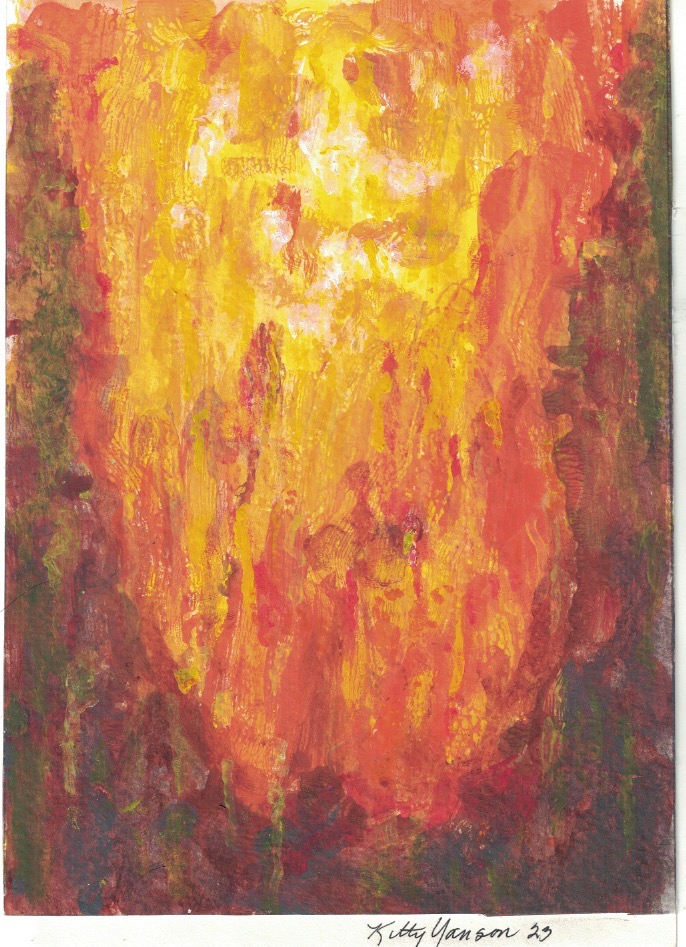
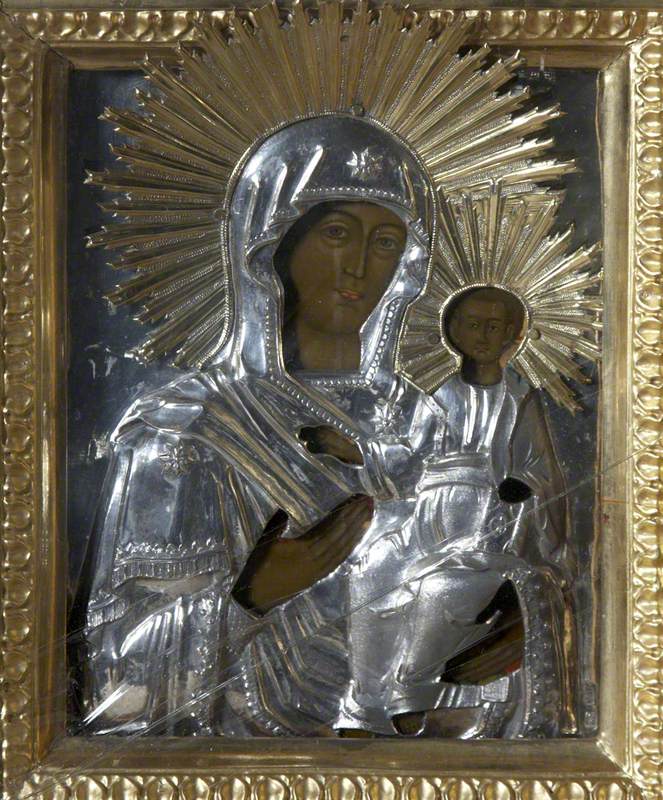
Mary, Mary, Not Contrary, How Does Your Garden Grow?

ky 9/2021

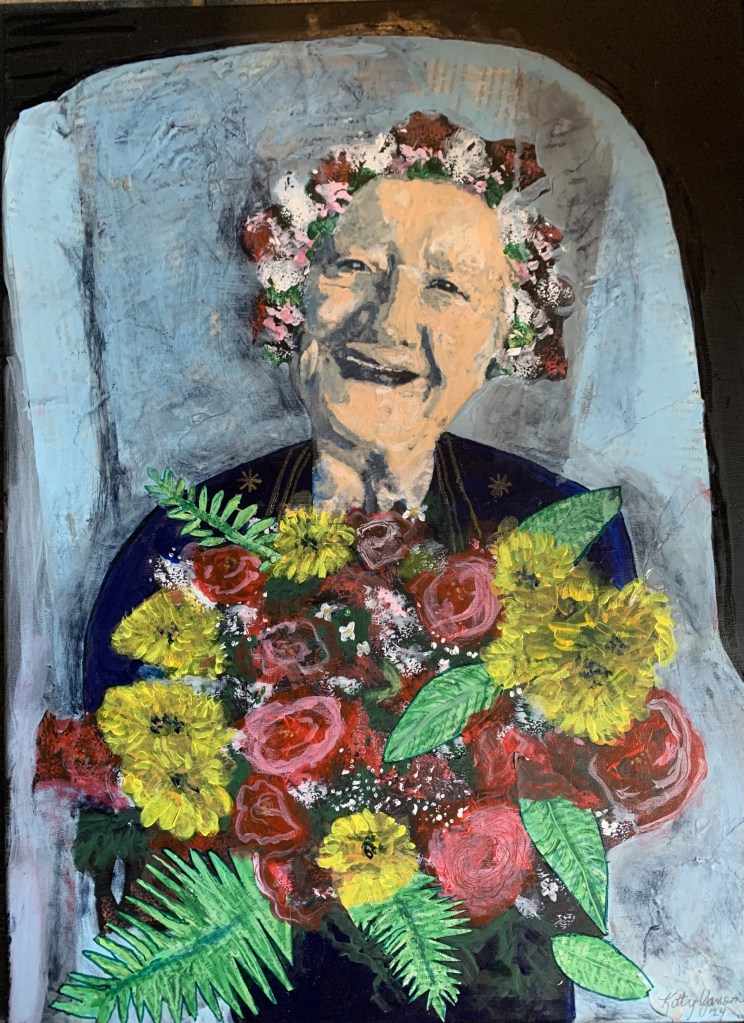
This all started with a meditation and a painting, the painting you see at the beginning of this reflection. I have had a devotion to the Black Madonna, who, in the words of the late Jungian analyst and author, Marion Woodman, is an embodiment of both matter and spirit, who is not just the spirit-heavy, idealized sweetness and balance of the Renaissance Blessed Mother, but a woman who is matter with real flesh and real blood and real emotions, is sensual and sexual, and not just air-possessed spiritual. This Dark Madonna is a woman whom I could relate to, who, pun intended, could matter to me.

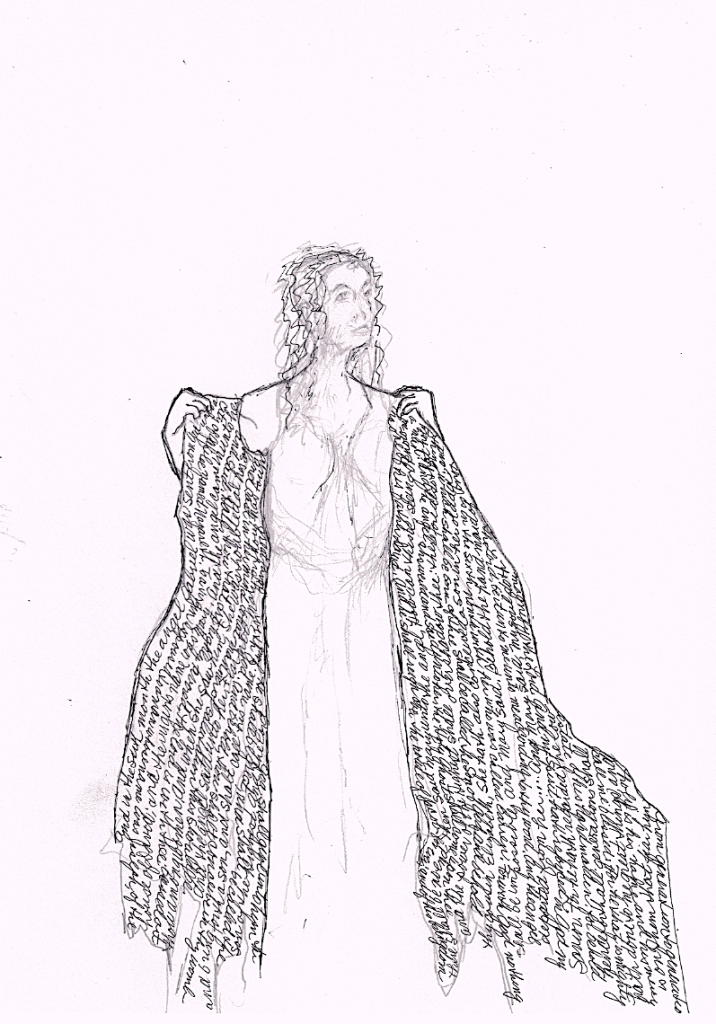
But what about the other Mary, the one who seems so passive and bloodless as described in Luke’s narrative? What was she like under the heavy weight of that story? The picture I made that stands at the front of this essay is of Mary taking off the cloak of the Gospel of Luke. Who was THIS Mary?

In meditation, I invited her to speak with me and the cast of a few of the many forms of Katherine that live in me and speak for the diverse and faceted parts of me. (Oh, come now, you can’t tell me that you have never experienced this in your own consciousness: just listen to what is going on in your head when it’s time to get on that exercise bike or turn down that luscious slab of chocolate cake with the butter-cream icing, yes, the one that haunts your dreams.)

At any rate, Mary agreed, and this is what followed:

Me: Mary, you have been with me all of my life in story, in ceremony, in learned prayer, but I’ve never felt YOU with me. I do not think of you; I think of your dark twin sister, the Dark Madonna, in whose deep shade I have lain, who gave me comfort in my dark times. But who are you? I’ve only heard stories about you. And why are you in my garden? You are a small brown girl, not the vision of complete balance and calm that the Renaissance painters have imaged you into being.

Mary: I love your garden!  It needs some tending, though. Where I’m from, the heart of the summers is longer and stronger. I wish I had had a hose like this to water vegetables and flowers. Come, I will help you weed.

But I am wondering: why does a part of you get angry when my name is mentioned?

Katarzyna: I’ll tell you why she is angry. She gets angry because you let yourself be used and you didn’t even question it. So this stranger angel shows up in your bedroom and tells you that you that you will be God’s mom. Sure thing, Boss, you say. So, you are pregnant and you don’t know how you got that way. I sometimes think that this whole angel thing was some sort of a screen memory under which hides something really awful. They didn’t have shrinks back then, I guess, or someone would have made you go. And if you didn’t actually have a man, you end up pregnant by some bizarre pathogenesis thingy and didn’t even get to enjoy the sex part. This is what I’ve always hated—This god is a SOB god who says, you’re going to do this job, and I’m not even going to ask you if you want to. And from what I hear, you didn’t even complain. How stupidly compliant of you!

Me:  Katarzyna, please calm down. I don’t want to drive her away with your anger. I know that you have been trying to protect me all these years, but sometimes I feel you are like that old Star Trek episode where the holographic woman left over from a long-gone civilization keeps appearing with a challenge to ANYONE who arrives. “I am for you, Captain Kirk. Phasers  charged.” Your anger shuts people up. This girl came at my invitation. We owe her respect.

Mary: I understand Katarzyna’s anger, really I do. But I need to say something about where you got all this. It’s as if you know me as a woman who was made up by Facebook or some 1950’s ad agency. I am what Luke says I said and did what I did. Stories are ruthless. You know the way people make up things about the motivations of people they don’t know. Misinformation. They were trying to create a myth to support their message and some things just slid right out—like my inner struggle. Who says I just took all this without complaint? I was scared to death and confused as hell. It was NOT a good inner scene for me. But my story is told for other purposes than the inner truth in the process. It all has to serve the architecture of a story for a bigger Truth. And that’s why I went along with it. I knew in my heart even then when I was naïve and not yet educated by the centuries of myth, that love was life. Life is love. It’s a simple equity. They are the same thing in different clothing. This is the law written in my heart. And God is this, but at times in human living, we just don’t get it, don’t give it the wonder it deserves. This God is in me, in you. And when I knew this, I had no problem bringing it into the world as my child. We all are incarnates, but we forget because we don’t see it. We are focused on other stories or shiny distractions—like those moving garden ornaments I saw on TV. I guess you need stuff like that when you have no flowers. It’s like a substitute beauty, a substitute life.

But giving birth out of wedlock in those times. Yes, that was hard. Don’t you think I struggled with that as much as you struggle with the love inside you waiting to be born? So I was a young child, pregnant, who had another young child in the garden with her which was as full of weeds in September as yours is now. We run out of steam with the work and we both need to ride the back of a sturdy story. So I ride my simple story of simple equations and the other child, the other me, rides a big galooting St. Luke Christmas story which they constructed from parts of other stories when all we really wanted to say was—Damn! it’s dark in here and we are scared and we need some light because fear lives in the dark. And danger.

You feel, and rightfully so, that there were people in your life that turned away from you when you needed them, and yes, loved them, and it was desperately dark and you drew the dark around yourself like a blanket and waited until the darkness passed. We all have versions of this story in us. But we were turned away in the Bethlehem story, not because the town was angry with us or wanted harm for us but because there was no room like your mother who was a loving mother but who had so little room for you in the chaos of all those children, and you felt left in the dark. And I know that it is hard to be angry at someone for being human and limited when you are human and limited but you do not have to hate yourself because you are the only available and safest target. I doesn’t matter what happened to you so much as what you do with it that counts, obeying the law that is written on YOUR heart.

I know that it may not be as simple as all that, but you can hate me if you need to until it is safe enough. I can wait.

Let me dip back into the BIG story, the part about my going to see my cousin. You know this…you’ve said it many times with all the intensity of one who knows that one’s words are hollow…my soul doth magnify the lord…It’s not what happened to me, but it’s what I did with it that counts. I am the one who uses my life and the whole damned story into something that you can feel and taste and see and hear and smell: love. The energy of life that you as a meditator, of which I am born, consciously sit with every day. But it is with you all the time. My life magnifies this. I am here.

So let me help you weed this garden together. And maybe when we are finished this day’s work, we can all sit down on the back deck and breathe together. Katarzyna, come on. There are no dangers here. I would say take a vacation, but I know you won’t.

Katarzyna: Maybe you can get Kate to stop trying to lure some poor guy into her procrustean bed of her logic. Isn’t she getting a bit old for that?

Me. Aren’t we all. I’ll get the tea.

We all belong.

……….And, if you’ve been kind enough to stick with me this far, look at the picture of Mary that began this essay. You can see Mary putting on the cloak of words once again, as do I.

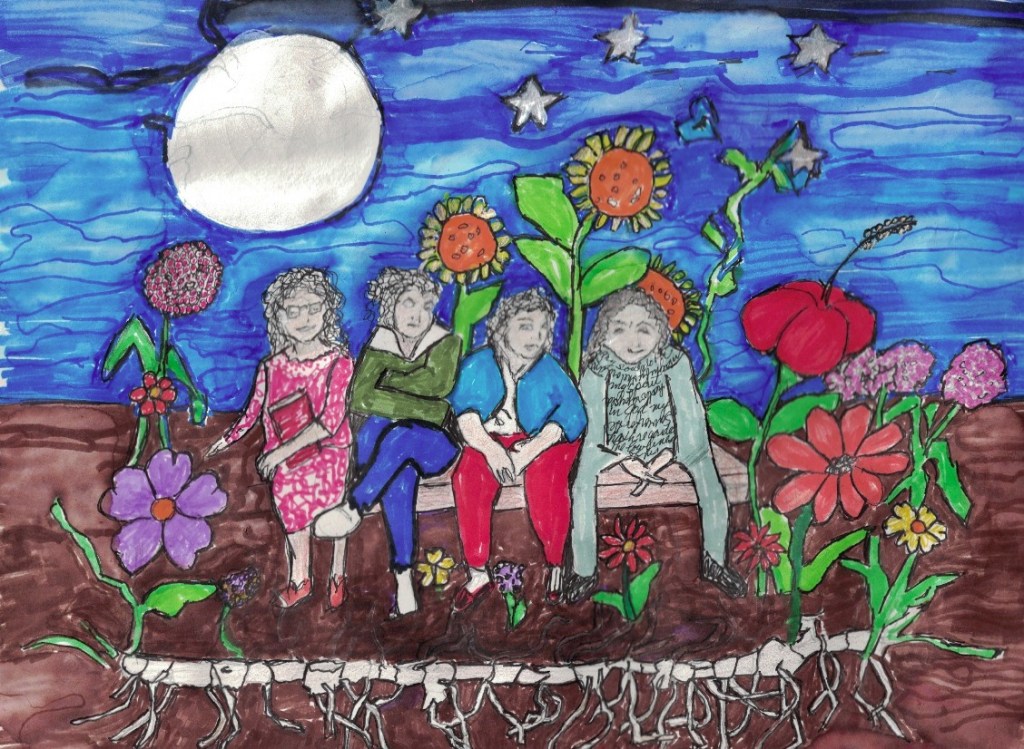
Kate, Katarzyna, Me, and Mary Sitting in Our Garden 9/2021

-Kitty Yanson, 9/2021

Anahata

Inside this cold is real and white.
On the drainboard the iceberg lettuce froze
filling the world with absent landlords
droning cross-wired conversations:
the rent is due the rent is due:
it’s always a bad connection.

They say that hearing is the last to go.

Here inside, the faint-hearted hunter
stalks her rodent soul; for practice
she picked off goldfish through ice-cream
scum on dishwater; ragdolls she routed
from hiding among the household bills.
In the traps she set for dragons,
snakes, or fathers–bigger game–
a rabbit lies rehearsing death.
Steel teeth hold it by the leg,
suck its flesh, as fiercely locked
as an unborn flower, petals
grit against the winter. Unmoving
the rabbit feeds its pain the blank
flow of milky quiet, unmoved.
The snare resists with the ingrown
grip of a curled childhood, groans
and gives, submitting to bloom, forced
by the hunter’s coward hand.
Freed, the rabbit leaps.

They say that suffering is the first grace.

From deep within my burrow,
above the din of bleached noises,
I hear my crippled spring snapping
angels from glaciers.
Blood sears snow and feelings hiss:

Anahata:
the lotus opens.

-Kitty Yanson

The Perfect Bind

Consider the source:
She is a person who has never considered herself “normal,” has come to realize that her concept of “normal” is most likely wacko, and currently has the sneaking suspicion that she just might be “it.” She is the type of individual who leads a rather quiet life externally but gets into rather bizarre situations between her two ears. There, she is in continual training for the Baltimore mind races, practices daily, and like other devotees of this reckless sport, often mistakes speed for quality. Many times she has pushed her brain’s motor well over 180 miles per hour, internal instruments indicating that the velocity and and direction were well in conformity with the logic of its own system, then crashed bloodily into reality.

During one of her convalescent periods, she decided to take the advice of some well-meaning friends and try meditation. How hard could it be? The breath goes in, the breath goes out, just focus the awareness on the breath and let your intruding thoughts just float peacefully away like a leaf on a stream. But her leaves carried on their backs brass marching bands, and she surfed after them downstream looking for the big waves to the tune of “The Stars and Stripes Forever.”

Then she tried a guided imagery exercise she found on YouTube of some woman leading her through an imaginary journey to consult her inner wisdom figure. She enjoyed it well enough. The path through the pine forest smelled like pine. She saw the appropriate pool of water. She entered the building where the figure lived and met a marvelous woman with a face like a pared-down Polish babushka. The woman even wore a modified Grecian wisdom-giving dress. The YouTube woman told her she could ask the figure’s name. She did.

“I’m your mother,” the answer came.

“The hell you’re not,” she replied.

Consider the source.

Now that that is established, let me slip from under the third person into something a little more comfortable. (It was getting a tad warm in there anyway.)

In the early stages of my recovery from alcoholism, I had a friend, Mac, who became a kind of father-confessor and reality check-point for me. He looked a little like a seventy-year-old, bald, and wiry extra from the town scene in Moby Dick, and sounded like, while he may have been in recovery from alcoholism, he had overdosed on a lethal combination of Rousseau, episodes of The Wild Kingdom, and The Tao of Pooh.

Now, I loved Mac a lot, but I was never really sure of what reality I had checked into. I would go to see him when I was in the middle of an attack of terminal angst, usually triggered by something with the metaphysical significance of why my ’77 Honda had appointed itself as my personal guru for tolerance training or what I was going to eat for dinner. He never gave me answers or concrete explanations. He just talked, and talked…and talked: about how his truck full of capture Calvados kegs got blown up by the Germans in the Normandy Invasion; about the mating habits of various ape species; about how the Monarch Butterflies manage to find those Mexican trees in the fall. Then he would show me pages from Henry Miller’s autobiography.

Much, much later, with me half asleep on the sofa, he finally came out with his advice: “Avoid perfection at all costs.”

Now, I had been waiting three hours for this gem, and I’d heard the story before with less brandy and fewer Germans; this was the third go-round for the apes. “Aw, Mac, come on. What’s the alternative–no one ever aims to be run of the mill. That’s not in our training. We live in a country that’s in search of excellence, where winning is everything (and the only thing), where there exists such an animal that can produce 150% without exploding. What about “The thrill of victory, the agony of defeat”; “Any job worth doing is worth doing well”; “No pain, no gain”? What would poor sainted Vince Lombardi say?

That’s just the problem, Mac said, misinformation; we’ve go too much of it. They start out early. You’re still in the cradle and you catch your parents’ expectations like some kind of a virus. This is the way you go to the bathroom—don’t forget to pull your pants down first. This is the way little girls play. This is the way little boys play. Don’t touch yourself; you’ll go blind. Then you go to school and you are good or bad by your A’s or F’s. Then they throw religion at you and give you a big parent in the sky who tells you that if you do like you like to do, you’ll go to your room forever. You get a little older and they tell you that if you work harder than hard, you’ll make it to the top (where ever that is). Then it turns out that if you don’t invest more than full time energy and anxiety in your work, you become a strange kind of abomination–a sinner, a social retrovert, and your own sweet mother’s heartbreak. You don’t make vice-president either. No wonder we drink. What it’s like to be a perfect human being has gotten so tangled up with misinformation that it’s impossible to sort it out.

Maybe Mac had a point: perfectionism is a dubious virtue at best. Those 1940’s movies I saw on TV when I was a kid starring some pre-adolescent girl whose beloved horse has a heart attack from the strain of his winning surge of effort at the finish line I saw from the viewpoint of my own pre-adolescence. The horse DIED. What’s so virtuous about that? Those same screenwriters who canonized the poor horse portray the hard-driving cop, the I-want-it-all superperson and even the artist chasing their vision as scornful of the limits of average humans. They are impatient, highly competitive, deadline preoccupied, time pressured, achievement oriented. Their standards are high above reach or reason…or their peers’. Characters on fire with their own potential are somehow forgivable, even at their worst, because their goals are so lofty. They either go out with a blaze of glory or go out in a blaze, and we, as spectators, love a good fireworks show.

Off the movie set, however, we don’t tend to gloss over the pitfalls of perfectionism. Its darker side is seen in the person whose self-worth is completely measured in terms of success and productivity, the individual who is paralyzed in the face of self-set, impossible goals, the student whose fear freezes her at exam time, the office worker who procrastinates the report until the night before or it is assigned to someone else. Perfection has to be faultless, without error, so the person tied to perfection is always vulnerable to being “found out,” to be found inadequate, is defensive to criticism, super-sensitive to disapproval. Often, “the best defense is offense,” and unreasonable performance standards are projected onto others, returning annoyance and more disapproval to the perfection-sick soul.

Within the past few years there has been a glut of self-help books on the market to help folks to employ cognitive behavioral therapy techniques to alleviate the self-persecutory aspects of perfectionism, but this dichotomous win or lose framework is deeply embedded in the epistemology of our Western civilization. It doesn’t allow for anything in between. One mistake equals total failure. One mistake is ALL mistake because it must follow the logic of its own system: if perfect is not perfect is not perfect is not perfect until your self-talk begins to sound like the demented computer, Hal, in 2001: A Space Odyssey.

This two pigeon-hole perceptual grid–perfect/imperfect leads to a rather rigid view of the way the world should be. I used to tell the kids I taught that our perceptual grid controls how we see the world. Picture this: you are walking around with a set of those cubby-style mailboxes in front of you. Someone throws an apple or a banana at you and you can experience dessert. If they throw a watermelon, however, you get a smushed mess or nothing. As a morality frame, this is a pretty judgmental (and besides, nobody wants a smushed watermelon living next door or, god forbid, married to your daughter). So everyone is saint or sinner, madonna or whore, democrat or republican (duck), and yourself an ego-maniac with an inferiority complex. This can make you pretty unpopular with yourself and/or other people unless, you can find others with the same perceptual grid as you and form your own religion.

My own Catholic upbringing called this way of thinking scrupulosity (although I don’t remember any of the nuns ever saying one could be too good–they usually didn’t bother you in that direction unless you kept leaving class to go to confession every two hours). Scrupulosity swings two ways. For example, I am old enough to remember when it was a mortal sin to eat meat on Fridays. OK. You’ve gone to the home of a non-Catholic friend (we called them publics) for dinner and your fiend’s mother served you a hot dog. You’ve forgotten it’s Friday and you take a bite. All of a sudden Divine Intervention did its thing: OH MY GOD, IT’S FRIDAY and you’re caught on the crest of a moral dilemma . You can a) spit the bite of hot dog disgustedly onto your plate or at your friend’s dog (while praying hard that your friend’s pet would not become the hot dog of hell); or b) swallow the hot dog, and, since you have already been condemned, finish the bite and run out to the nearest steak house for the biggest prime cut you can find.

The scrupulous self-evaluator will, of course, find it difficult to achieve any goal that requires protracted, daily effort. The runner will be torn between inertia and shin-splints, the dieter between starvation and Godiva deep dives. It takes some major cognitive retraining to even begin to see “progress” over “perfection.”

I don’t know, Mac. Maybe we are too balled up in misinformation to even start to know what real perfection is. I hesitate to throw the concept out completely. I still find it pretty repulsive to “aim for average” and still suffer from PTSD from a graduate school teacher who kept grading my papers B+ (as an incentive to do better, mind you!). And I don’t see anything called The Quest for Mediocrity on the New York Times best seller list. It still seems too simple, vaguely immoral to do as you implied and please yourself and let it go at that. Perhaps part of my problem lies in the word itself–perfect seems to have a set of self-cancelling meanings, an internal equivocation. On the one hand it is “the state of complete excellence, free from any flaw or imperfections of quality; faultless. That meaning plunges into never-never land, where potential is posited by act, where a touchable reality is only a starting point. Yet, perfect also means “having all its parts, all of its essential characteristics; complete. To be a perfect human being, then, is to be flawed and….

Hold it. The third-person writer wishes to interrupt. She feels as if there is an intrusion dangerously into her territory and this is one of her favorite places to spin out. She is fond of fantasizing about what it would be like to live inside a self-relevant construction–to be perfect is not to be perfect is close enough. To be a perfect human being is to have all its parts. Part of being human is having flaws; to be flawed is not to be perfect. To have all its parts, a human has the ability to abstract a perfection it is not. Or is it? (Isn’t this fun?) She wonders if the Hebrews forbade the utterance of the name of God, Yahweh, I am Who am, because of its self-relevance, back and forth in a spinning mystery. If the writer keeps this up, continually rebounding against the sides of meaning, where would it eventually take her? If she were a computer, would she self-destruct? Would she implode into a black hole? She imagines that it would be like falling down Alice’s rabbit hole with no end. Lines of memory remaining where her thoughts touched the walls of reason, mirroring the shape of the double helix….

I’m sorry. I seem to have lost myself for a moment there. She must have jumped me when I wasn’t looking. Well Mac, if you are listening to me from heaven, we seem to have made a fine mess of this essay. Your thesis, to avoid perfection at all costs, is still fighting in me with Sister Mary Rigida, Theory Z, the old afternoon soaps and the Green Bay Packers, a sad and unreasonable state of affairs. I will not blame the reader one bit for dropping out completely. But we can’t say we didn’t warn you. It seems as though “authorities” on this subject are a little more skewed than we thought: a writer whose judgment cannot be trusted, a self-admitted old fool , and a hopelessly confused “I” in between.

Consider the source. Really.
Mr. and Mrs. Bridge

Lisa Bridge unties her halter top
so the sun can play unfettered
her untempered clavicle
her shoulders’ rounded notes:
Allegra.
Mr. Bridge in his upstairs bedroom
watches his daughter on the lawn
through panes of old glass
that ripple like heat risen long-ago.
The tongue of her thigh parts
the wide mouth of her shorts.
Her hair in amber rebellion
falls in the indoor quiet
like sweat beneath white linen.
With her father just the day before
she practiced Juliet from the balcony:
Wherefore art thou Romeo?

It is August.
The afternoon is sullen.
Mr. Bridge makes love to his wife,
her curlers in rows of recapitulation,
her eyes wide as a daylight owl,
irises wild in an ungardened field,
their pupils, pinpoints
of a thousand doubts surprised mid-dance,
or none. Their sheets are stained
with silence and mown grass.

Mr. and Mrs. Bridge will go
to Paris to view the Louvre.
He will admire the Winged Victory.
For the sake of tradition,
he will bury his daughter
wrapped in tea and burlap
until she, too, has no arms and head,
appearing ancient and all wings,
on the lawn, a gift for his wife.

Mrs. Bridge will join an art class
and paint a woman standing
calmly in the ocean’s surf,
holding a swan of Dresden china.
She has no feet.
Outside the gilt
of this portrait’s frame,
the firebombing has begun.

-Kitty Yanson

Proofing the Generations

In memory of my mother, gone and ungone.

In the back of the pantry, behind the oatmeal,
to the right of the dried milk and cans of pencil stubs,
on a willow-ware plate,
my mother lives
beneath a blue glass bowl.

I watch her brew beneath the glass and wait
for her to storm the surface with her flesh,
impress against its imperfections, cracks
and chips. She’ll crawl into arms of spider galaxies
to grout her sky with great clouds of self.
She will rise
until the horizon breathes to her rhyme,
balanced like a babe on her white hip.

My fingers sink hollows that do not heal
into her round skin.
Dinner’s at eight.
The table is set,
butter knives sharpened for this occasion,
heavy with need, thick with expectation.

But she rises still, breeding beyond her promise,
rebellious as a heartbeat,
sticking to the roof of my soul,
beyond the prying of my words.

-Kitty Yanson

A Sort-Of Love Poem

This poem is not your regular erotic;
The usual metaphors of fruit and flowers,
the sweetness of vegetable amours,
do not apply: we are not viney lovers.
No, we see used moonflowers, limp
on the concrete at dawn and laugh
at their resemblance to condoms killed.
Venus does not rule here, but Mars.

You lean close to my ear and the whisper
of my name becomes an arrow hissing
by my cheek. You bury lightening strikes
into my earth; I break open, a gibberish of breasts
and mouth against the volley of your fingertips
and blasts of deprivation,
and, alas, my wide wound weeps
with glowing sorrow.

Infiltrate, dear enemy. Bury your dead deep
behind my lines, and then, perhaps, wild grape
will grow to mark our mutual surprise.
Later, when the sun comes again through
the stained glass window to scar the wall
above my bed with blue light,
surely, our peace will be stained
with strong blood metaphors, oh, my sudden soul,
is this birdsong?

-Kitty Yanson

my reading

Doctrine of Correspondences

Things rhyme at night;
images in dreams repeat
with only minor variations–
a shift in light,
a different parking hardscape
in which to lose my bright red car,
another subject flunked in high school–
Spanish or algebra–
to redress in the brown serge skirt
and catholic saddle shoes,
a fifty-year-cold remediation.
The penance over, I can slide again
behind the podium to teach
the terza rima and perfect numbers
in Dante’s vision of a balanced hell:
hypocrites wear unbearable brocades
with leaden threads. and desire-blown
lovers, in solo circles, embrace
the nothingness of emptied hearts:
the punishment fits the crime”
The Doctrine of Correspondences.

In daylight, does our living also rhyme?
Does the living fit the living
in the stages of our lives?
I think it does. The childhood table
I burrowed into books beneath
becomes my unlit Sundays encaved
in work and grading student papers.
But now I’m old and do not want
to hide from the fading sun that
crawls across my living-room floor.
Instead, I count and match the shadows cast
against the wall to corresponding names–
of fear and hurt, of wounded heart and anger–
and dare the many tongues of the inner fire,
to speak a doctrine of my fierce completion
in one clear voice: conflagration.
-Kitty Yanson

Me reading.

Dark Madonna

She knows in whose boredom the sun sleeps.
She studies space, fixes images in their absence,
hangs portraits the masters never saw
in their crafty light, interrupts the talk
of dragonflies attending all creation.
She is the holder of pain, the unmoved target.

I wonder who this woman is
who moves as separately as silence,
who pauses to applaud a renegade dogwood,
red, in still-green autumn, understands
the bloody revolution of ticking clocks,
the second-hand arrows that pierce
the flesh but leave it whole.

I hear her coming. She whispers to me
between the folds
of perception:
You will believe:

There is nothing left
but love.

-Kitty Yanson

Vigil

I
On the bed she seems blown
into adjustable corners,
a dropped marionette.
Her breath folds over and in:
like yellowed silk, it cracks
into powder at the creases.
You do not look.

You tell her there is a lake
outside she has not seen
that slinks in the sun,
an unrolled bolt of blue fabric,
where a lone gull flies, taut as a grin.
She seems indifferent.

Crocuses bloom beneath
the stone Maris Stella.
Yellow and purple, you tell her.
Yellow purple, she repeats,
her words fading as soon
as they’re struck,
a fast fading bruise.
Yellow purple.

She sleeps. You start to read
the paper of a student who
serves you signs of God
in Lord of the Flies on
intellectual toothpicks,
the appetizers of thought
for which you have no hunger.
Your pencil plies her lines,
a blunt instrument that you
put down in mercy.
Night comes. You wait.

II.
If you were still a child,
eyes of the Disney demons
would open in the window,
the buzz-saw eyes of the
reprobate Queen who would be
the fairest, the fairest of them all.
Once, in the darkened theatre
those eyes spiraled inward,
draining the mirror of its shine
ending all debate. Then they slashed
outward in reverse to stain
the Snow-White beauty with
ribbons of apple red. You ran to the bathroom,
closed the door like a blanket over your head,
and stayed until the music again played safe.
But in your bedroom in the dark
with constant crickets, those eyes broke loose
without warning, turning in, turning out.
You hid beneath the sheets, recycling breath
in small and smaller circles, turning in, turning out
your humid innocence until you could no longer.
You must inhale fresh terror
and pray for the Prince of Sleep.

If you were still a child,
a long-haired Captain would scratch at the glass
with his metal hook. He was the one who stole
unripened children from the heart-safes of trees,
made them stare at the inverse ocean, the swell
of obligation, then pushed them into fate,
into time, into the gullet of the ticking crocodile.
You ran to your mother who told you
that you would never die. It did not matter
that she lied; the truth of heartbeat was greater.

III.
The wind hooks leaves against the window.
Now demon’s eyes are chifforobe knobs
catching the light from where
the nurses pass. You life is now unanimated.
It is real.
The shift changes.

The woman on the bed now breathes
in shallow pants, a final labor: turning in,
turning out, the reel of her breath near its end
scratches at the unseen seam at its core.

Last night she told you that in a dream
she was a seagull high above her cousin’s shore,
above the castles ringed with sea nettles
drying their shine in the sand,
above the clouds transfigurant,
above the sheen of fish smocking the waves,
stitching them together with geometries of flame.

You told her that this dream revealed her flying soul,
free as her final child whose birth is near.
You held her hand.
You want this to be true.

-Kitty Yanson

Revision of Sleep

This winter’s unexceptional in its decay
the miscanthus has ceased its flagrant waltz,
and from the garden a golem
of dry grass rises. A single leaf dallies
in the sweet gum tree, and a crow,
like Rhadamanthus calls: Fall!

This time of deprivation I am used to.
I’ve found a trick for it:
when the seed lies underground,
before its maggot roots gnaw
deep to corrupt the earth with hope,
lie still: do not desire.

But this unexceptional season
won’t be stilled: the germ turns,
restless in its bed and dreams
of greatness, parting quadrants
of summer stars with irascible limbs.

I am struck awake by the cold bite
of your not-quite promises.
Buried in my silence, arms
of longing burrow beneath
the wet oak leaves.

You go again. The door closes.
I stand by the door exactly where
I saw you last. And for one slow
moment, I breathe the May air.

-Kitty Yanson