I.
Once shocks had cured and dried in contours of time;
this field had gathered whiles of corn in long,
curved rows. But the war and the drought of men ended.
Flash floods of housing ran off down this hill
in torrents, puddled into close, brick queues
and cement alleys with iron-barred storm drains,
the teeth of Moloch we as children fed
with relinquished sneakers, stuck like virgins bound
for the deep, wet furnace that fed Herring Run.
These alleys are my wilderness of dragon’s teeth
and cracked glass slippers, the bones in my mother’s back.
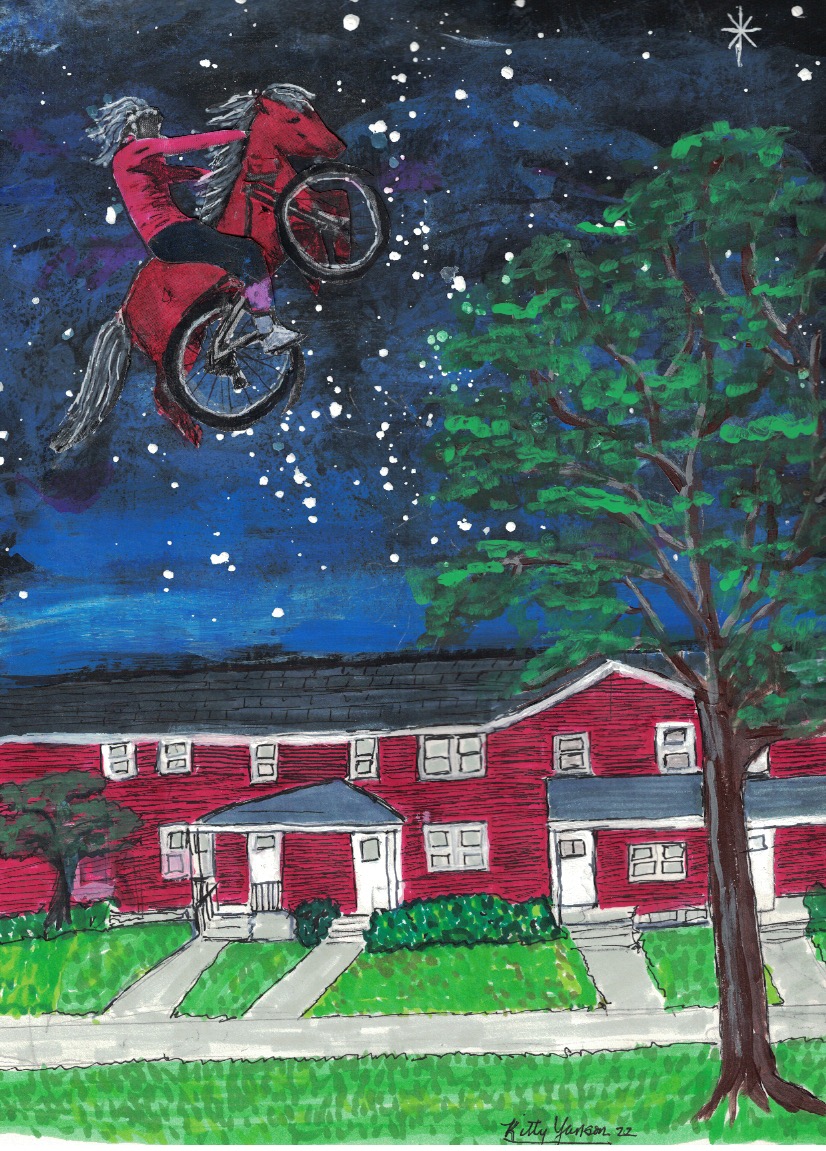
I ride my horse, Tzarina, there. Raucous hooves
are borrowed jokers clacking against her spokes;
for reins, frayed clothes lines tied to handle bars.
Through the stick-ball games, the den of boys beneath
the bridge, the wiffle-headed trolls, I spur
in circles, bend hell, hold my breath, and pass
their puppy stink that whirls from their heads like a smoke
of gnats. I dodge their litter and insults hurled:
“girl,” squashed tin cans, “turd ball.” Fast, clatter fast
down the alley, low in Tzarina’s deep sway, her mane
in my face, her mane as long as August flags
my face with humid air. Like Sunday car
wash water, rush, like whispered sins confessed,
forgotten prayers expelled in a hiss, rush, rush:
the storm drain waits to hear my story told.
Tzarina rears. Hooves turn and slice the sun
to crescents. I will go to heaven when I die.
II.
In Northwood, trees were chosen not for grace
or stateliness, color of bloom, or autumn leaves
but for speed, exuberant growth. Our maple, rank
as Hydra, devoured time, spat seeds, platoons
of wishbones groomed for flight, stripped clean of all
but wings and banzai war cries that whirred the name
of earth in silent troth. My father raked
siege lines, demanded his turf against the Spring,
against these dizzy kamikaze seeds.
Still, some escaped to infiltrate the thatch
or mined beneath the concrete slabs till June’s
slow sun touched off a blast of rootwork, called
to attention stems, blades ready, fixed, alert
to the exigent stand, the requisite shalt be, of trees.
I am traitor. I glean the walks, gather green
from hoods of cars, and raid my father’s heap
of vanquished enemies. Through my fingers I sift
seed-eyes, brows arched in questions that fly unasked,
unpeel their wrinkled lids, un-half their hopes,
eat them, stick them in my ears to hear the wind
as trees do–ocean swarms, shelled whispers trapped–
toss them, watch them spin, twist the whirl-a-gigs
in my hair and call the birds to nest. I make
chains, rosaries to hang about my neck,
pray mystery language swiped from gargled chants
of radio novena priests: hail, fulla grace,
the lurid’s with thee, blessib is the fruit of thy wound,
(nod) Jesus. Wedging seeds up my nostrils, I
become a cross-eyed alien, scream like a cat
with saber teeth so upcurled that when I nod,
I fork up dinosaurs: yes, I kill, yes, I sleep,
I am older than you, more violent, more real,
I am fiercer than shadows street lights force from night.
I will live forever: as long as even Spring.
III.
Some years my father, half accountant, half
a hero, hewed the maple’s head. He said
this was essential discipline to stay
its excrescence. While this giant, panoplied
with leaves, took hostage the harrowed summer sky,
my father sipped inadequate old-fashioneds
and swizzled ambered thoughts of two AM
in Saipan. The officers club: unfinished, undrunk
Jack Daniels, Johnny Walker Reds, the rum
and cokes, the Tanqueray gins with their juniper taint
of evergreen, their tinge of poison faint
enough to immunize, not kill, all mixed
to a punch, doled out to the pilots of rescue flights:
the remains of courage. He had been last called.
Home now, he exchanged his pilot wings for wood
saws, planned the strategic moment, watched
the autumn’s yellow peril fade, the day
of weakness, the tree’s double timed-death
in December. Then struck. Deposed, the maple endured
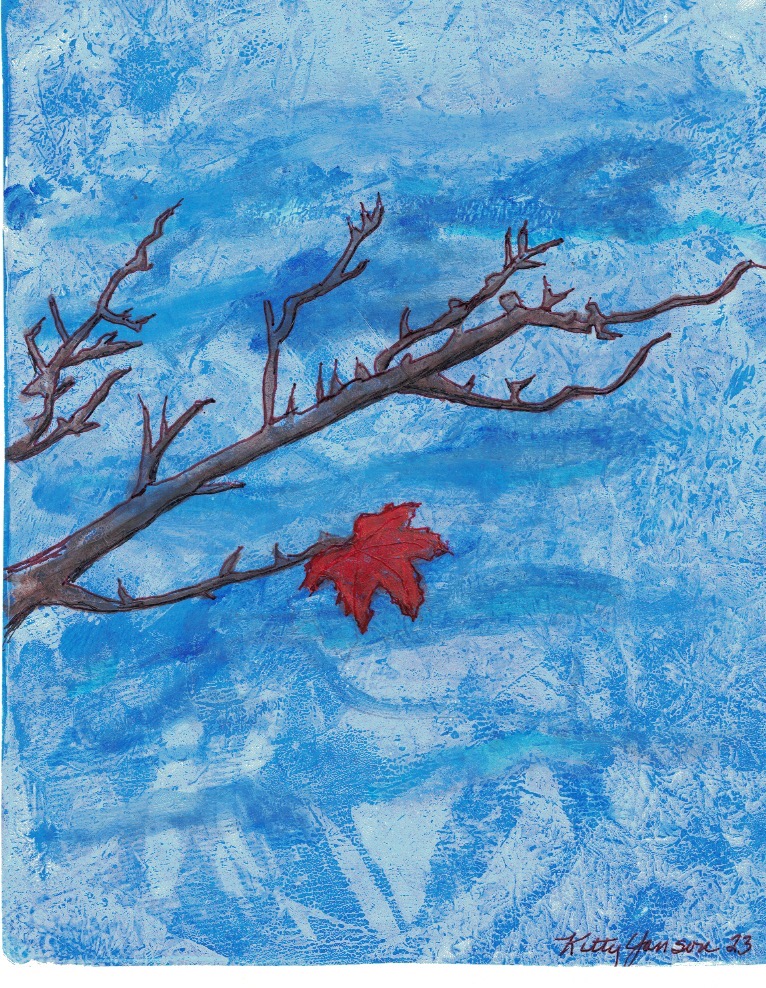
through winter, its frozen cyclone and hardened rhyme
of seeds exposed by the oval cut, now crowned
with tar. A dark fist clenching life, it raised
its sleeping challenge: Know before whom you stand.
IV.
In this tree’s hesitation, stars are spawn, unschooled
until my father’s Sistine finger calms
the obstreperous moon to trace across the black
construction-paper night the forms of cartoon
stick things, connecting dots in this puzzle book
in constellations. He takes my gloved hand, lines
my sight with his” “Polaris. That’s the North
Star. Find it and never lose your way at night.
See? It leaps from the cup like a bubble that stings
your nose, an effervescence. Orion’s there
with his club, a hunter chasing pigeons–girls
they were once, the Pleiades, seven sisters loved
so hotly, so hopelessly pursued that a star
was born in Orion’s armpit, Beteljuice,
the gleaming sweat of eternal war. And there
is Lyra, the harp of Orpheus, playing the gods’
stone silence, while the swooping eagle, Vega, tunes
the strings, ensnaring those who listen, who spy,
on gods, with ears against the door of night.”
In a room upstairs, my brother cries in straight
unyielding arrows until my mother bends
them, coaxes them with lullabies to curl
in her lap like willow withes. The Polish words
I do not understand, but I know the tale
her body speaks: the phrase of powdered warmth,
the grammar of arms, the syntax of fluent skin.
the order of breath, the spelling of pulse. I’ve walked
the labyrinthine passages, open courts,
the columned temples, the pillared caves of sleep
against her breast. The winding trail of dreams.
Outside alone, I look to find a tale
of crooning mothers, but legends always flex
in unrelenting waves among the stars,
the bones of heroes that led my father home.
They leave no pages blank, without a word
to colonize, to fill with inevitable fact
and purpose, destination. They’ve conquered night.
But I want these stars, against the darkened wall
like shattered apples, to cling with bits of bright
debris, an unswept vacuum, and all the stars
dissolved but one. North Star. In the crook of my sight
it’s the never-closing eye of my motherland,
now foreign: an ache, a throb, a small white cry.
-Kitty Yanson




 Memorizing the Laws of Gravity