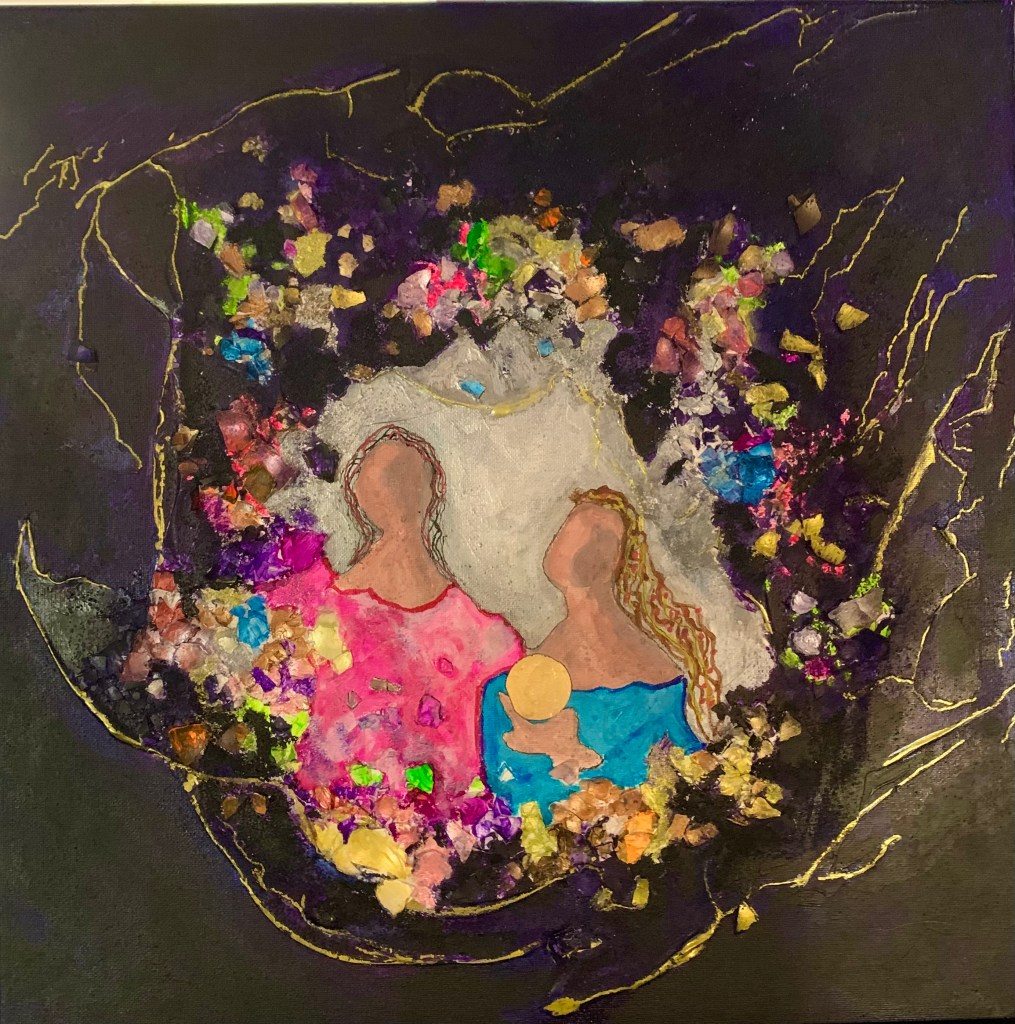
Multiplicity of Self

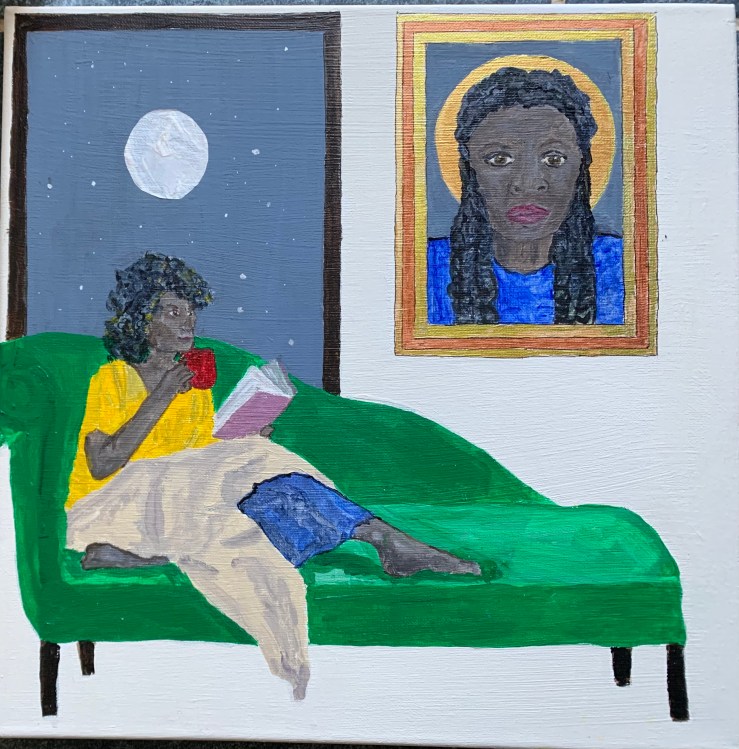
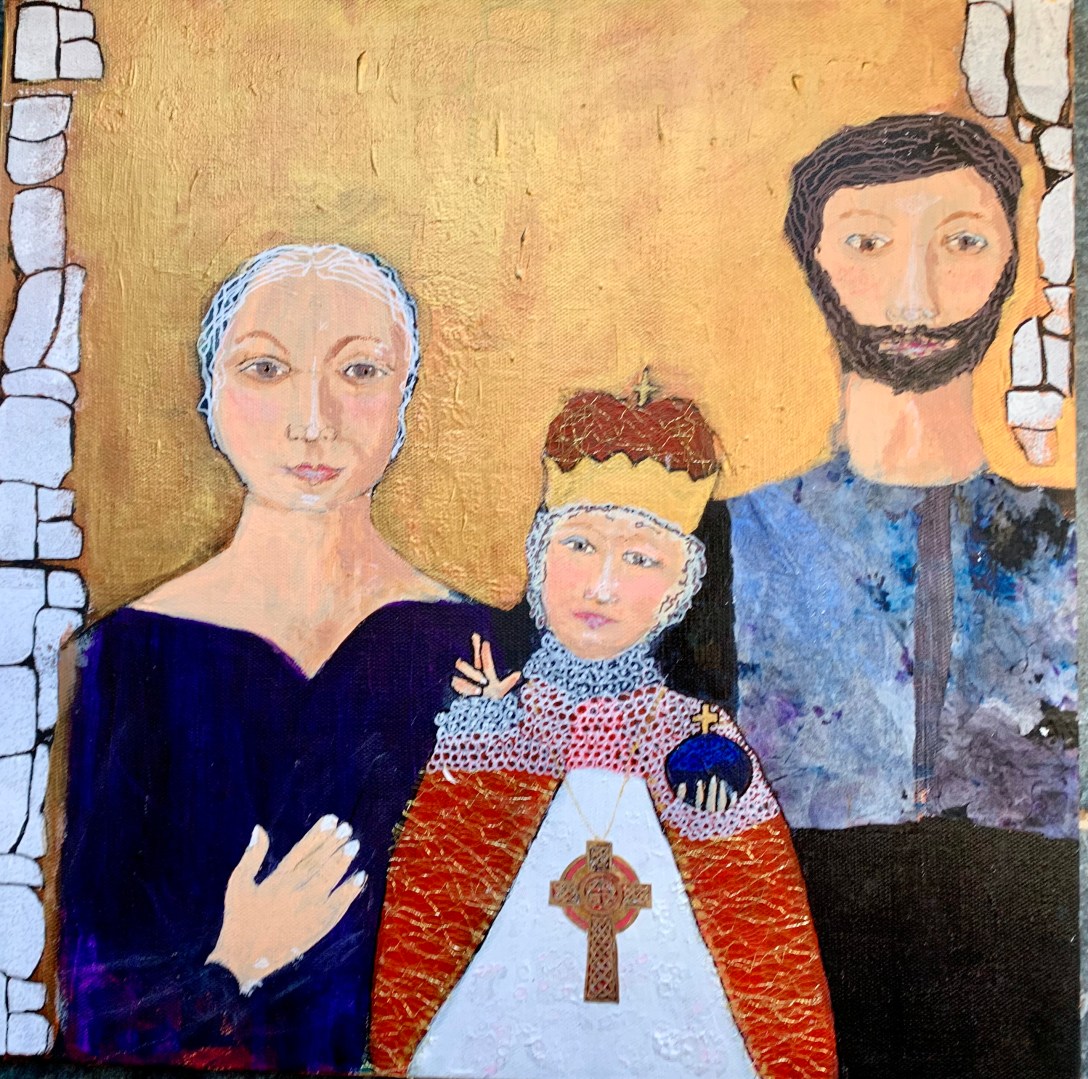
I have spent the last few months doing self-portraits in response to a prompt from my little group of artists that meet to show our works to one another and to talk about the Jungian images in them. Interestingly, the view of myself differed depending upon the day and the mood, the leaning of my mind, and the tendency of my heart. The first one (the one above) is the inner self, the song in the heart of stones, the twin aspects of conscious and unconscious in friendship.
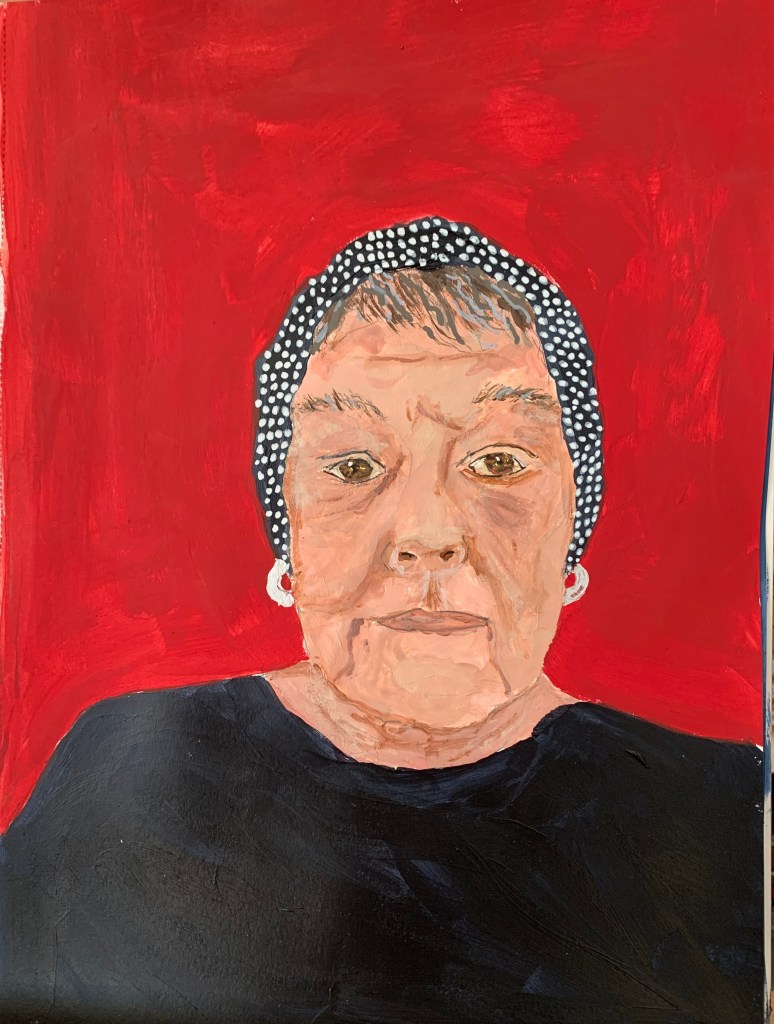
The second one is one with a life-model–me in a mirror, the only live thing in my house other than my cat Francis. While I was painting, I was concerned about the shapes I saw in my face and where the light was coming from. I wasn’t lamenting a sagging chin or the deepening nasal-labial lines. It led me to laugh about what had I been so concerned about: now my face is, well..my face. I kind of like it.
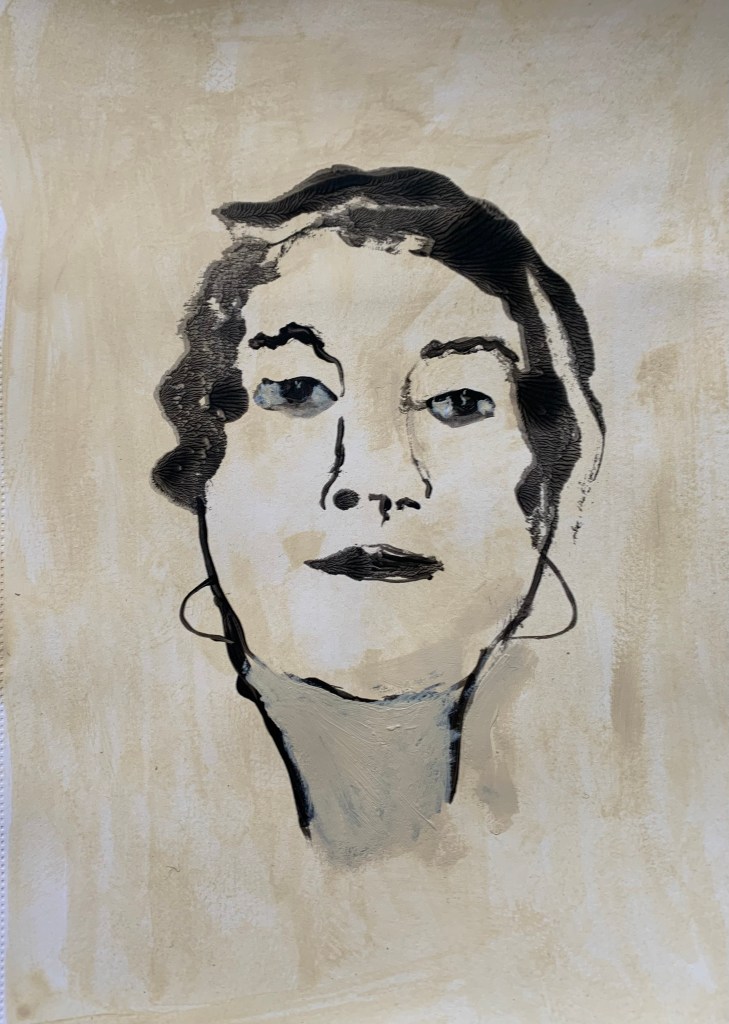
This one, a transfer from a painting on acetate, has a kind of dreamy feel to it. She reminds me of my grandmother and my Nowakowski kin. When I squint my eyes at the image in the page, I can almost hear my Uma’s powerful contralto voice unfurling like a moonflower, calling our Northwood neighborhood in to sleep to the phrases of Brahm’s Lullaby.
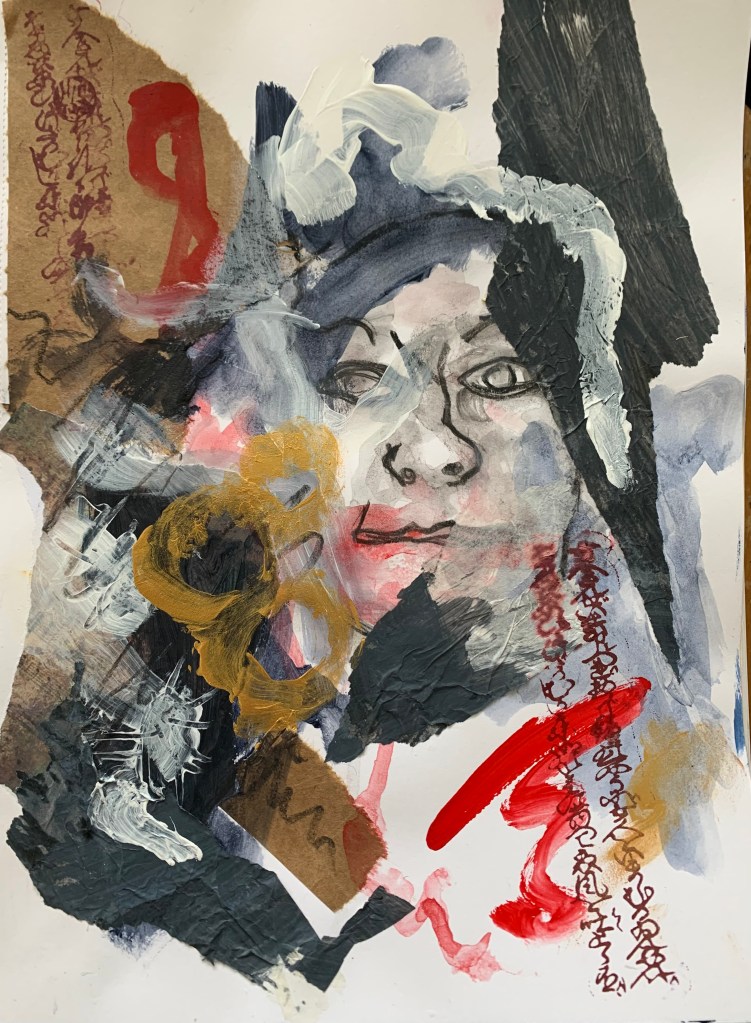
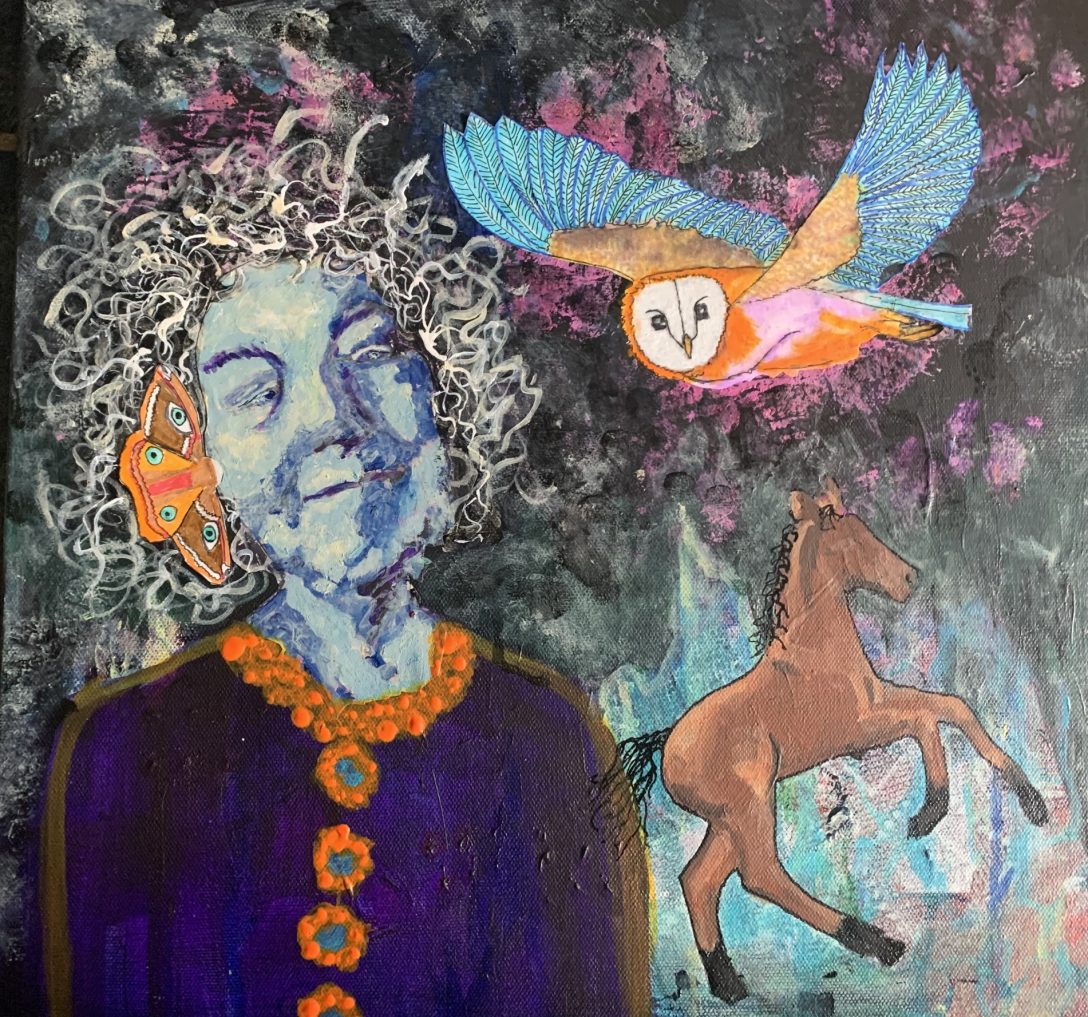
This is me falling apart. I do it often. I must have just watched the news before painting this one. I think it must have been particularly bad that day, but, really there are so many.
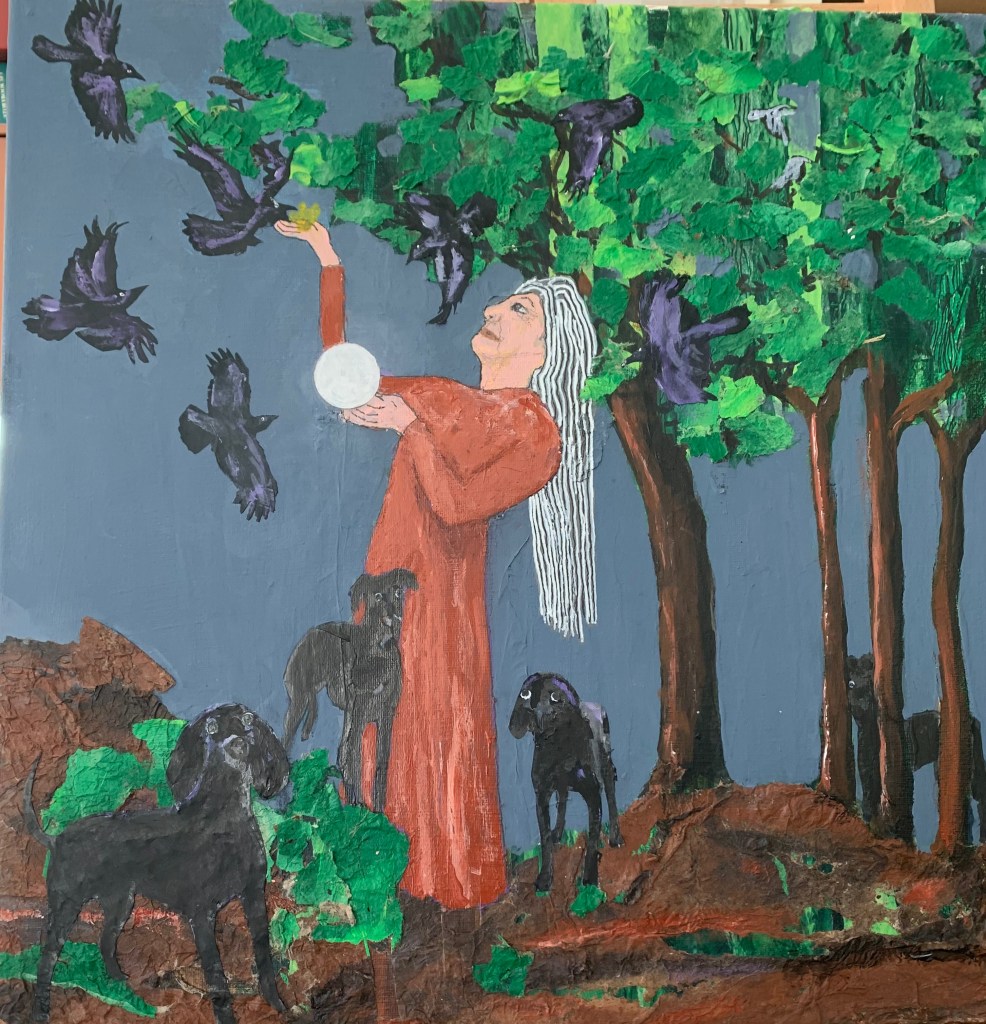
This final one is a painting not of me but of the archetypal energy that I am channeling in this stage of my living: The Crone. Also known as Hecate or the third stage of the moon’s triple goddess, the Crone hangs out with her crows and black dogs to bring an intense magic to the world touched by women of my age who know so much but also know that they know so little in the vast ocean of mystery.

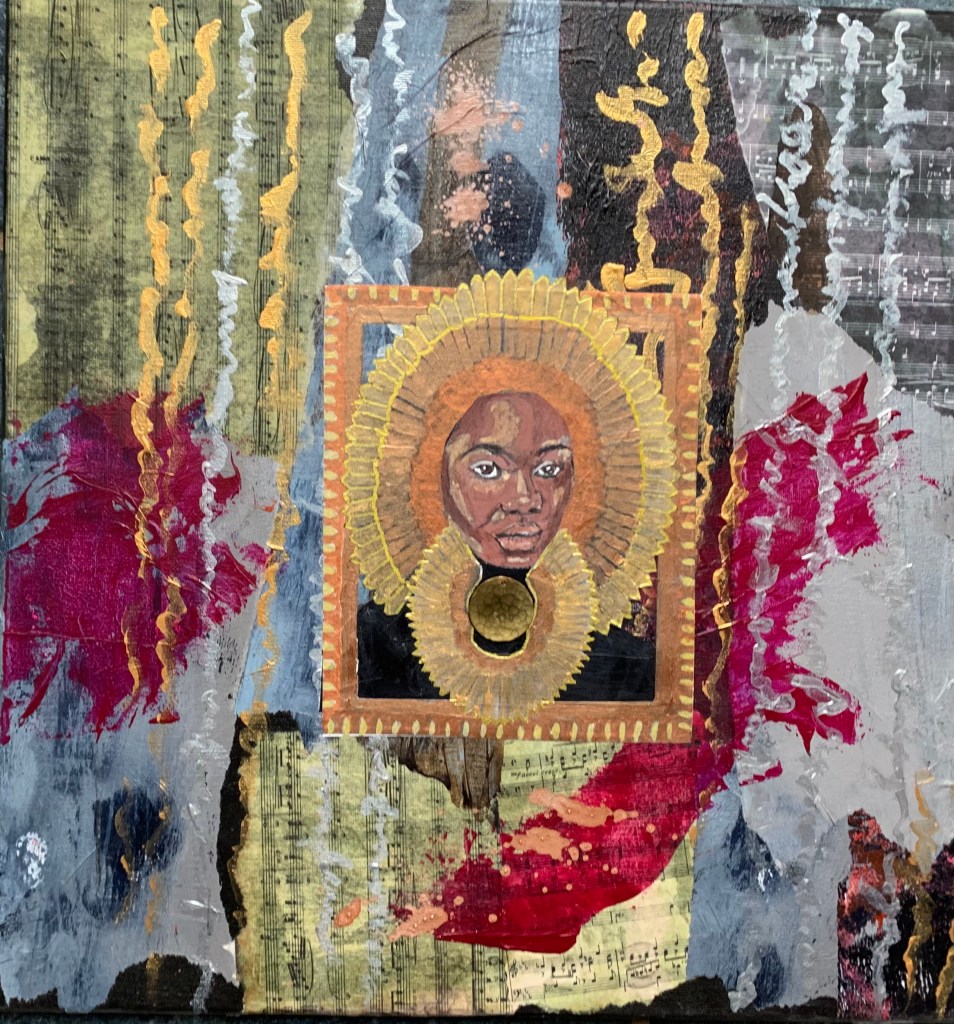
The Black Madonna Series

Dark Madonna

She knows in whose boredom the sun sleeps.
She studies space, fixes images in their absence,
hangs portraits the masters never saw
in their crafty light. Interrupts the talk
of dragonflies attending all creation.
She is the holder of pain, the unmoved target.

I wonder who this woman is
who moves as separately as silence,
who pauses to applaud a renegade dogwood,
red in still-green autumn, understands
the bloody revolution of ticking clocks,
the second-hand arrows that pierce
the flesh but leave it whole.

I hear her coming. She whispers between
the folds
of perception:
you will believe:
there is nothing left

but love.
-Kitty Yanson

I first became acquainted with the Black Madonna sometime in the early 1980s after getting sober, after my divorce, when I was trying to get through depressive episodes without the liquid medication I had used to try to treat them. First, it was a picture of Our Lady of Czestochowa in my ancestral Poland which drew me toward her, then I searched out others, the Dark Madonnas of Spain, and the one enthroned in Chartres Cathedral. Eventually, I found that she was indeed an archetypal presence in the psyche, a sister of the Hindu Kali, the apocryphal Lilith, and the Egyptian Isis. In all of these forms, she embodies the union of opposites: life and death, spirit and matter, the conscious and the unconscious, body and soul. For me back then, she was the hope I had for healing and wholeness, and so she remains with me today, as I continue to find new ways to create while my body, beginning its 77th year this week, reminds me with a new ache every morning that mortality is destiny, a part of life. This image of this Great Mother, both womb and tomb, comforts me, sings me awake and to sleep in endless cycle of God. These three paintings are my way of exploring her great truth without words.

Painting the Dames

This month has brought images in my sketchbook–paintings of the ladies who live with me in the little world of my head and heart. The first began using a Chagall portrait as my inspiration. My black cat Francis (who is growing purple with age and irritation) sat next to her, then a goldfish plopped in a bowl. I call this woman Lady C for Lady Creativity.

Then I had a dream that above a Gothic doorway was inscribed “Vocatus atque non vocatus Deus aderit” (Called or uncalled, God will be present), the inscription that C.G. Jung had above the doorway to his home and the office where he saw his patients. So Lady Creativity in the next painting stormed that door, mirroring my daily prayer that I borrowed from Darius Bashar, a meditation teacher on The Artist Morning website (https://www.artistmorning.com/.

Dear God, it goes, Please use me as a vessel for your divine expression. Use me as an instrument for your love. Give me the strength to go into the depths of my heart to find my truth and the courage to speak my truth in my own authentic voice. Whatever happens from there, I let go and let God.

In his approach to meditation, Darius uses Julia Cameron’s The Artist’s Way, a book I highly recommend to all creatives to help to feed their souls.

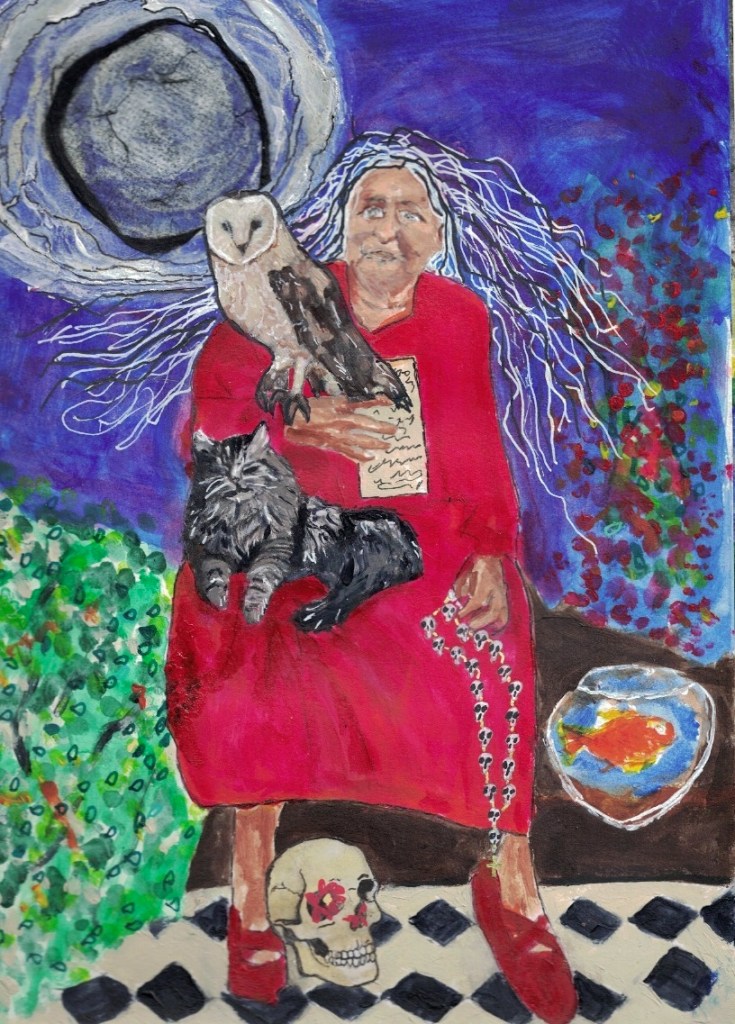
Then, I revisited my old friend Lady Wisdom, to me both a representation of Sophia, the feminine aspect of God, and an embodiment of the Great Mother Archetype. Francis my cat and the goldfish return again, but as I was painting, I saw skulls with flowers bloom while Lady W prayed the rosary of years. She became Baba Yaga, a Slavic fairytale figure with the characteristic doubleness of all archetypes: the benevolent grandmom and the witch who lives in a hut in the forest and terrifies children (which was, perhaps, the hidden reason why I thought 70 some years was the age when I would begin to terrify my students–though some of my former would say that I started much earlier than that). So Baba Yaga is here:

Finally, I had to render another Lady W, standing before the triple trees of life, representing, perhaps, the triple lives of women: maiden, mother, and crone. She wears a cloak of spirals and the moon in her hands. Someone once told me that living was like moving up a continuous spiral up the core of ignorance; when you start up the climb, you are flat up against the core of ignorance, so you cannot see what you do not know, the bricks of the core blind you in their proximinty. But as you ascend farther up and farther away from that core, you begin to see how much you do not know, and when you get to this age, it’s a heck of a lot. But at the same time, you can see the layers of circles you have traveled, the mistakes made over and over again, the former selves that have transformed and reshaped who you are today: the lady of wisdom, of knowledge and ignorance.

Ritual

When I was a child, I used to dress
and redress the body of the baby God,
Infant of Prague, with satin clothes
tailored to liturgical rhymes,
running my fingers across the hemline
rows of sequins, struggling to pull
the ruched armholes around the orb
of power his innocence cradled
in one tiny hand. I love you, Jesus,
I prayed as I returned his plaster vulnerability
to the altar atop my Uma’s chest of drawers.

In the afternoon after school, I met my friends
and a drafted brother or two to play Communion
in the basement, bribing my bros with chocolate
Jesus Necco Wafers giving the licorice ones
that nobody wanted to my ex-bestie Gerry
for some unremembered grievance,               
grabbing a bed-sheet from the laundry pile
as vestment across my outlawed priestly shoulders
to dole out sugar in lieu of transcendent mystery
around the sweet table of childhood.

But these were stories of another time
when I played with God, splashing
in the shallow waters of rituals’ river,
too young to swim in the deep end of faith.
Now I finger the decades,
counting faults and graces
bead upon bead, blurring
into wholeness in the rosary of my years.
I dress and redress again
that child of Prague, swaddling
his naked holiness in satin comfort
with sequins I have poorly sewn upon it,
now a broken princess playing with God
in second innocence repeating
and repeating the ongoing ceremony
of the all-along truth of love.
-Kitty Yanson

I Love This Getting Old

I forget a lot of what I read.
Some days I’ll fall madly for a moment, a phrase,
a word, then I’ll scuttle with compulsive curiosity
to find more meaning in all this. I’ll swat at a life-changing
articulation (I got you, you elusive bugger!),
then smoosh it like a drain fly smacked
against a kitchen wall to keep it, black and white, forever.
It is usually gone by bedtime.

Where do all these things go? Into unconscious
trash bins to hang out with used-up TV tropes
and winged horses and my flesh ballooning
like yeast dough rising, pressing against the
walls of dreams? Or do they just hide to jump
out dressed in white sheets and shouting BOO
in the middle of a conversation about which
is better with pan-fried, crispy gnocchi,
garlic spinach or roasted brussels sprouts?
I remember once (I think) that I woke up from sleep
in the middle of the night to scratch life’s meaning
onto the pad I kept at my bedside. In the morning
I looked: “Airedale.”

But maybe all the forgotten words are really seeds
that germinate in the dark to sprout one day
as a glorious dahlia or noxious weed in the garden of my being.
Or maybe they will one day gather with the quiet drones
of departed declensions of Latin nouns and (what?)
I ate for Tuesday’s dinner. Together we will stand around
the altar of my heart in the sanctuary of silence,
counting breaths and waiting for an Easter meaning to arrive.

                  -Kitty Yanson