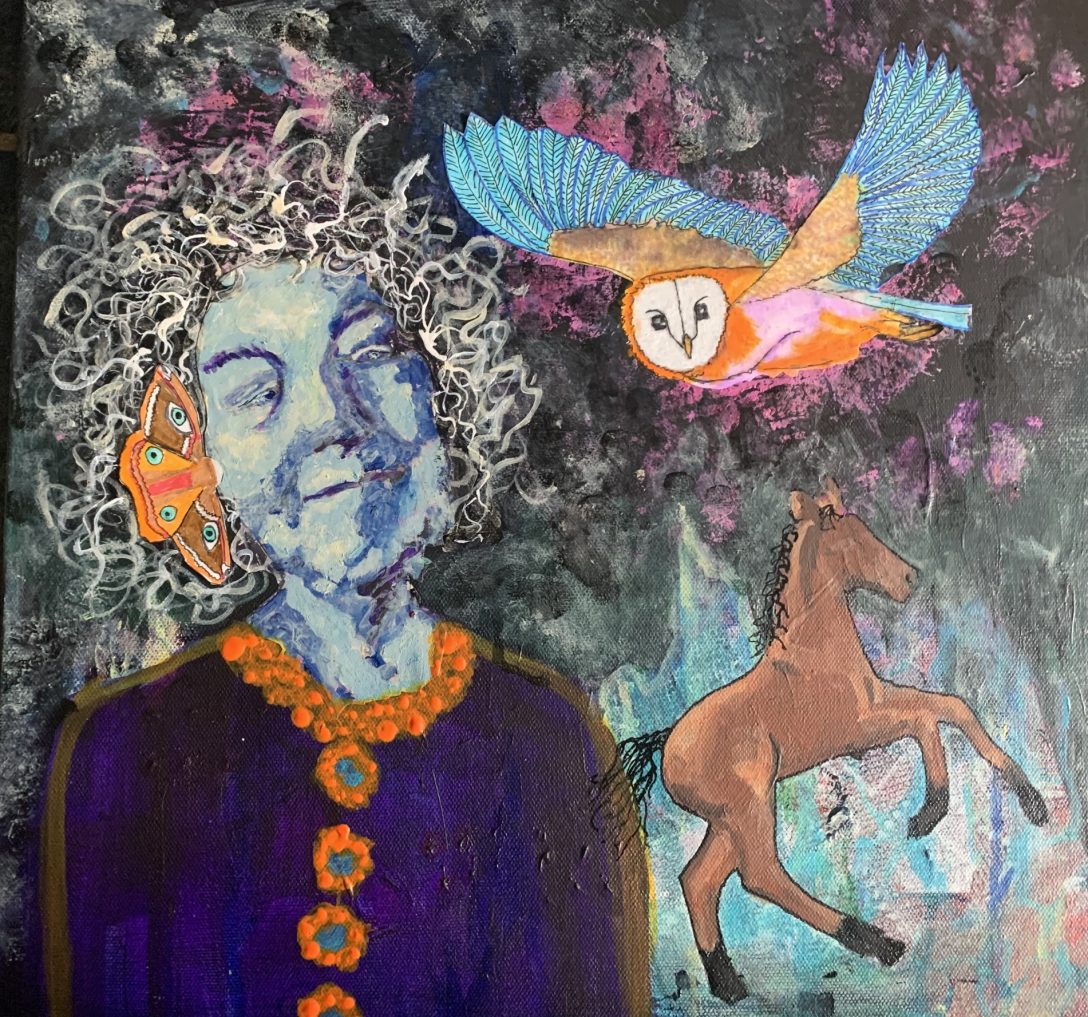
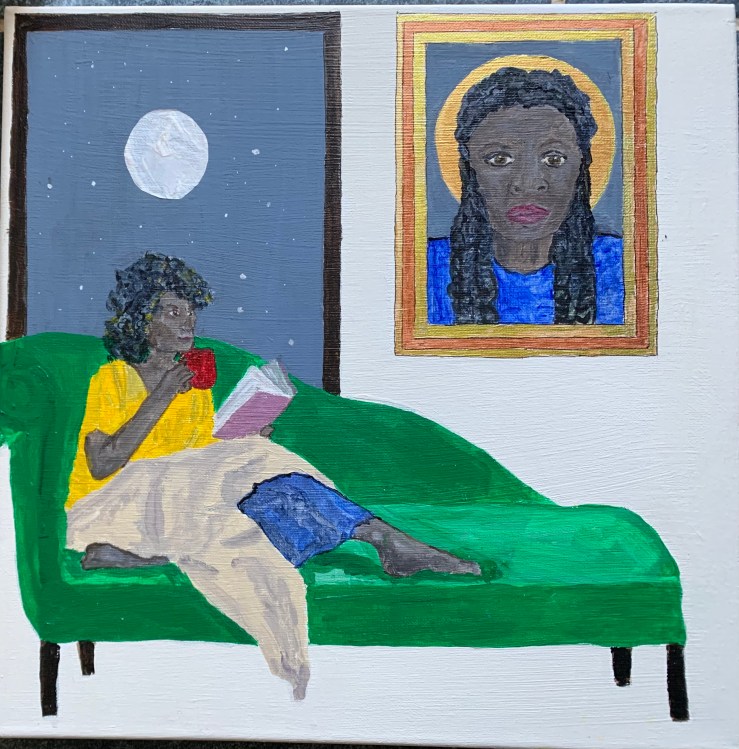
I have spent the last few months doing self-portraits in response to a prompt from my little group of artists that meet to show our works to one another and to talk about the Jungian images in them. Interestingly, the view of myself differed depending upon the day and the mood, the leaning of my mind, and the tendency of my heart. The first one (the one above) is the inner self, the song in the heart of stones, the twin aspects of conscious and unconscious in friendship.
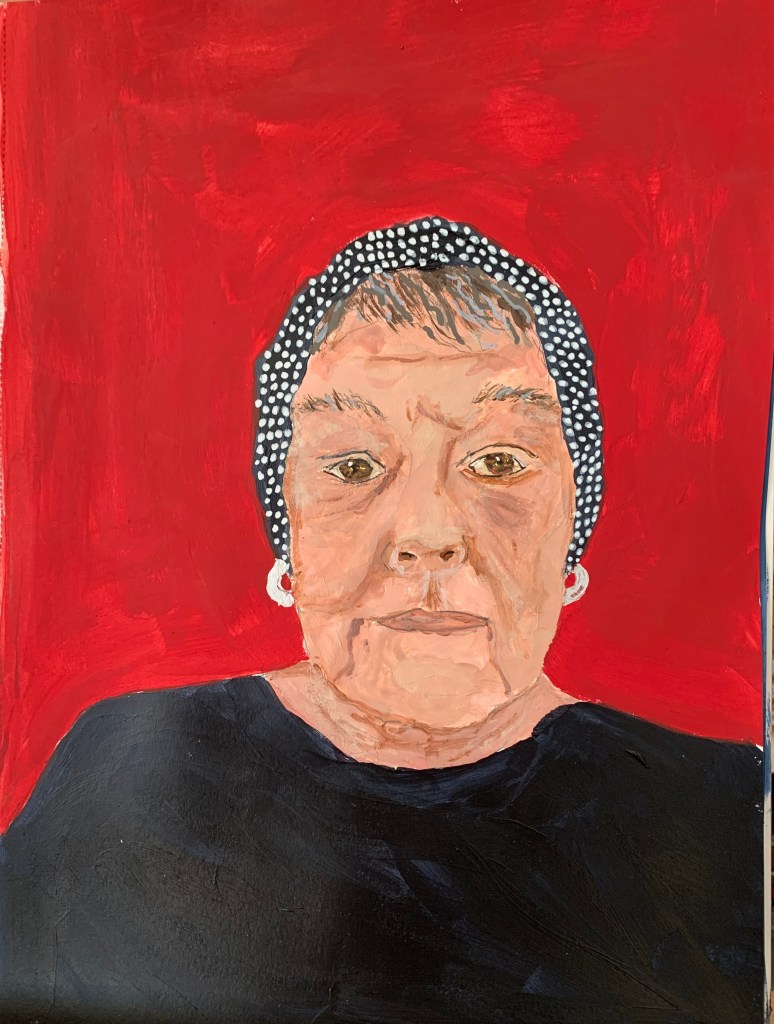
The second one is one with a life-model–me in a mirror, the only live thing in my house other than my cat Francis. While I was painting, I was concerned about the shapes I saw in my face and where the light was coming from. I wasn’t lamenting a sagging chin or the deepening nasal-labial lines. It led me to laugh about what had I been so concerned about: now my face is, well..my face. I kind of like it.
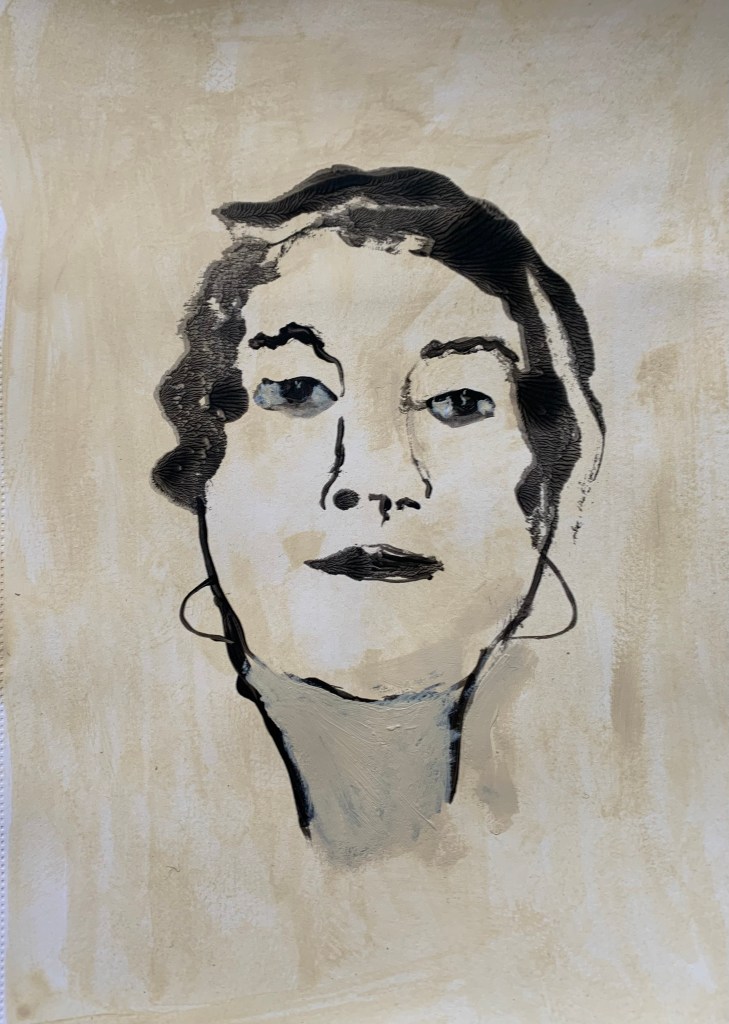
This one, a transfer from a painting on acetate, has a kind of dreamy feel to it. She reminds me of my grandmother and my Nowakowski kin. When I squint my eyes at the image in the page, I can almost hear my Uma’s powerful contralto voice unfurling like a moonflower, calling our Northwood neighborhood in to sleep to the phrases of Brahm’s Lullaby.
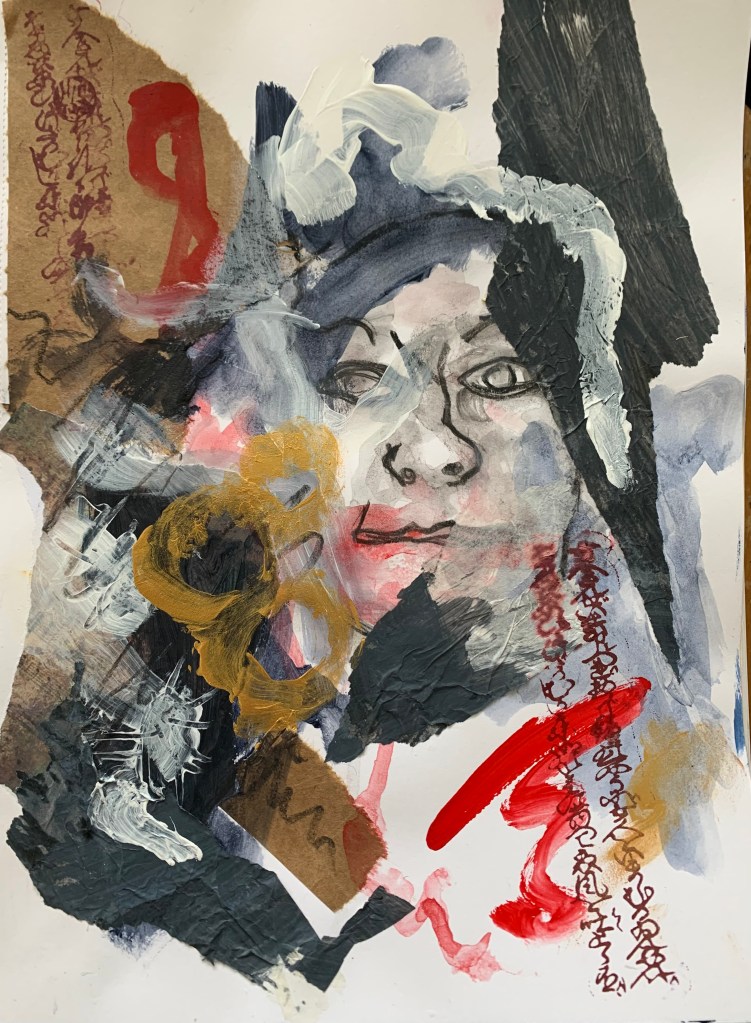
This is me falling apart. I do it often. I must have just watched the news before painting this one. I think it must have been particularly bad that day, but, really there are so many.
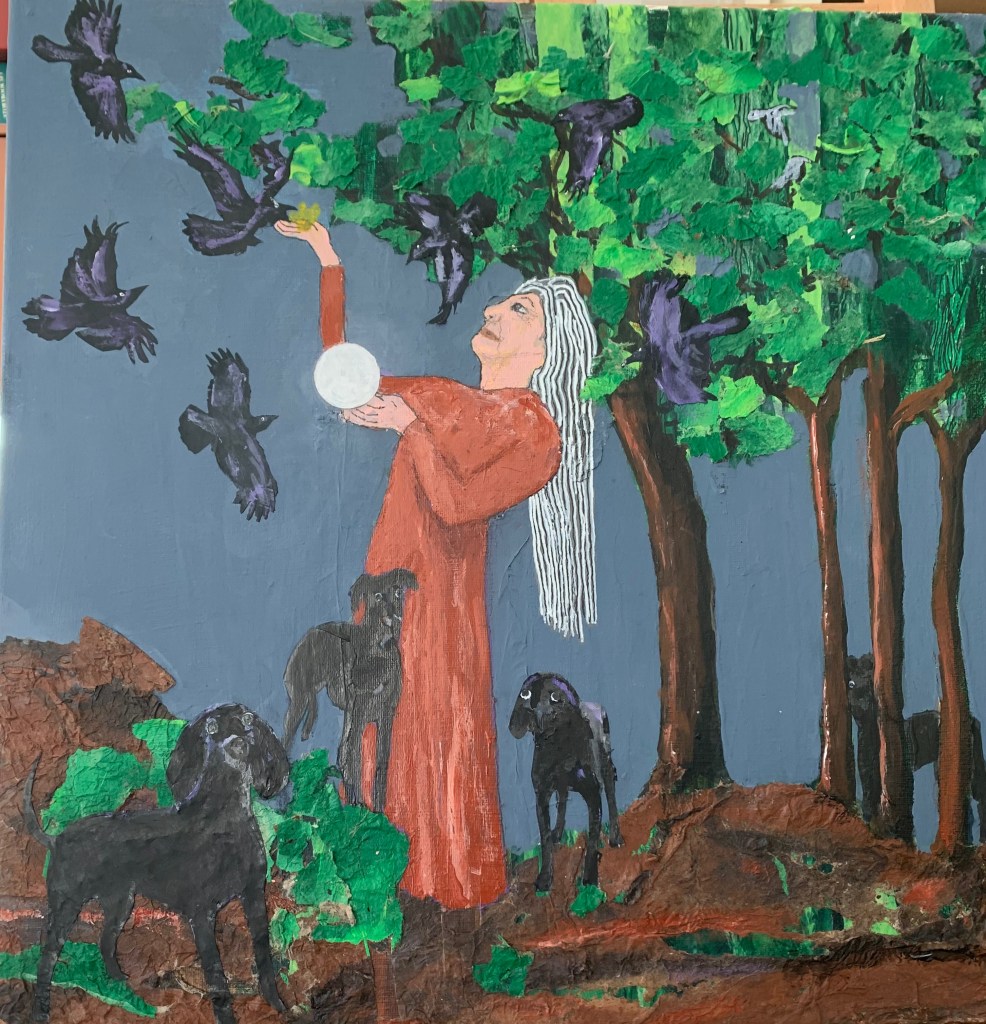
This final one is a painting not of me but of the archetypal energy that I am channeling in this stage of my living: The Crone. Also known as Hecate or the third stage of the moon’s triple goddess, the Crone hangs out with her crows and black dogs to bring an intense magic to the world touched by women of my age who know so much but also know that they know so little in the vast ocean of mystery.
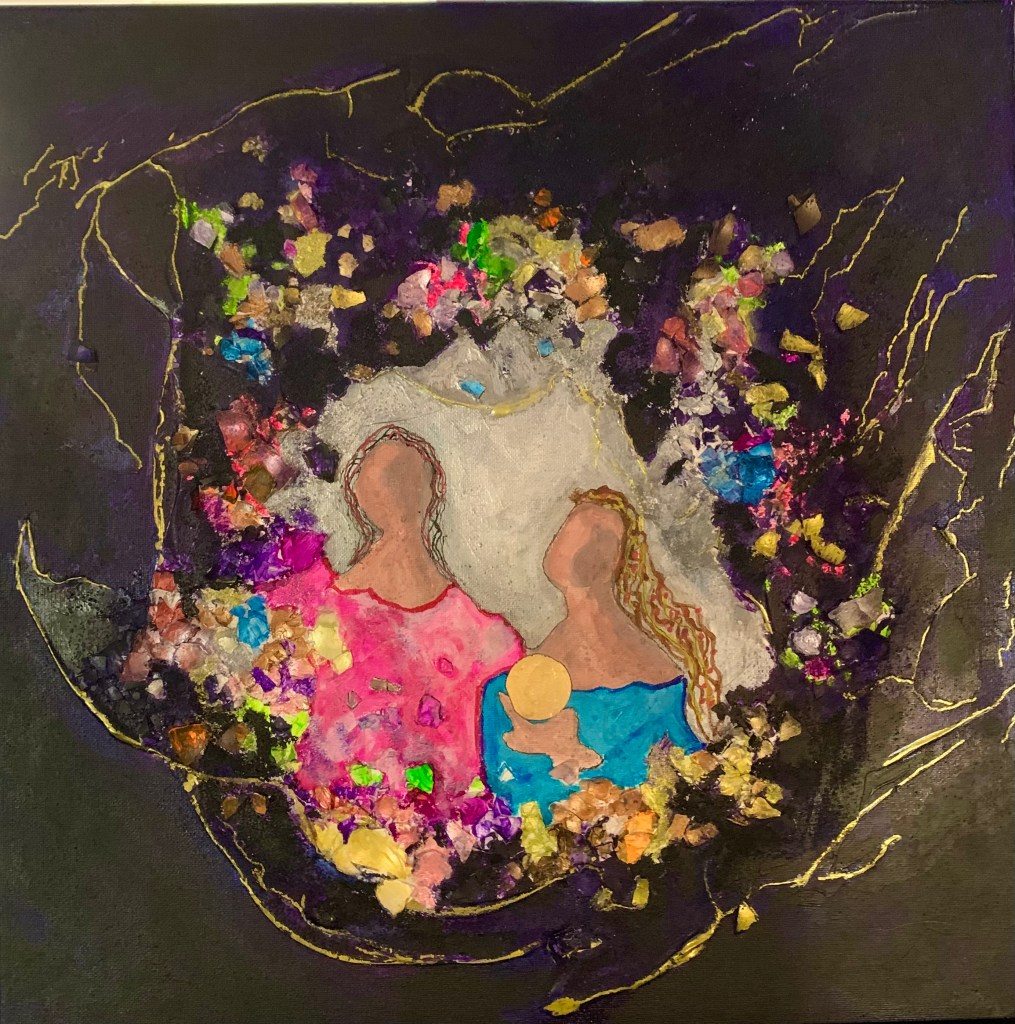
‘Tis the season…of darkness and waiting but not of desolation. There is a richness in this darkness which gestates the brightness of hope. This painting is about planting seeds of love deep in the earth to rise into the heaven to become stars that light the path to the archetype of the Divine Child, Jesus, yes, but also new life in all its forms, the creative sparks from the unconscious that implant in the womb of mind to become a painting, a poem, a new idea, a vision of peace.
She knows in whose boredom the sun sleeps. She studies space, fixes images in their absence, hangs portraits the masters never saw in their crafty light. Interrupts the talk of dragonflies attending all creation. She is the holder of pain, the unmoved target.
I wonder who this woman is who moves as separately as silence, who pauses to applaud a renegade dogwood, red in still-green autumn, understands the bloody revolution of ticking clocks, the second-hand arrows that pierce the flesh but leave it whole.
I hear her coming. She whispers between the folds of perception: you will believe: there is nothing left
but love. -Kitty Yanson
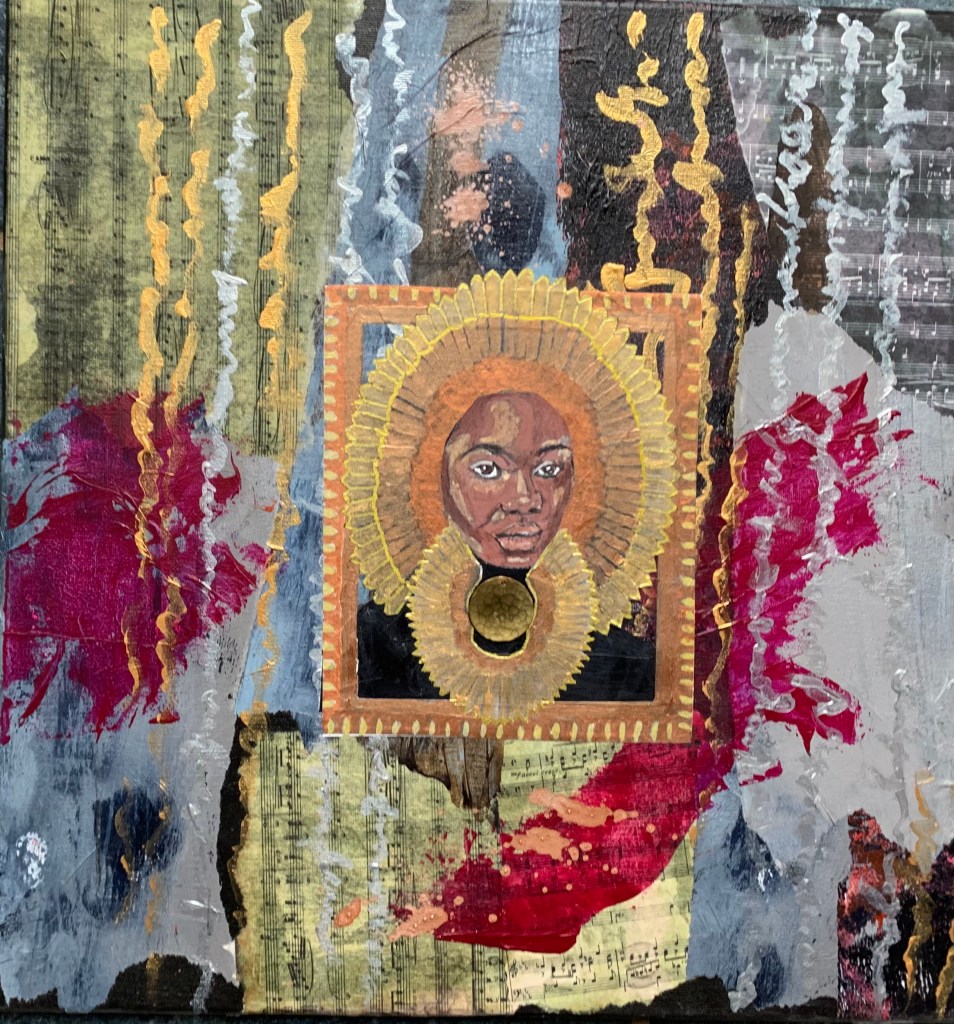
I first became acquainted with the Black Madonna sometime in the early 1980s after getting sober, after my divorce, when I was trying to get through depressive episodes without the liquid medication I had used to try to treat them. First, it was a picture of Our Lady of Czestochowa in my ancestral Poland which drew me toward her, then I searched out others, the Dark Madonnas of Spain, and the one enthroned in Chartres Cathedral. Eventually, I found that she was indeed an archetypal presence in the psyche, a sister of the Hindu Kali, the apocryphal Lilith, and the Egyptian Isis. In all of these forms, she embodies the union of opposites: life and death, spirit and matter, the conscious and the unconscious, body and soul. For me back then, she was the hope I had for healing and wholeness, and so she remains with me today, as I continue to find new ways to create while my body, beginning its 77th year this week, reminds me with a new ache every morning that mortality is destiny, a part of life. This image of this Great Mother, both womb and tomb, comforts me, sings me awake and to sleep in endless cycle of God. These three paintings are my way of exploring her great truth without words.
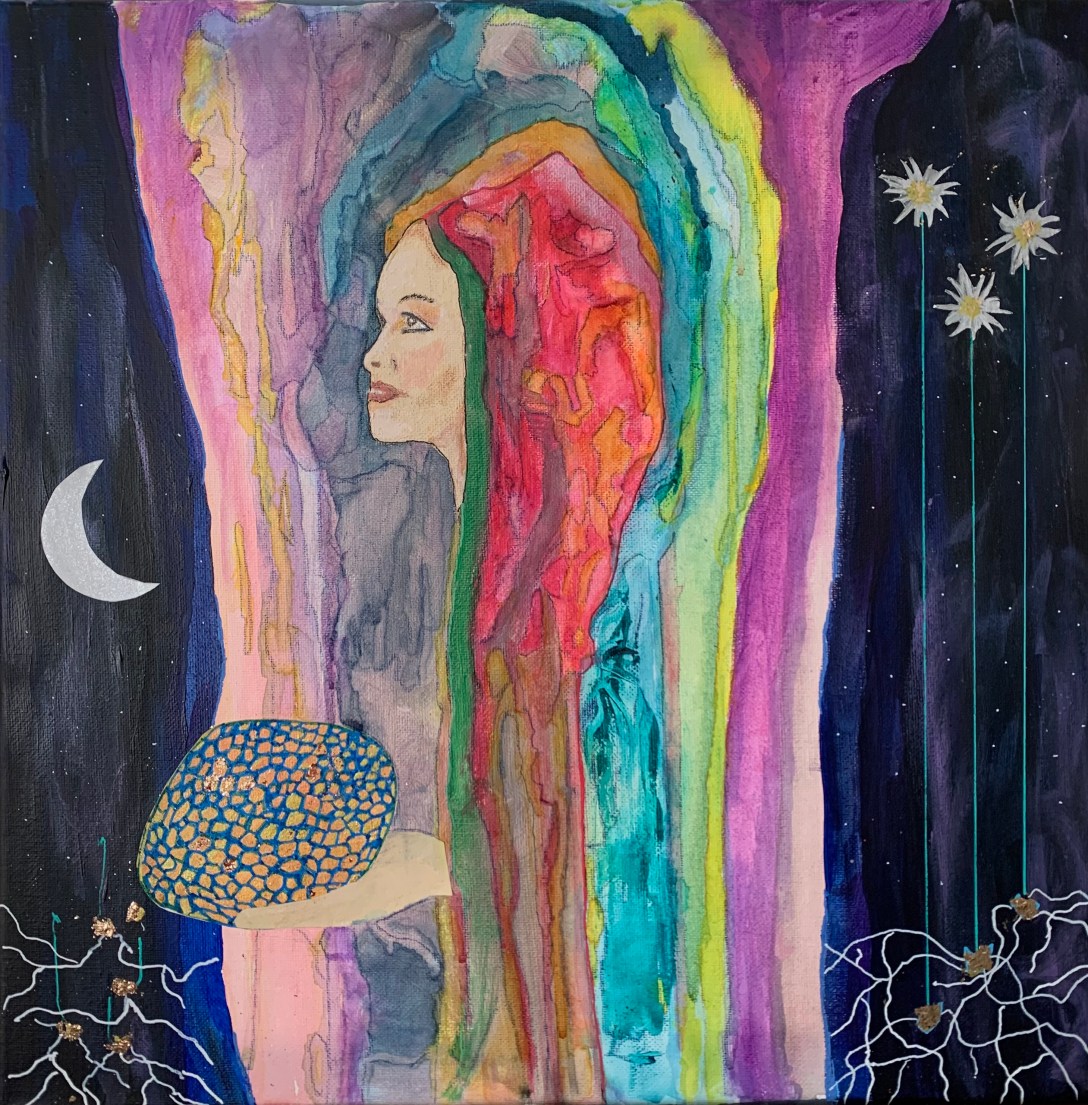
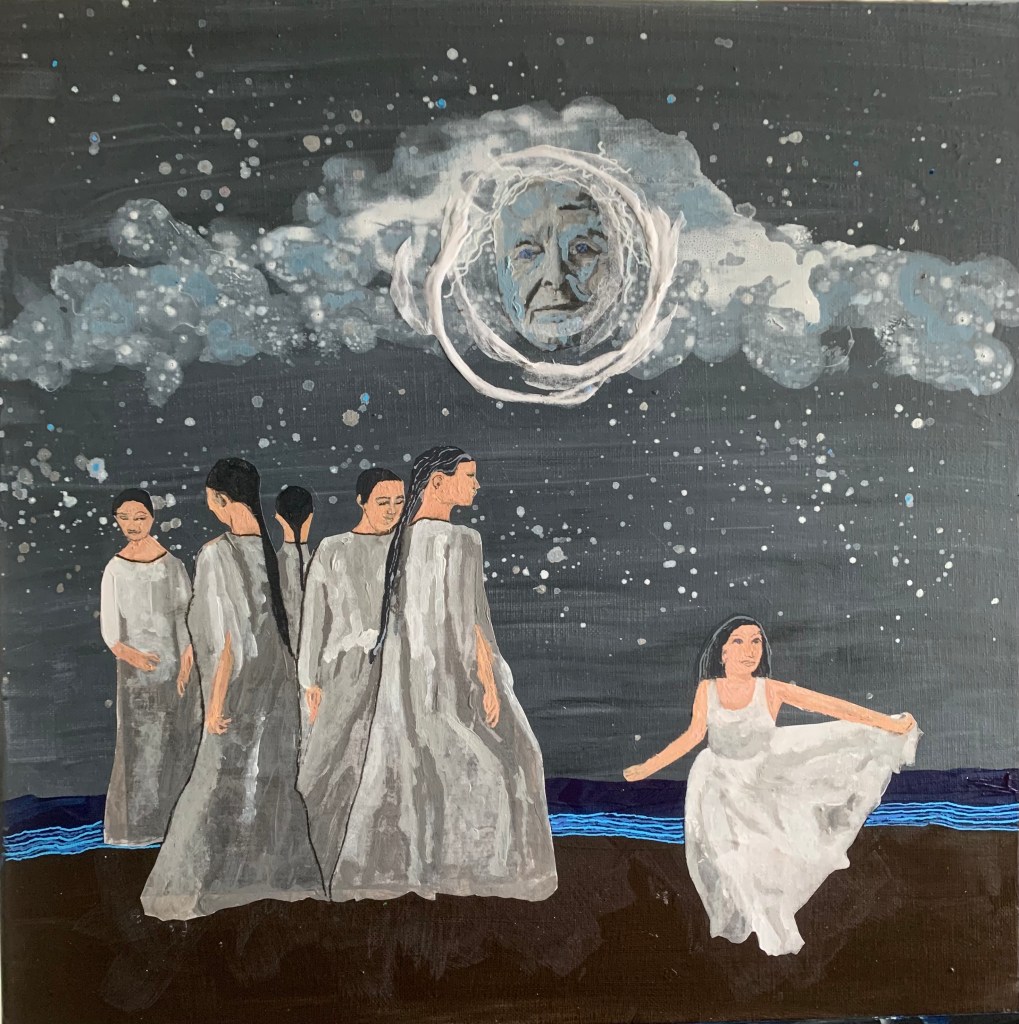
Many of you may know, but the moon in mythology was seen as an embodimet of the triple goddess, a reflection of the life of women in three-fold–maidenhood (Kore), the mature woman of child-bearing age (Selene), and the old aged Crone (Hecate). In this painting, the middle goddess is pictured as five women, reflecting the long adulthood that felt like many stages to traverse. The final stage, pictured as the moon is Hecate, the prototype of the Witch, the Enchanter, the Caster of spells. I am well into the Crone archetype myself and thinking about the power in this stage to enchant my world with meaning under a light that may be dimmer, but beautiful in its own right.
This month has brought images in my sketchbook–paintings of the ladies who live with me in the little world of my head and heart. The first began using a Chagall portrait as my inspiration. My black cat Francis (who is growing purple with age and irritation) sat next to her, then a goldfish plopped in a bowl. I call this woman Lady C for Lady Creativity.
Then I had a dream that above a Gothic doorway was inscribed “Vocatus atque non vocatus Deus aderit” (Called or uncalled, God will be present), the inscription that C.G. Jung had above the doorway to his home and the office where he saw his patients. So Lady Creativity in the next painting stormed that door, mirroring my daily prayer that I borrowed from Darius Bashar, a meditation teacher on The Artist Morning website (https://www.artistmorning.com/.
Dear God, it goes, Please use me as a vessel for your divine expression. Use me as an instrument for your love. Give me the strength to go into the depths of my heart to find my truth and the courage to speak my truth in my own authentic voice. Whatever happens from there, I let go and let God.
In his approach to meditation, Darius uses Julia Cameron’s The Artist’s Way, a book I highly recommend to all creatives to help to feed their souls.
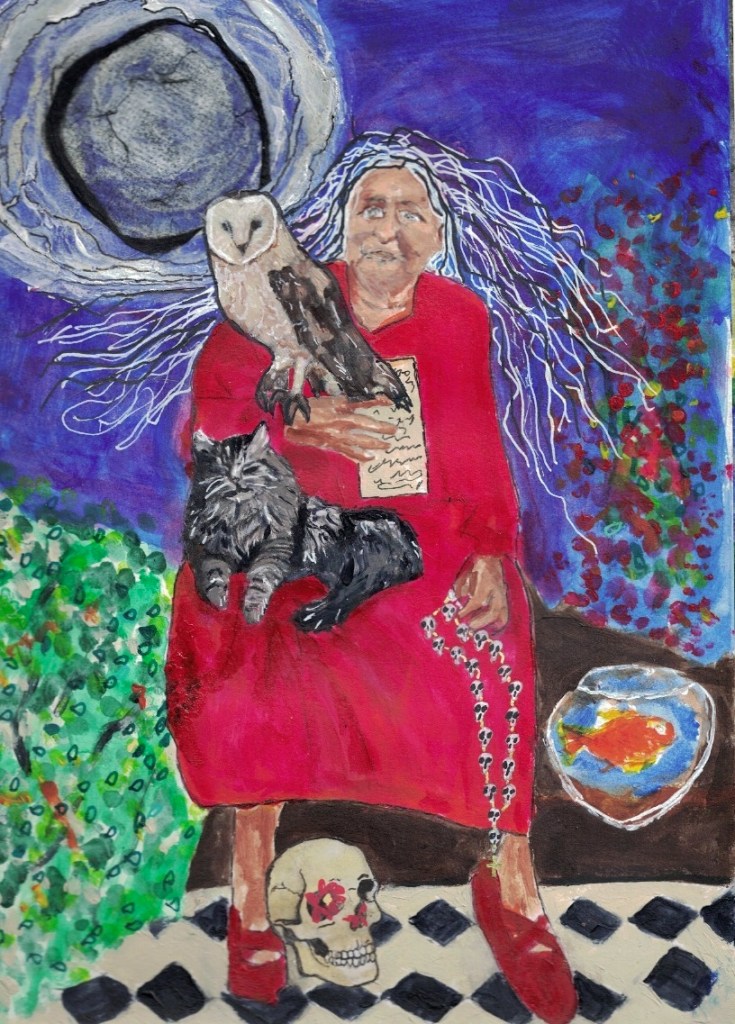
Then, I revisited my old friend Lady Wisdom, to me both a representation of Sophia, the feminine aspect of God, and an embodiment of the Great Mother Archetype. Francis my cat and the goldfish return again, but as I was painting, I saw skulls with flowers bloom while Lady W prayed the rosary of years. She became Baba Yaga, a Slavic fairytale figure with the characteristic doubleness of all archetypes: the benevolent grandmom and the witch who lives in a hut in the forest and terrifies children (which was, perhaps, the hidden reason why I thought 70 some years was the age when I would begin to terrify my students–though some of my former would say that I started much earlier than that). So Baba Yaga is here:
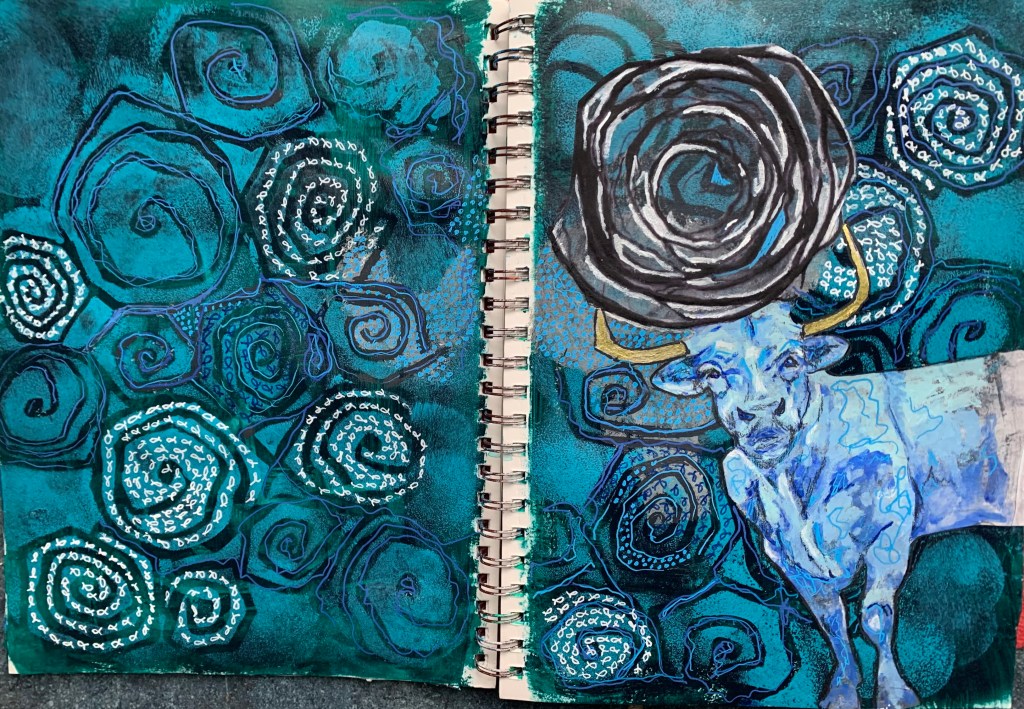
Finally, I had to render another Lady W, standing before the triple trees of life, representing, perhaps, the triple lives of women: maiden, mother, and crone. She wears a cloak of spirals and the moon in her hands. Someone once told me that living was like moving up a continuous spiral up the core of ignorance; when you start up the climb, you are flat up against the core of ignorance, so you cannot see what you do not know, the bricks of the core blind you in their proximinty. But as you ascend farther up and farther away from that core, you begin to see how much you do not know, and when you get to this age, it’s a heck of a lot. But at the same time, you can see the layers of circles you have traveled, the mistakes made over and over again, the former selves that have transformed and reshaped who you are today: the lady of wisdom, of knowledge and ignorance.
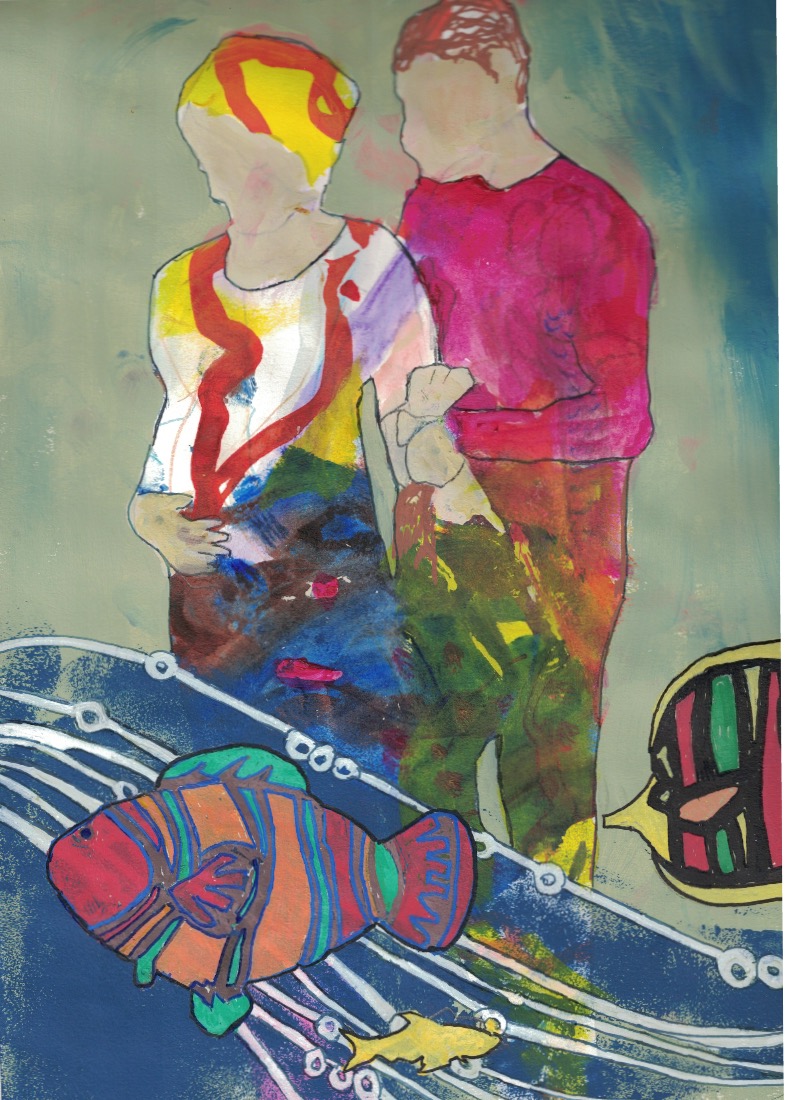
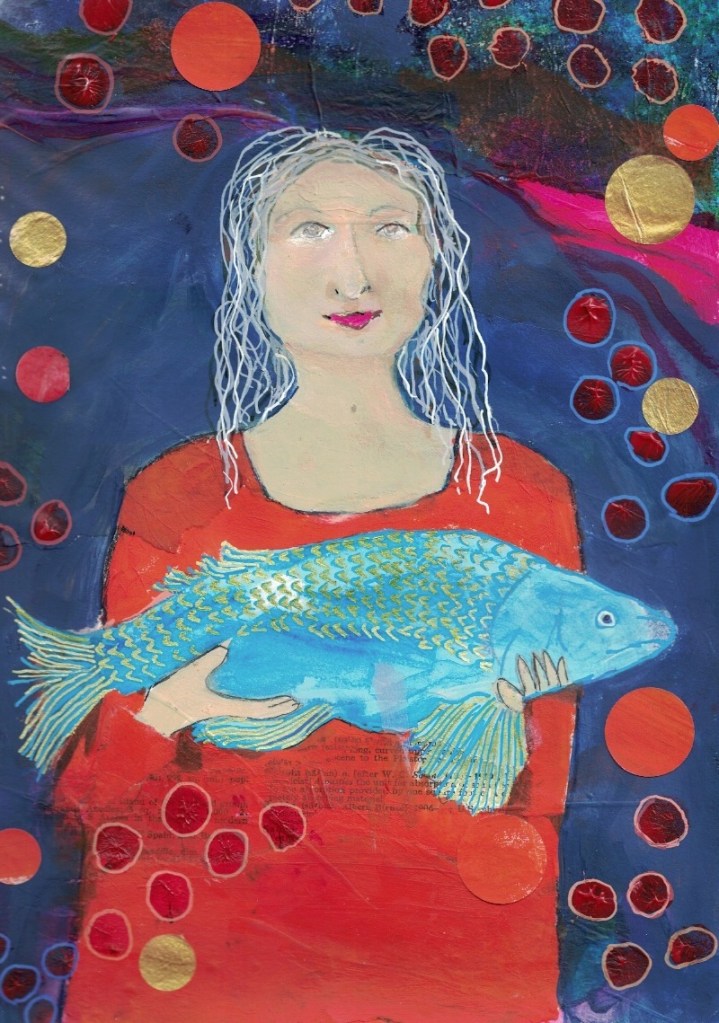
This past December I had a dream of a man standing with a very-pregnant woman. Her water breaks, and in this gushing river fish swim–many fish splashing in this prelude to birth. It was a simple dream, but one stocked with archetypal symbols and meanings of the Advent season. Then came the urge to paint in my sketch book, one image, then another. I’d go to sleep and wake up with yet another image. Another followed, then again, another. Finally, I thought I was through all the fish painting and then, in a session of unplanned intuitive art making, music notes on a piece of collage paper reminded me of a woman’s eyes. Fish Lady emerged. A fish jumped into her arms, a glorious fish with golden fins and scales. I asked her what all this was about, and she told me. This blog post is a storybook of images and lessons learned.
Yesterday, I started another painting…of a train from my childhood, the Little Engine that Could. Next to the track there is a stream. I was getting ready to pack up my paints for the day…a fish breached tissue-paper water.
Fish Lady Speaks
Fish Lady: I stand at the crossing between what you know and what you don’t. Don’t you like the gift I am bringing to you? It is a beautiful fish, at first pencil drawn then all blue, the color of the sky and the sea, all the fluidity of the outer and the inner, your daily mind in retirement that flows from one thing to the next without plan or methodology unless you are cooking a new recipe or learning a new lesson about how to paint shadows. Because the fish’s scales are gold tells that it is from God and needs to be eaten and consumed, digested and made part of your wholeness.
Me: But it is beautiful, Fish Lady! If I cook and eat it, it will be destroyed. I do not like that. I want to watch its beauty swim in my awareness.
Fish Lady: That is your need to keep things certain and in one form. But this gift allows all that beauty to go into your core, just as it is now hugged against my heart. I know that the physical act of eating no longer brings you the pleasure that it once did now that your taste buds are dull and confused, but maybe this is a call to eat of the spirit.
Me: I am aware that Jesus and fish are associated; if this is a call to buy the Jesus of religion and eat it completely, I am afraid that the bones will stick in my throat. It has always silenced me.
Fish Lady: You are stuck in the old stories and need to digest the beauty to become the beauty. The stories of Jesus you remember from childhood when he was all goodness and light even in the face of death, these are stories that float like beautiful clouds in the sky that produce the rain that becomes the sea that you find yourself in swimming with the fish that are now the gifts of mystery. Watching childhood stories, like watching the action in an aquarium, may calm but not sustain you in what you are doing now. You must slit the fish in its belly, pull out its innards, filet it, throw it into the fire, and eat it. That means finding Jesus in the missingness of taste you used to revel in, the pains in your face and joints, the cake you bring to your new neighbors, the squirrel on the back deck you fed with peanut butter, the conversation with the kid down the street who shoveled your walk who looks like a linebacker and wants to become a clothes designer, a visual, walking contradiction whose dreams you can support. You see God through curious attending to both mundanity and magnificence.
Me: And like the initial dream of the fish swimming in the water breaking before the pain of labor and the joy of birth, the work of dailiness is the catching, gutting, cooking, eating and digesting, avoiding the bones when I can. I am not sure I can.
Fish Lady: Yet you also dreamt one night of can openers. But can is not just a noun; it is a verb too. You are being invited to open your fears and have dinner…Take another look at my image. Did you notice that the only piece of collage visible still beneath the paint is the dictionary page. Dictionaries give definitions and meaning. Definition and meaning. There is more here to look for. Pay attention!
The starlings in the dying oak, loud as children in a schoolyard, gather force for an evening murmuration that will clot the sky with commas. I pause to wonder at and wonder again, (though I have seen many times) this turning and turning of the dusk like the turning of the soil in spring, like the turning circles of life in this chittering world seen once, seen always, ever-changing, ever-same.
Wisdom is a pattern-finder seeing circles in straightforward time. She lives behind a veil that sometimes stirs in dark breezes to unmask our shared laughter in a sudden, spectacular sun much like when a sinner squints through the confessional grate to find a person breathing the equal air of absolution in reciprocal eclipse.
So I look for circles in these ever-turns: the world cracking open like an eggshell pouring its gold into a pink china bowl, like the empty vase’s round absence that promises tomorrow’s rose, like the eye in the great storm in the Gulf churning up our broken trust, like the unwinding white of the moonflowers dilating silence in the eyes of night.
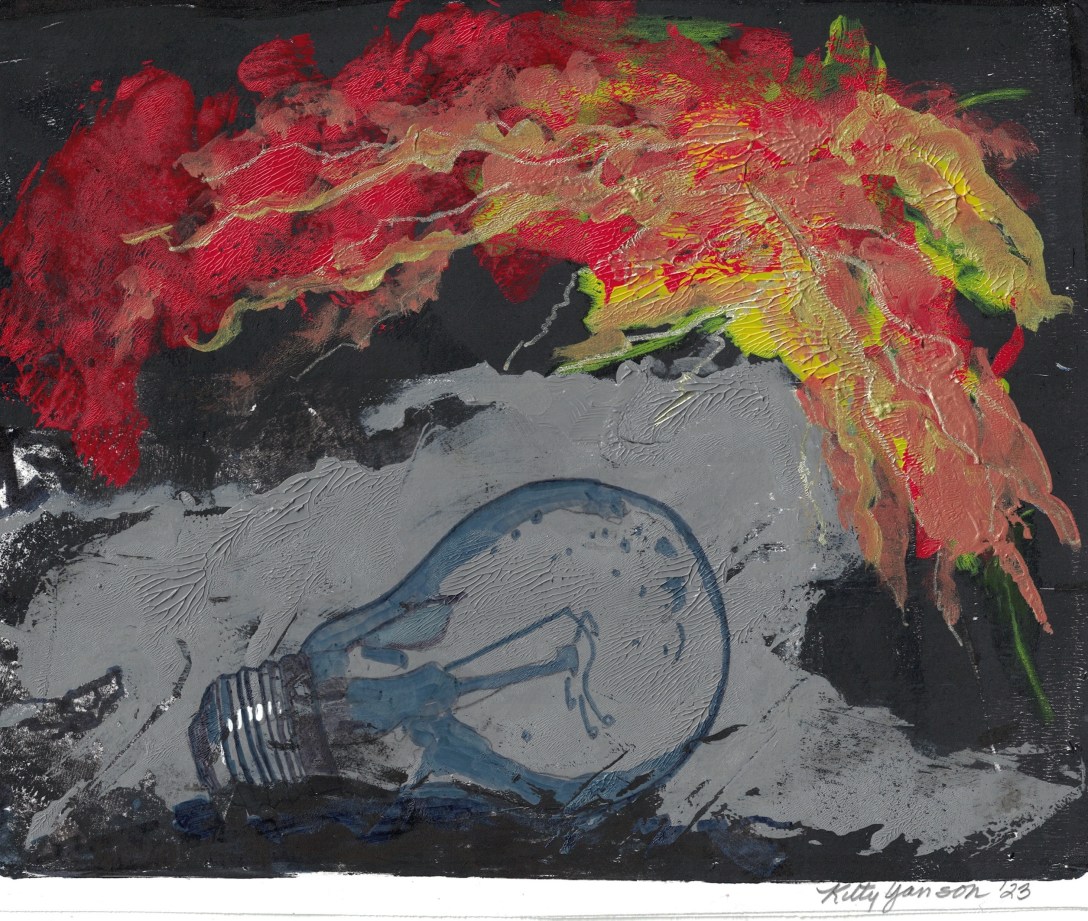
“…Divinity is found in the current that generates the light and not the container of the light….No one I know collects light bulbs after the luminous capacity has left them. We are briefly illumed, and then what is left is the glass receptacle not light.”
-James Hollis. The Broken Mirror: Refracted Visions of Ourselves
A pyracantha bush, burning, by the side of the road, collects in its thorny, painful love, tossed liquor bottles and cellophane wrappers tucked together with incendiary berries like the abandoned resolutions of not-quite-evil sinners. No wonder God gave Moses two stone tablets; it takes a hard head or downright idolatry to break them. Poor calf, shining in the valley like investment accounts in a bull market. Va vitello d’oro!
Or the Old Man River Deity on the Sistine ceiling touching Adam’s outstretched finger, a guy after a guy’s own heart. Yup, you’ll follow Him through the just-cleaned kitchen and litter it with stinky sports clothes and bloody Crusader armor. But he kisses you on the cheek and says he loves you! All is forgiven. Why aren’t there any kitchen lady gods? No Santa jolly either, He, without the toys and Christmas lights unless we include the burning bushes of underwatered pines, the too-dry catastrophic tinder.
And why do we never see a God who laughs? I’m not saying a slapstick guffaw; that would be mean. But maybe a raucous hoot while rocking a hip-hop tukus or conga line kick at a Pascal celebration. God must have a sense of humor, you know, to put up with the rest of us. I mean what does He do when we do the equivalent of peeing on the floor behind the bookcase because the ants need watering?
But seriously now, it’s more convenient to believe in the skinny one who hangs upon the cross than the skinny one we see on Calvert Street with his sign that reads: Homeless Vet, Hungry, with hand outstretched whom we choose to believe …or not.
Yet no one pictures a female God. Her sense is touch. We feel her deep down in subtle skin below our skin, Hidden in the unlit corners of souls. She is the heartbeat that trained your heart to beat, The unmet longing that threads your pulses, a string of perpetual beads, of never-ending feeding. She rocked us into breathing, then retired to the primitive good that lives in ancient parts of the brain, the body’s memory, escaping awareness through cracks in useless concepts. She calls us to love as she did in the early tales of loving, even when we act like an ass and sin. I imagine that she covers her nonexistent mouth with a nonexistent hand to keep from laughing. But, anyway, we hear.
It’s time to ditch the stash of burned-out light bulbs, and look for God in other places: in the jagged fissure of a broken heart, in the untold stories of a dark night’s stars in the purple halleluiah of the Lenten Rose. If Rumi is right, that what you seek seeks you, be still. Wait to be caught. Wait for God to sneak in secretly Between, perhaps, two mundane moments. Or maybe wait for the shock of God, a jolting bolt of love to run joyfully amok through the firing filaments of your longing.










 Memorizing the Laws of Gravity