Multiplicity of Self

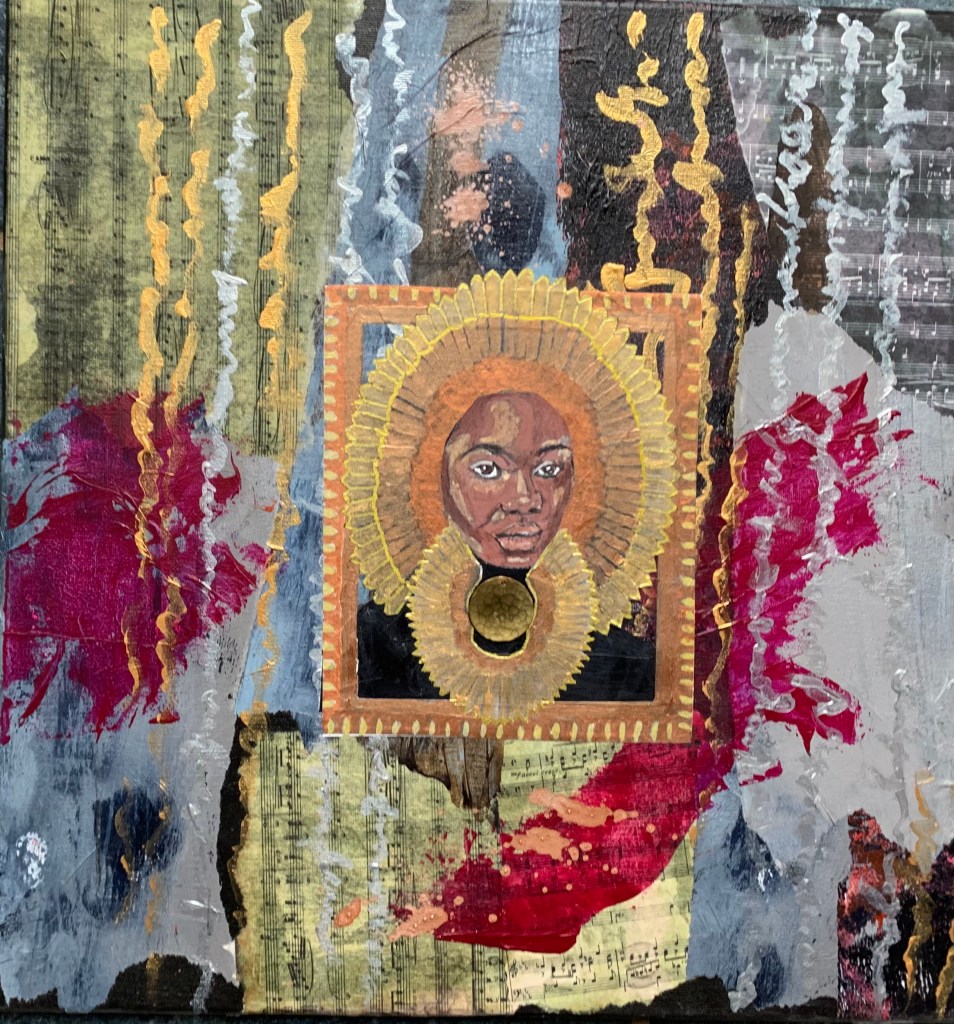
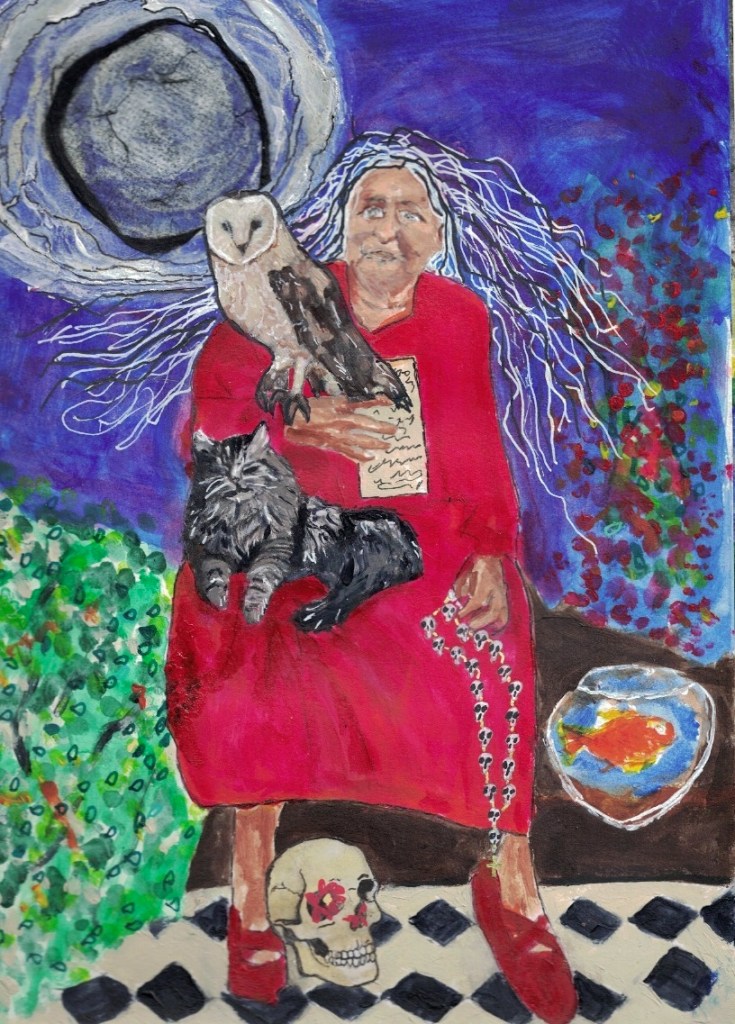
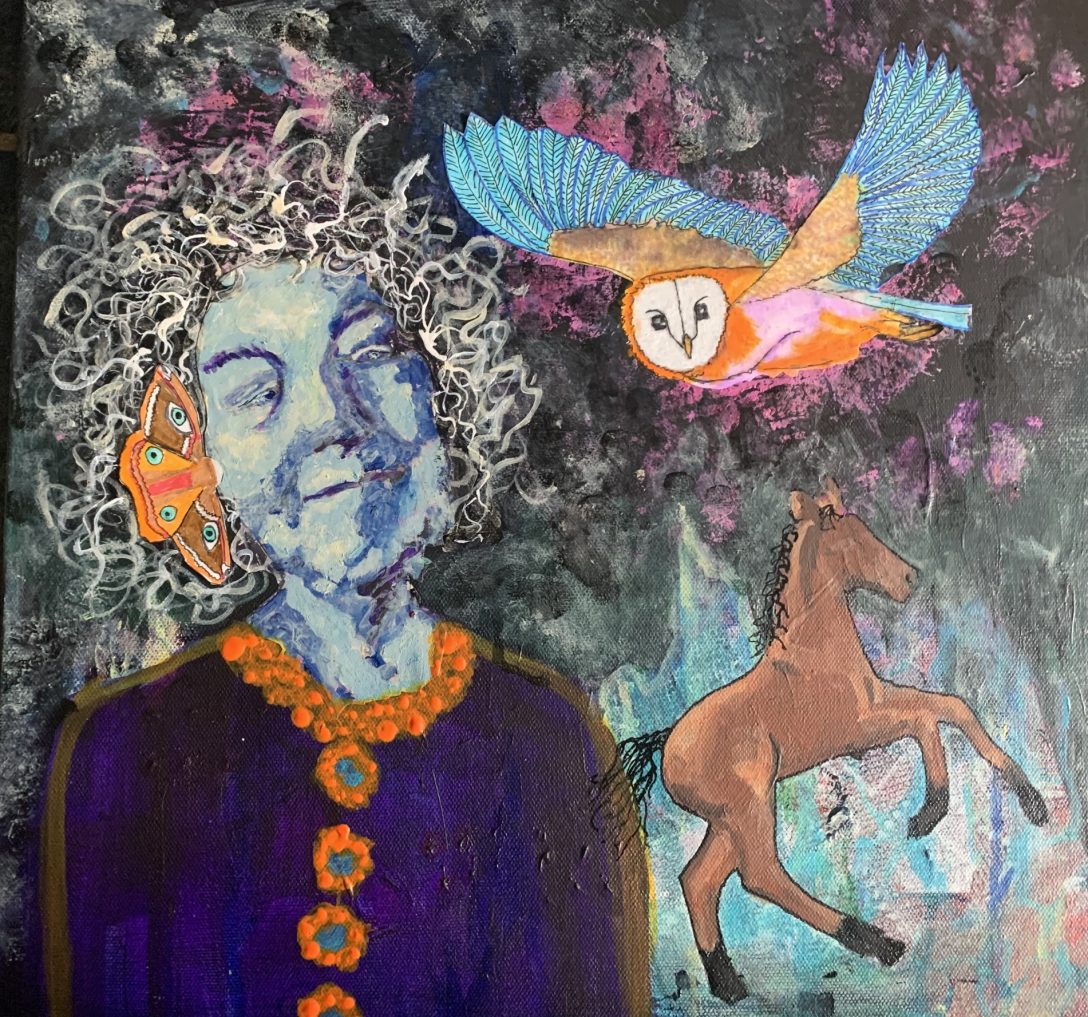
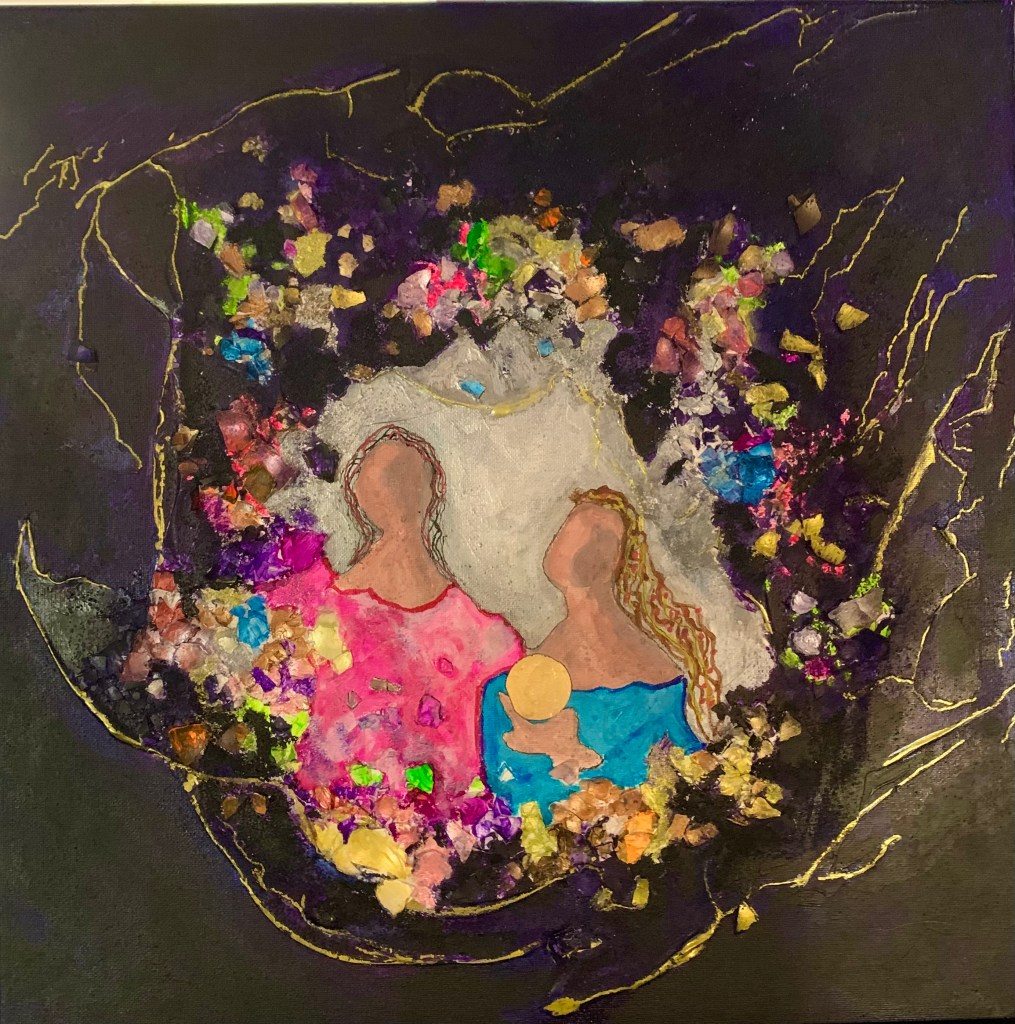
I have spent the last few months doing self-portraits in response to a prompt from my little group of artists that meet to show our works to one another and to talk about the Jungian images in them. Interestingly, the view of myself differed depending upon the day and the mood, the leaning of my mind, and the tendency of my heart. The first one (the one above) is the inner self, the song in the heart of stones, the twin aspects of conscious and unconscious in friendship.
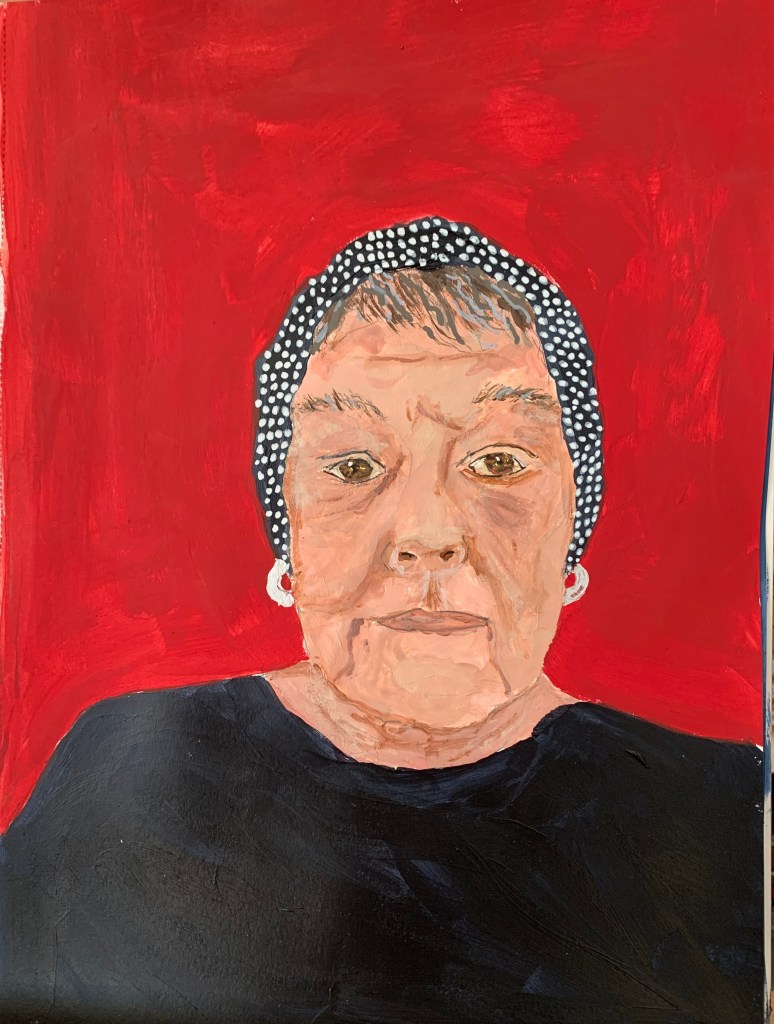
The second one is one with a life-model–me in a mirror, the only live thing in my house other than my cat Francis. While I was painting, I was concerned about the shapes I saw in my face and where the light was coming from. I wasn’t lamenting a sagging chin or the deepening nasal-labial lines. It led me to laugh about what had I been so concerned about: now my face is, well..my face. I kind of like it.
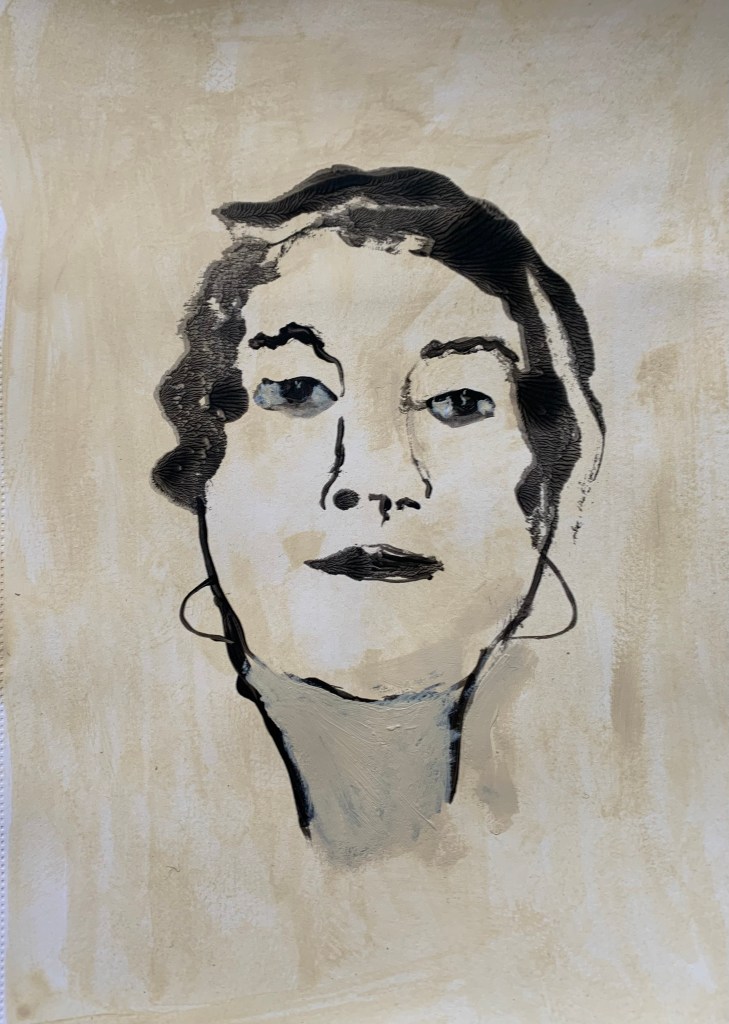
This one, a transfer from a painting on acetate, has a kind of dreamy feel to it. She reminds me of my grandmother and my Nowakowski kin. When I squint my eyes at the image in the page, I can almost hear my Uma’s powerful contralto voice unfurling like a moonflower, calling our Northwood neighborhood in to sleep to the phrases of Brahm’s Lullaby.
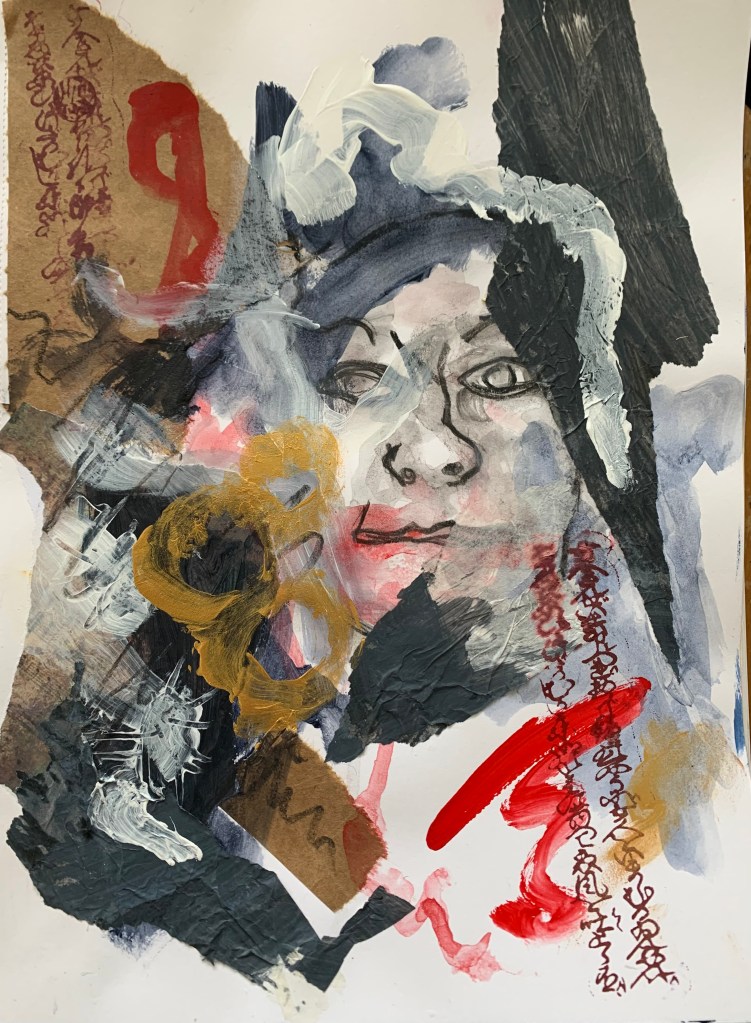
This is me falling apart. I do it often. I must have just watched the news before painting this one. I think it must have been particularly bad that day, but, really there are so many.
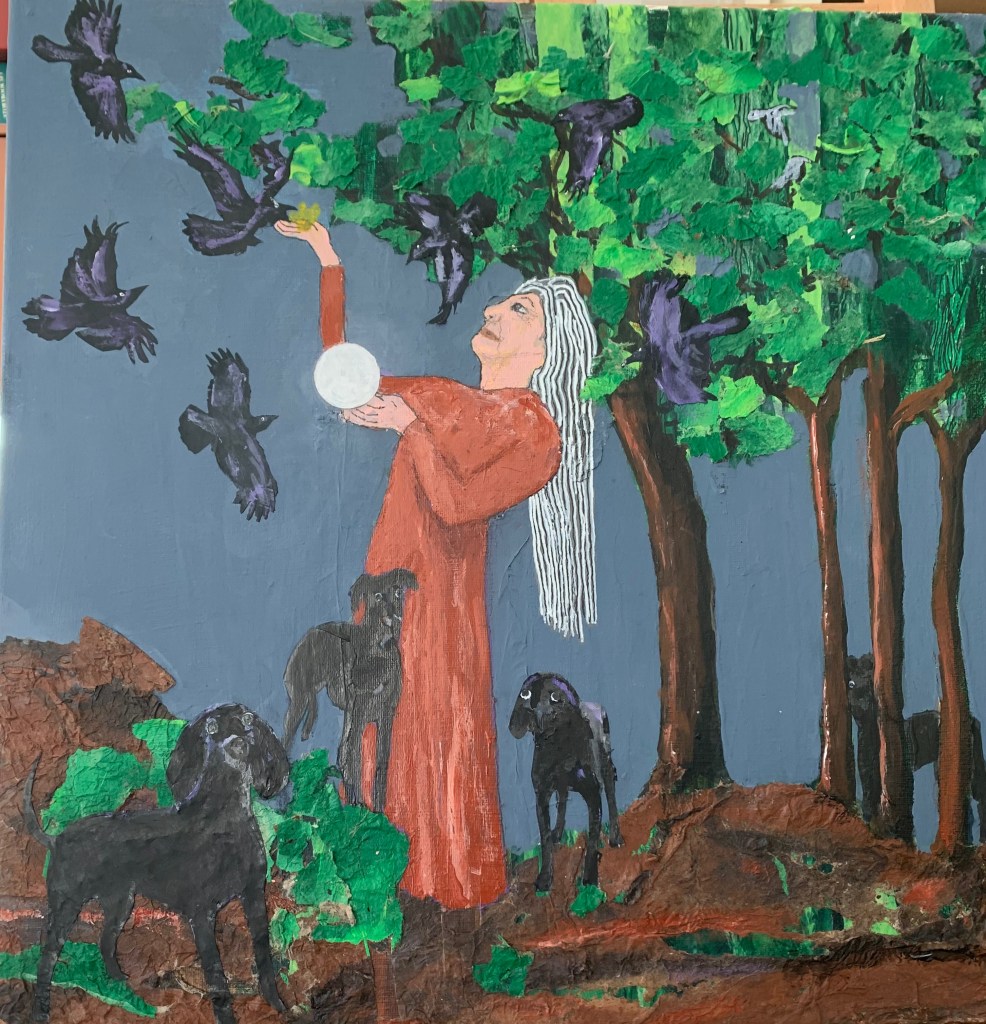
This final one is a painting not of me but of the archetypal energy that I am channeling in this stage of my living: The Crone. Also known as Hecate or the third stage of the moon’s triple goddess, the Crone hangs out with her crows and black dogs to bring an intense magic to the world touched by women of my age who know so much but also know that they know so little in the vast ocean of mystery.
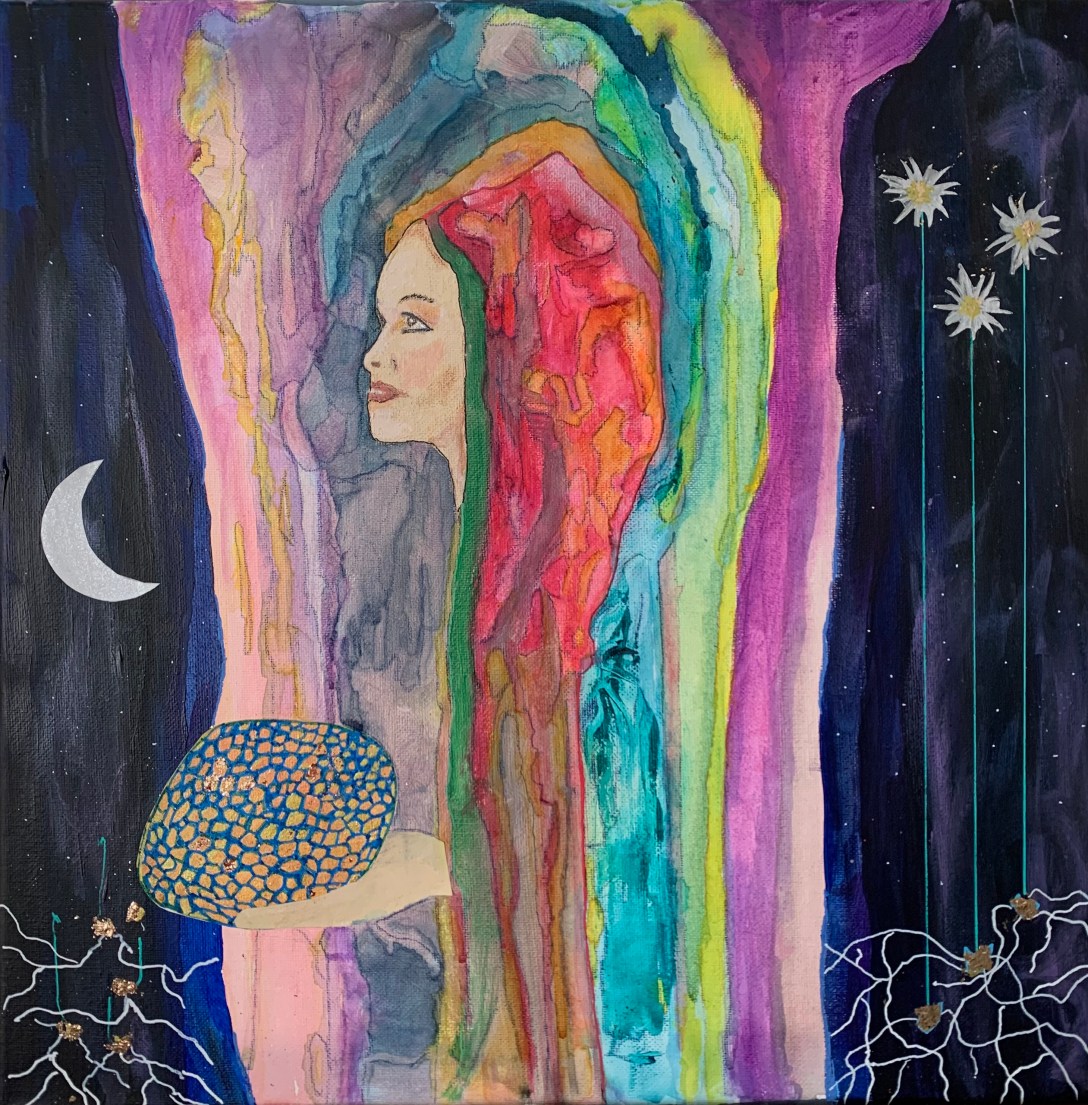
Advent: From Darkness to Light: The Journey of Creation

‘Tis the season…of darkness and waiting but not of desolation. There is a richness in this darkness which gestates the brightness of hope. This painting is about planting seeds of love deep in the earth to rise into the heaven to become stars that light the path to the archetype of the Divine Child, Jesus, yes, but also new life in all its forms, the creative sparks from the unconscious that implant in the womb of mind to become a painting, a poem, a new idea, a vision of peace.

The Black Madonna Series

Dark Madonna

She knows in whose boredom the sun sleeps.
She studies space, fixes images in their absence,
hangs portraits the masters never saw
in their crafty light. Interrupts the talk
of dragonflies attending all creation.
She is the holder of pain, the unmoved target.

I wonder who this woman is
who moves as separately as silence,
who pauses to applaud a renegade dogwood,
red in still-green autumn, understands
the bloody revolution of ticking clocks,
the second-hand arrows that pierce
the flesh but leave it whole.

I hear her coming. She whispers between
the folds
of perception:
you will believe:
there is nothing left

but love.
-Kitty Yanson

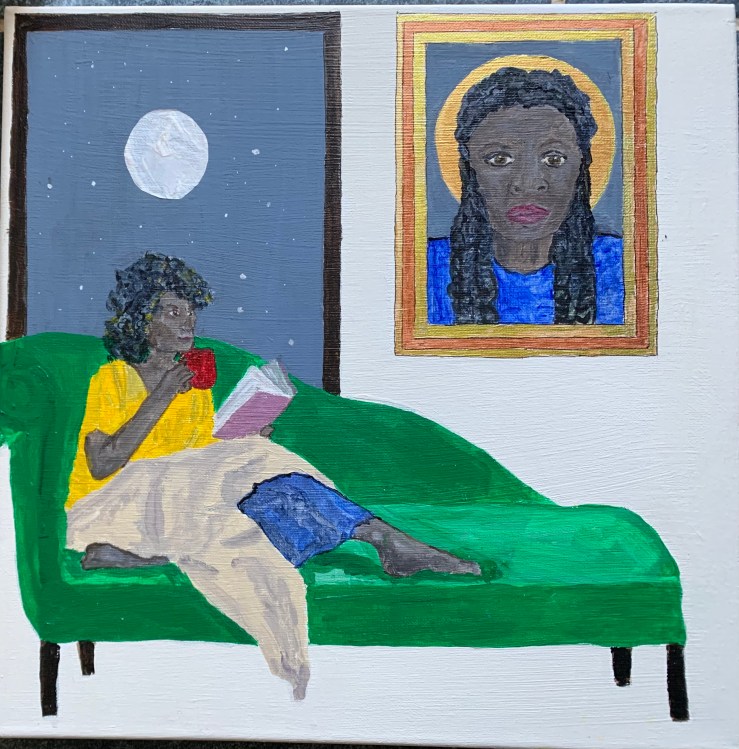
I first became acquainted with the Black Madonna sometime in the early 1980s after getting sober, after my divorce, when I was trying to get through depressive episodes without the liquid medication I had used to try to treat them. First, it was a picture of Our Lady of Czestochowa in my ancestral Poland which drew me toward her, then I searched out others, the Dark Madonnas of Spain, and the one enthroned in Chartres Cathedral. Eventually, I found that she was indeed an archetypal presence in the psyche, a sister of the Hindu Kali, the apocryphal Lilith, and the Egyptian Isis. In all of these forms, she embodies the union of opposites: life and death, spirit and matter, the conscious and the unconscious, body and soul. For me back then, she was the hope I had for healing and wholeness, and so she remains with me today, as I continue to find new ways to create while my body, beginning its 77th year this week, reminds me with a new ache every morning that mortality is destiny, a part of life. This image of this Great Mother, both womb and tomb, comforts me, sings me awake and to sleep in endless cycle of God. These three paintings are my way of exploring her great truth without words.

This Is What Community Looks Like

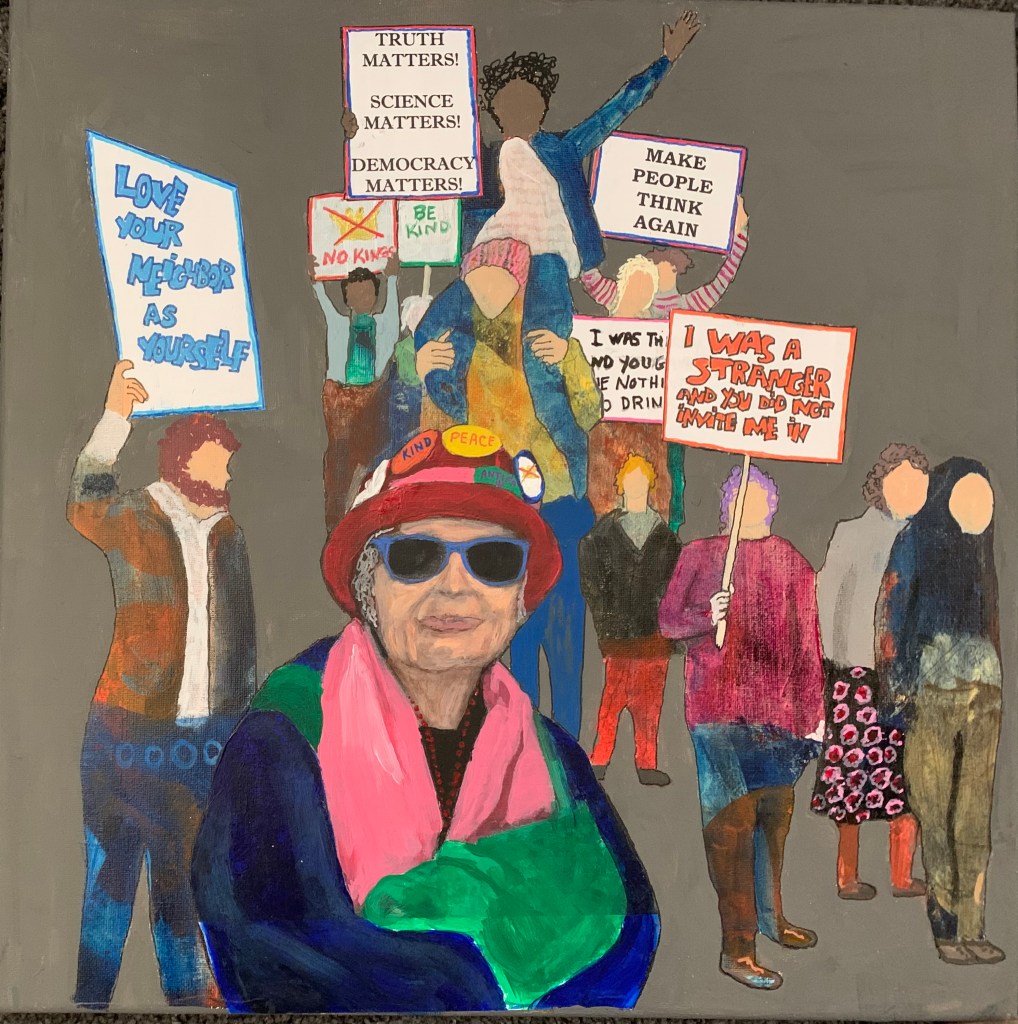
I had been feeling so helpless and alone before the No Kings Rally where I saw so many people who also feel that we are going in the wrong direction in America. The method I used in this painting is called negative space painting. Out of a chaos of color on the canvas, I found people hanging out together and painting a grey background around them, then adding details to define the them, capped off with a lady from my generation. Something tells me that I knew her from the 1960s!

Kairos

It swells like a bubble blown by breathing time:
You are stroking the cat on your lap
and suddenly know that this is Love
and together you are in a boundless world
the confines of the clock had kept you from.
The cat gets up and stretches.
You eat your breakfast.

Or you are on your morning walk,
and Eddie’s dark face illuminates your route
with “good morning” from his wheelchair
where he sits cheering on the accelerating sun.
You say good morning back,
and check the heart rate on your watch.

Or you see the image of Our Lady on the wall,
standing on a crescent moon with stars
around her head. She becomes a doorway
that opens just a crack to flash the glint
of God. Then a draft of time slams it shut,
leaving longing to stand eloquent
as an angel with a flaming sword
barring the entrance to Eden.

The decision now is yours:
Believe each moment is a hiccup,
hallucination, or errant imagining that
has nothing to do with the redundant daily?
Or maybe it is the Life living in life:
an invitation to Truth
that you never but always knew.

The Triple Goddess

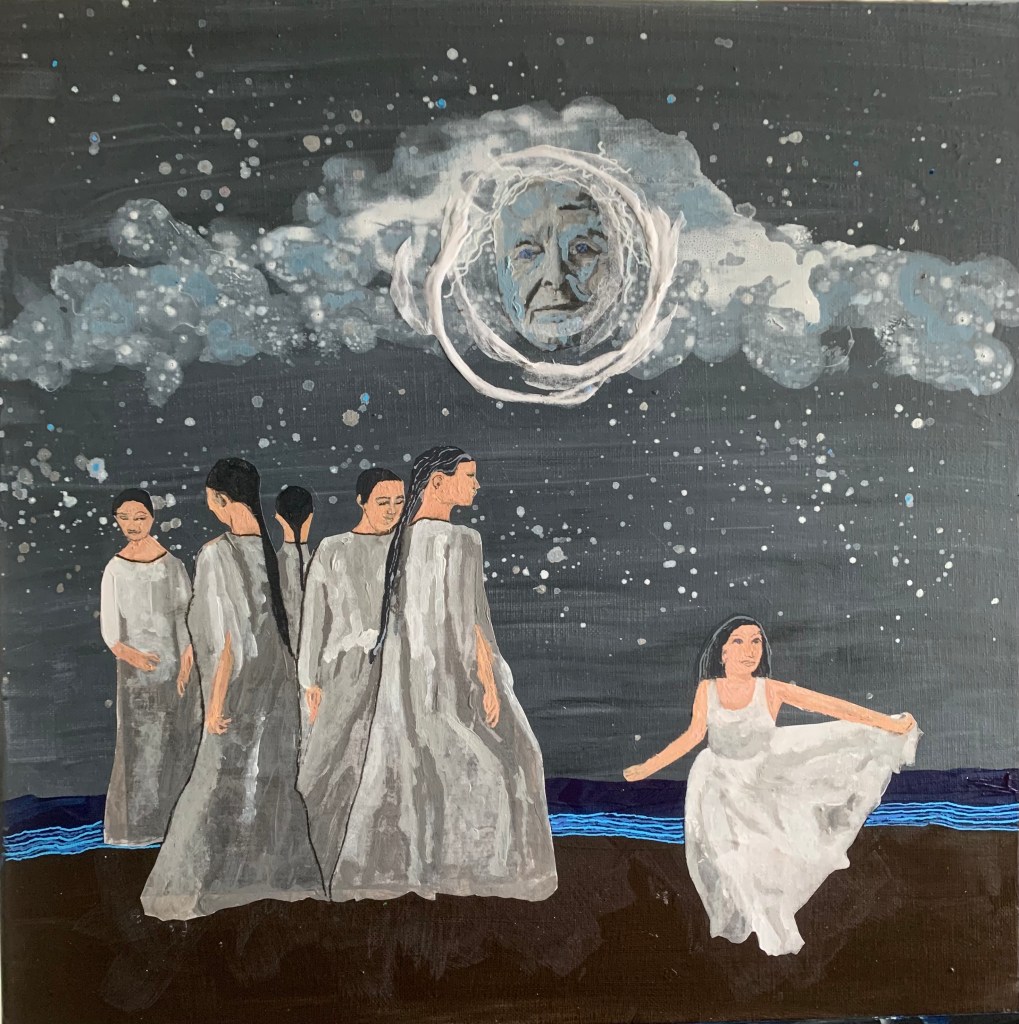
Many of you may know, but the moon in mythology was seen as an embodimet of the triple goddess, a reflection of the life of women in three-fold–maidenhood (Kore), the mature woman of child-bearing age (Selene), and the old aged Crone (Hecate). In this painting, the middle goddess is pictured as five women, reflecting the long adulthood that felt like many stages to traverse. The final stage, pictured as the moon is Hecate, the prototype of the Witch, the Enchanter, the Caster of spells. I am well into the Crone archetype myself and thinking about the power in this stage to enchant my world with meaning under a light that may be dimmer, but beautiful in its own right.

Hagia Sophia at Table with Tea, Bread, and Julian’s Hazelnuts

Hagia Sophia is often seen as the feminine of God; Lady Wisdom is how I’ve come to know her in my own spiritual path, a friend who has stuck by me whether I wanted her to or not in the moment. In this painting she invites us to tea and has included hazelnuts; I am often overwhelmed by the immensity of God in this incomprehensible universe. Julian of Norwich in her mystical text speaks to this. She reminds me in my hazelnut smallness that Love in its hugeness has a place for me as well:

“And in this he showed me a little thing, the quantity of a hazel nut, lying in the palm of my hand, as it seemed. And it was as round as any ball. I looked upon it with the eye of my understanding, and thought, ‘What may this be?’ And it was answered generally thus, ‘It is all that is made.’ I marveled how it might last, for I thought it might suddenly have fallen to nothing for littleness.

“And I was answered in my understanding: It lasts and ever shall, for God loves it. And so have all things their beginning by the love of God. In this little thing I saw three properties. The first is that God made it. The second that God loves it. And the third, that God keeps it.

“But what is this to me? Truly, the Creator, the Keeper, the Lover. For until I am substantially “oned” to him, I may never have full rest nor true bliss. That is to say, until I be so fastened to him that there is nothing that is made between my God and me. This little thing which is created seemed to me as if it could have fallen into nothing because of its littleness. We need to have knowledge of this, so that we may delight in despising as nothing everything created, so as to love and have uncreated God. For this is the reason why our hearts and souls are not in perfect ease, because here we seek rest in this thing which is so little, in which there is no rest, and we do not know our God who is almighty, all wise and all good, for he is true rest. God wishes to be known, and it pleases him that we should rest in him; for everything which is beneath him is not sufficient for us. And this is the reason why no soul is at rest until it has despised as nothing all things which are created. When it by its will has become nothing for love, to have him who is everything, then is it able to receive spiritual rest.” (1st Revelation)

Home

Sometimes doing art is a kind of healing. This painting, in particular, began with a memory of a moment many, many years ago, my earliest memory, I think. My not-yet-huge family was standing on a hill watching an itinerant carnival spinning a ferris wheel and merry-go-round on a lot in Northwood. A very small me, little more than a toddler, was circling my father, round and round, my hand self-tethered to his knees. But when I looked up, my father’s face wasn’t there. A strange man stared down at me. Of course, I was terrified by my father’s seeming disappearance. It was a momentary separation, but one that carved a missingness that has lived all these years in me.

During my meditation practice recently, I saw the idea of this painting: What if I sat with God on that hill of my imagination looking at horses freed from the merry-go-round and a ferris wheel turning in the stars? What if we looked together at the missingness that lives in the center of all relationships to see there the longing for completeness as a holy quest. I think that my own father, now in heaven living in perfect love, understands this now. I feel him scooping me up to look at the stars he loved so much. “Look, Kitty, that is Orion the Hunter and that bright one in his belt is Betelgeuse, one of the great navigational stars.” It brought him home when he flew rescue missions in the South Pacific during World War II. It guides me home today.

 The Small of Big

There is a big God out there
counting the stars as they pass
through the gate to universal pastures,
feeding each its eon-ration of cloudy nebulae.

I am, I am told, a distant relative of stars,
a supernova memory
in its death-belch of hydrogen and dust,
heaven’s indigestion hardened into clay.

I am a quantum in creation,
a second in divine expression,
as brief as the urge to blink,
wee as a fruit-fly’s toe,
smaller than just a thought
and justly as large.

There is a little God too
(the same one, actually)
who dances with mockingbirds
on the hot asphalt lots,
who summons tiny suns from mosses
growing between paving stones,
who dares into play the stuttering desires
for rebirth and destruction.

This little God has a big job too
shepherding stars and children,
small in stature, large in being,
across the quadrants of our park
constructing the contagion of laughter
under our earth-shining moon,
to entangle us with hope.

-Kitty Yanson

Painting the Dames

This month has brought images in my sketchbook–paintings of the ladies who live with me in the little world of my head and heart. The first began using a Chagall portrait as my inspiration. My black cat Francis (who is growing purple with age and irritation) sat next to her, then a goldfish plopped in a bowl. I call this woman Lady C for Lady Creativity.

Then I had a dream that above a Gothic doorway was inscribed “Vocatus atque non vocatus Deus aderit” (Called or uncalled, God will be present), the inscription that C.G. Jung had above the doorway to his home and the office where he saw his patients. So Lady Creativity in the next painting stormed that door, mirroring my daily prayer that I borrowed from Darius Bashar, a meditation teacher on The Artist Morning website (https://www.artistmorning.com/.

Dear God, it goes, Please use me as a vessel for your divine expression. Use me as an instrument for your love. Give me the strength to go into the depths of my heart to find my truth and the courage to speak my truth in my own authentic voice. Whatever happens from there, I let go and let God.

In his approach to meditation, Darius uses Julia Cameron’s The Artist’s Way, a book I highly recommend to all creatives to help to feed their souls.

Then, I revisited my old friend Lady Wisdom, to me both a representation of Sophia, the feminine aspect of God, and an embodiment of the Great Mother Archetype. Francis my cat and the goldfish return again, but as I was painting, I saw skulls with flowers bloom while Lady W prayed the rosary of years. She became Baba Yaga, a Slavic fairytale figure with the characteristic doubleness of all archetypes: the benevolent grandmom and the witch who lives in a hut in the forest and terrifies children (which was, perhaps, the hidden reason why I thought 70 some years was the age when I would begin to terrify my students–though some of my former would say that I started much earlier than that). So Baba Yaga is here:

Finally, I had to render another Lady W, standing before the triple trees of life, representing, perhaps, the triple lives of women: maiden, mother, and crone. She wears a cloak of spirals and the moon in her hands. Someone once told me that living was like moving up a continuous spiral up the core of ignorance; when you start up the climb, you are flat up against the core of ignorance, so you cannot see what you do not know, the bricks of the core blind you in their proximinty. But as you ascend farther up and farther away from that core, you begin to see how much you do not know, and when you get to this age, it’s a heck of a lot. But at the same time, you can see the layers of circles you have traveled, the mistakes made over and over again, the former selves that have transformed and reshaped who you are today: the lady of wisdom, of knowledge and ignorance.