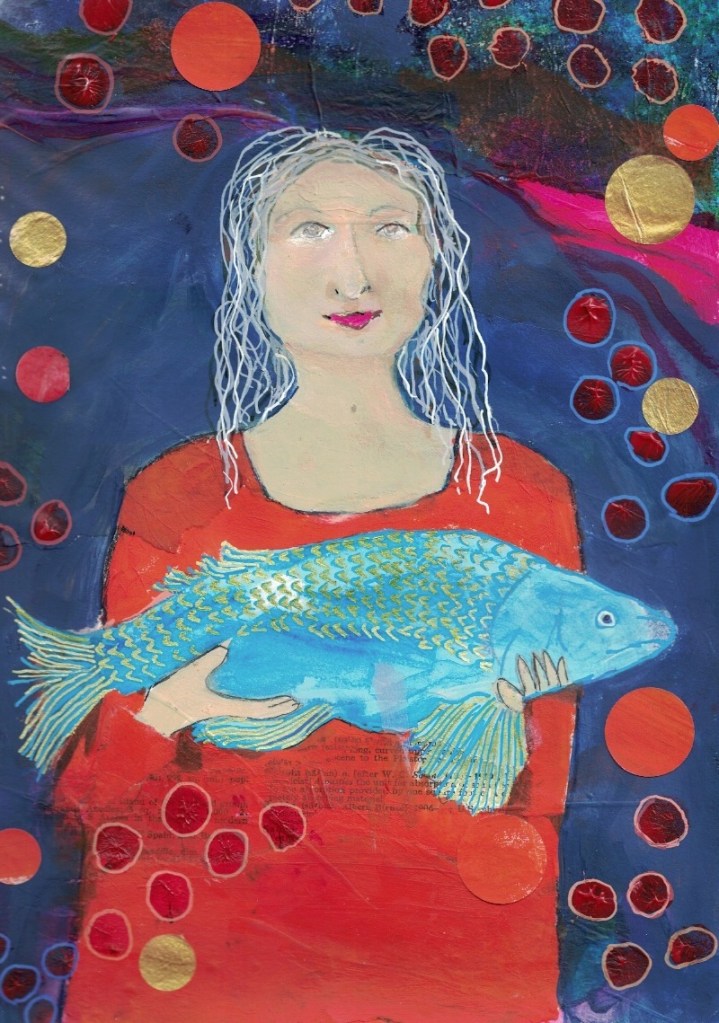
This past December I had a dream of a man standing with a very-pregnant woman. Her water breaks, and in this gushing river fish swim–many fish splashing in this prelude to birth. It was a simple dream, but one stocked with archetypal symbols and meanings of the Advent season. Then came the urge to paint in my sketch book, one image, then another. I’d go to sleep and wake up with yet another image. Another followed, then again, another. Finally, I thought I was through all the fish painting and then, in a session of unplanned intuitive art making, music notes on a piece of collage paper reminded me of a woman’s eyes. Fish Lady emerged. A fish jumped into her arms, a glorious fish with golden fins and scales. I asked her what all this was about, and she told me. This blog post is a storybook of images and lessons learned.
Yesterday, I started another painting…of a train from my childhood, the Little Engine that Could. Next to the track there is a stream. I was getting ready to pack up my paints for the day…a fish breached tissue-paper water.
Fish Lady Speaks
Fish Lady: I stand at the crossing between what you know and what you don’t. Don’t you like the gift I am bringing to you? It is a beautiful fish, at first pencil drawn then all blue, the color of the sky and the sea, all the fluidity of the outer and the inner, your daily mind in retirement that flows from one thing to the next without plan or methodology unless you are cooking a new recipe or learning a new lesson about how to paint shadows. Because the fish’s scales are gold tells that it is from God and needs to be eaten and consumed, digested and made part of your wholeness.
Me: But it is beautiful, Fish Lady! If I cook and eat it, it will be destroyed. I do not like that. I want to watch its beauty swim in my awareness.
Fish Lady: That is your need to keep things certain and in one form. But this gift allows all that beauty to go into your core, just as it is now hugged against my heart. I know that the physical act of eating no longer brings you the pleasure that it once did now that your taste buds are dull and confused, but maybe this is a call to eat of the spirit.
Me: I am aware that Jesus and fish are associated; if this is a call to buy the Jesus of religion and eat it completely, I am afraid that the bones will stick in my throat. It has always silenced me.
Fish Lady: You are stuck in the old stories and need to digest the beauty to become the beauty. The stories of Jesus you remember from childhood when he was all goodness and light even in the face of death, these are stories that float like beautiful clouds in the sky that produce the rain that becomes the sea that you find yourself in swimming with the fish that are now the gifts of mystery. Watching childhood stories, like watching the action in an aquarium, may calm but not sustain you in what you are doing now. You must slit the fish in its belly, pull out its innards, filet it, throw it into the fire, and eat it. That means finding Jesus in the missingness of taste you used to revel in, the pains in your face and joints, the cake you bring to your new neighbors, the squirrel on the back deck you fed with peanut butter, the conversation with the kid down the street who shoveled your walk who looks like a linebacker and wants to become a clothes designer, a visual, walking contradiction whose dreams you can support. You see God through curious attending to both mundanity and magnificence.
Me: And like the initial dream of the fish swimming in the water breaking before the pain of labor and the joy of birth, the work of dailiness is the catching, gutting, cooking, eating and digesting, avoiding the bones when I can. I am not sure I can.
Fish Lady: Yet you also dreamt one night of can openers. But can is not just a noun; it is a verb too. You are being invited to open your fears and have dinner…Take another look at my image. Did you notice that the only piece of collage visible still beneath the paint is the dictionary page. Dictionaries give definitions and meaning. Definition and meaning. There is more here to look for. Pay attention!
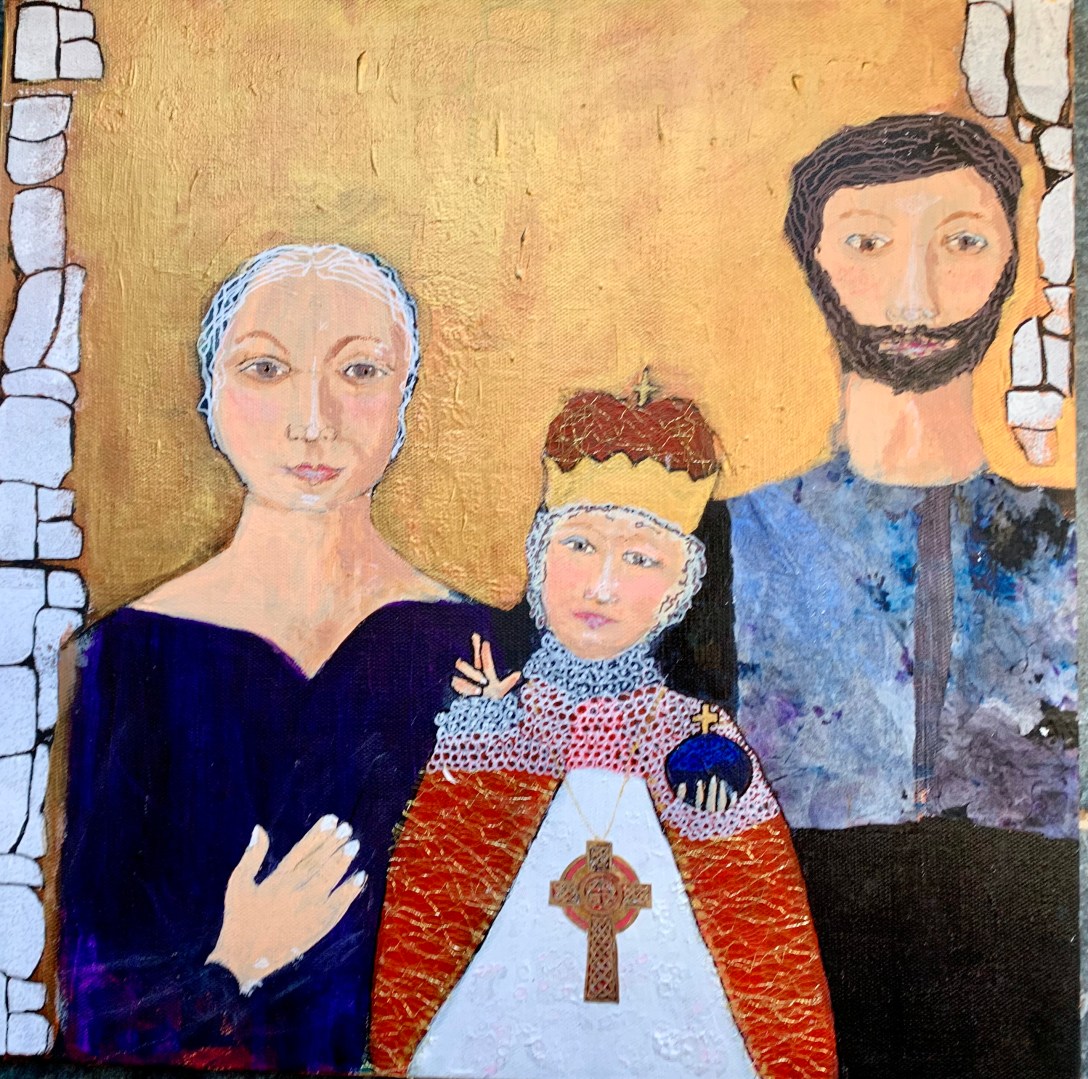
When I was a child, I used to dress and redress the body of the baby God, Infant of Prague, with satin clothes tailored to liturgical rhymes, running my fingers across the hemline rows of sequins, struggling to pull the ruched armholes around the orb of power his innocence cradled in one tiny hand. I love you, Jesus, I prayed as I returned his plaster vulnerability to the altar atop my Uma’s chest of drawers.
In the afternoon after school, I met my friends and a drafted brother or two to play Communion in the basement, bribing my bros with chocolate Jesus Necco Wafers giving the licorice ones that nobody wanted to my ex-bestie Gerry for some unremembered grievance, grabbing a bed-sheet from the laundry pile as vestment across my outlawed priestly shoulders to dole out sugar in lieu of transcendent mystery around the sweet table of childhood.
But these were stories of another time when I played with God, splashing in the shallow waters of rituals’ river, too young to swim in the deep end of faith. Now I finger the decades, counting faults and graces bead upon bead, blurring into wholeness in the rosary of my years. I dress and redress again that child of Prague, swaddling his naked holiness in satin comfort with sequins I have poorly sewn upon it, now a broken princess playing with God in second innocence repeating and repeating the ongoing ceremony of the all-along truth of love. -Kitty Yanson
The starlings in the dying oak, loud as children in a schoolyard, gather force for an evening murmuration that will clot the sky with commas. I pause to wonder at and wonder again, (though I have seen many times) this turning and turning of the dusk like the turning of the soil in spring, like the turning circles of life in this chittering world seen once, seen always, ever-changing, ever-same.
Wisdom is a pattern-finder seeing circles in straightforward time. She lives behind a veil that sometimes stirs in dark breezes to unmask our shared laughter in a sudden, spectacular sun much like when a sinner squints through the confessional grate to find a person breathing the equal air of absolution in reciprocal eclipse.
So I look for circles in these ever-turns: the world cracking open like an eggshell pouring its gold into a pink china bowl, like the empty vase’s round absence that promises tomorrow’s rose, like the eye in the great storm in the Gulf churning up our broken trust, like the unwinding white of the moonflowers dilating silence in the eyes of night.
“Our undoing is also our becoming.” -Terry Tempest Williams
Fall apart. Let yourself crash to the floor and come apart. Pick up the pieces and see an iris of an eye, a tree twig on another, a sliver of sky, a letter that looks like it could be Q: a Question, a Quandary? a Quiet? You are a puzzle you did not know you were. Find the edges first then work inward from there.
When finished, fall apart again. Pour yourself into the box of God. Shake. Slide yourself out on the ground of being. You are now a shattered crystal vase to superglue with sunsets. It will hold the roses you have just brought in from your garden overgrown with excuses. One hides a spotted lantern fly the experts say that you must kill. You smash it. It becomes the pattern of your dying– red and black scraped across the concrete pathway you no longer walk that is still cemented in your heart.
Fall apart again
You are not just a puzzle to be solved or something unwhole to be heroically healed: You are all of these and none: your breath in continuing circle: unknown to known: known to forgotten: back again repeating: always new, always old: your heart broken open to a begging world.
Once more, fall apart.
You are now a billion stars. Orion and the Pleiades have left; Wanda the Story Weaver is waiting in the wings of your experience.
The morning calls, the star, smack dab in my face. Yellow and wide, it drips across the sky like my deepest wound or a broken yolk on a pink china plate. I break my dark fast from joy today.
Today I have no mind for philosophy for dasein or ontology, interstitial sentences, prohibitory fences set up against the sun. I’d rather play with angels AWOL from their allotted choirs. They show me squirrels on the backyard electric wires, their rodent toes embracing the hum, outrunning death. Today. They show me the front-yard oak trees, fast toward and slow from acorns. They show me the counterclockwise morning glory turning in quarter circles toward the sun. One day, its bloom will bond with August light releasing all the hoarded hopes of its assent in one audacious boom of blue.
But today, I live at the center of this same sun: there is nothing I can do to make God love me more; there is nothing I can do to make God love me less.
I imagine because you walked in here through this title, because you are reading this, that even though you don’t know me, you know me. We meet in this place of words of shared longing for something we can’t quite name.
Let the finger that touches this pencil touch the eyes that read these words, gently salving your eyelids with their meanings freed and liquid. We’ll crack open the O of wonder and let the air escape for both of us to breathe. I am reaching out to you right now: can you feel me touching the face that no one knows (even you) in this bright right now?
Together we can enter through the door of our yearning the endless room of love that is built by God, the room of humanhood pooled, so frail and so full of might. Here we might embrace the world and together hold it close as one would to calm an agitated child whose limbs thrash out against fear-of-many-names like the sudden arms of lightning in an April storm.
If you do not want this, stop reading now.
But if you do, follow this line of words into silence, into the stillness of the space of our sameness. (Even though I do not know you/I do. And even though you do not know me/you do.) We live in the might of our longing and hang curtains red in open windows to dance like flames in the wind that fills our room with All with flashing wings or fire or in a quiet sun.
My first AA job forty years ago was to make coffee, hauling plastic pitchers of water to the silver coffee maker that wheezed when it got going like a bad asthma attack or dry heaves after a bad drunk. I set out the sugar packets and jars of powdered creamer filled with trans-fat that would get us eventually but maybe slower than the alcohol, the stirrers, the napkins the tin foil tart shells to serve as ash trays. We were all on the water wagon, striking up our agency a day at a time. Our lives had been paralyzed by addiction, but here we were, laughing our shared shame away in a bubbling pool of humor sweetened with the intensity of metanoia. The chalices were Styrofoam, the coffee sacramental, celebrating the shift in perspective when “I drink because of my problems” becomes “my problem is that I drink.” If I had lacked power over my addiction and needed to find a power greater than myself to recover, then sharing this communion of caffeine helped to show me how to heal.
After the meeting, we could walk outside in the evening cool and look into the sky to watch the constellations line up in different forms: There was the horse that Mac had talked of when he spoke of horses that have more sense than humans; when one of their herd was ill, the others gathered and pressed their warm bodies against it, to heal and give strength. There was Hermione the Trashcan talked about by a delicately made woman with pinch-nose glasses who spoke of taking her empty bottles to her neighbor’s trash can because she didn’t want the trash men to know how much she drank. To its right in the autumn sky was the Forest of Words which kept our minds occupied while the real healing of propinquity took place. Finally, where the Big Dipper transformed into the coffee cup in its imaginary clouds of Styrofoam pointing in the heavens to the North Star, Polaris, the navigational beacon that we could rediscover if we lost our way and kept our sight sober and true. This North Star, the power greater than ourselves, the God of our understanding that some saw in the religion of their upbringing, some saw in whatever…a doorknob, and some saw in the group.
Many an evening, our cars filed the familiar path up Charles Street to go the meeting after the meeting at the Towson Howard Johnsons, the orange-roofed HoJos that some may remember, where we cemented our friendships and dedication to the 12 steps with French fries, and hot fudge sundaes washed down with even more coffee. On the way home, I passed a familiar friend, a beautiful, old weeping willow across the street from the entrance to Sheppard Pratt Psychiatric Hospital with its fairytale stone Gate House. This willow took one’s breath in the spring when it leafed out before any of the other trees, weeping gold first, then green. It reminded me of the willow my father had planted in the backyard of our Northwood row house that that grew with the vigor that only proximity to the sewer lines could give it in its incredible thirst for water
Weeping willows are greedy flora. Their roots spread fast and far to suck up any form of water in the nearby soil. God help the homeowner who plants one in a backyard that also holds the water and sewer pipes in terra cotta pipes. Well, my father did, and after many plumber visits and roto-rooterings, he finally had to admit defeat and take the darned beautiful tree down, digging up any remaining roots that could sprout a sapling to begin its cycle of destruction all over again while it leafed out toward the sun in beauty. I loved that tree. I loved the way the hanging branches stirred in the breeze to tickle your face. I loved how you could cut a long branch and tie your brothers’ hands together, an older sister torture technique. I loved how the fully leafed curtain of withes made all the weather theatrical: the August lightening, wind whipping from the west, the curtain parting for the curtains of rain, the air thundering with anticipation, my grandmother, afraid of lightning , calling us away from the willow to go into the basement to pray the rosary until the storm passed. But I had already been struck…with wonder as this tree grew more beautiful by day, its roots sucking in the dirty bath water and stinking excrement from the sewer pipe, converting our waste into juices of life for new leaves burgeoning like our ever-expanding family, this tree, itself a meditation on living, the tree growing taller and taller with each inhalation and then raining to the ground an exhalation of branches.
Early in my sobriety, my sponsor suggested that I begin a meditation practice, I think because my mind in post-acute withdrawal was racing around in circles like clothes in the spin cycle, only with peanut butter (of course, all that coffee didn’t help). My beginning practice was sporadic; only in the last 20 years or so have I settled into a regular sitting routine. Recently, however, I have been studying the Christian mystics because I’ve come to understand that this longing for something, for something more that I have felt all my life is really a longing for God. One practice is that of Centering Prayer, a method of contemplation named and popularized by the late Trappist monk and priest, Thomas Keating. In this, the prayer is instructed to choose a word meaningful to them to repeat as an anchor, much like a mantra or breath counting in Zazen, to help still the mind enough to hear the breath of God in the inward ear. I am particularly fond of the way James Finley in the podcast Turning to the Mystics describes the use of the word: look at the birds, he says, the eagles, vultures, even gulls that ride motionlessly upon the pillars of heat that rise from the earth called thermals.
They just fly. And then every so often, as they lose a little altitude, they flap their wings a few times. So, you’re sitting in this presence, and you realize there’s distractions. And so, you say “Jesus, Jesus, Jesus[your word],” like you flap your wings a few times to maintain altitude, but you’re really trying to use the word to get beyond all words. And I think it comes full circle. We use the word to get beyond words to discover the holiness of words, how God’s present, and the way we talk to each other and so forth. (Finley)
The word I chose is Bethesda.
There is a story that many, many years ago, an angel came to Jerusalem. Where its heel struck the ground, a fountain sprang and the pool that formed from it healed all those who bathed in it. This healing pool became know as Bethesda a name that means House of Mercy or House of Grace for the healing that occurred. Yet the place also became called the Place of Shame or Disgrace for the people who hung out at the pool, all suffering the shame and disgrace of disease-wracked bodies, a multi-denominational leper colony, so to speak, unspeakingly shouting, “Unclean! Unclean!” to those who came near.
But this is just the kind of place that always attracts Jesus. Traveling to Jerusalem for some sabbath or another, Jesus passes the crowd of those waiting by the pool, waiting for the angel to stir the waters, waiting to be the first in the pool and get healed. He sees a man who had been paralyzed for thirty-eight years. Jesus asks him if he wants to get well, and the man answers that he has no one to help him into the healing waters. Jesus then tells him to take up his mat and walk. Which he does. And is healed. Later Jesus tells the guy to go and sin no more so he doesn’t have worse things happen to him. Of course, no good gesture ever goes unpunished, and our man J catches grief for healing on the sabbath and the healed guy also is hassled for working on the sabbath by carrying his mat. Apparently, there were legal hair-splitters then too who enforced the old Blue Laws in Jerusalem (am I dating myself talking about Blue Laws when one couldn’t buy or sell stuff on Sundays?).
But the part of the story that interests me is the answer that Jesus gets when he asks the man, do you want to get well. The guy says that there is nobody to get his ass into the water. Jesus ignores his declared lack of agency and tells him YOU get up off the mat and walk as if he is making the man aware that the healing is already hiding within him. No one can do it for him. But someone can do it with him by reminding him of who he truly is, or, as the Zen koan suggests, showing the man his original face before he was born, his Buddha nature, his child of God-ness. I think the man sees this in Jesus’ face. So the man, made pliant as a willow by his thirty-eight years of suffering, chooses to take up his mat and to walk into his life.
That’s kind of the way healing worked for me in AA. I got sober at a meeting place called Agape that was held in an old classroom out-building on the grounds of the motherhouse for the School Sisters of Notre Dame. I met the woman who had answered the phone at AA, and we walked into the building with the words Alcoholics Anonymous shamelessly painted on the wall with an arrow pointing to the two rooms where the meetings were held. To me, that sign could have read, Disgusting People’s Entrance or Weird Wackos’ Cattle Call, so great was my apprehension. But after a few meetings, I took my last drink and I picked up my metaphorical mat and walked (well, drove, actually, in a falling-apart Honda) to more meetings where the folks there showed me that there was a true self beyond the person who drank and got drunk, whose life was filled with the waste and whose marriage was crumbling. And I picked up my agency by not picking up a first drink. A few meetings later, someone asked if I would help make the coffee.
That angel who stirred the waters in Jerusalem, the Bethesda Angel has a central place in Tony Kushner’s Angels in America, a play set during the AIDS scourge in the 1980s gay community in New York. It’s an extraordinary commentary on disease and healing, grace and shame, paralysis and agency, as the protagonist Prior Walter discovers the lesions that herald the infection and loses his lover and his belief in certainty. An Angel, hallucinatory or not, crashes through his ceiling at the end of the first play to tell him that he is called to be the prophet of paralysis, of stasis of the way things used to be even though they are crumbling in decay. God has walked out on them and taken the force of Creation with him. In the end, Prior, refuses this role by becoming, instead, the herald of creative energy, by declaring desire to the Angels of Immobility sitting in a derelict heaven. “We just can’t stop. We’re not rocks—progress, migration, motion is modernity. It’s animate, it’s what living things do. We desire. Even if all we desire is stillness, it’s still desire for. Even if we go faster than we should. We can’t wait” (Kushner 264). And Prior takes up his desire and walks into the final scene of the play, set five years later at the Bethesda statue of the Angel of the Waters. He and his friends, all of whose character arcs reveal healing and action and transformation, talk about Peristroika, the fall of the Soviet state and the thaw of the cold war into a spring of uncertainty. Prior, leaves their conversation to deliver his final words to the audience: “The world only spins forward. We will be citizens. The time has come. Bye now. You are fabulous creatures, each and every one. And I bless you: More life. The Great Work Begins” (Kushner 280). And the four walk up the stairs from the fountain. In the excellent HBO adaptation of the play (starring the likes of Meryl Streep, Al Pacino, and Emma Thompson in multiple roles), one hears their animated conversation into the fade-out. But in the movie remake that lives in my head, I imagine them drinking coffee from white Styrofoam cups.
The year I got sober was 1983, and as I’ve said before, my life was a mess, as was my marriage. I was running to AA meetings as many times as I could and reconciling and re-reconciling with my husband, moving out, moving in. During the summer of that year, we decided that I would move back into the big cedar-shake house that we had been living in and try again. Ten days after, he told me that he just didn’t think he could do it, and we decided that we would remain together through the summer and then get legally separated. I am not going to get into why we broke up because I’ve found that most relationship ruptures are overdetermined in causality and much too complicated to explain simply, and now I count my ex-husband as a dear friend. Yet there I was for the rest of that summer, mourning the end of the marriage while living it still together and mourning the end of dependence on alcohol.
The backyard of that house had a spot in it where the drainage was just terrible. Every time it rained, one could feel the lawn get soft and spongy making the squishing, sucking sound where your tennis shoe hit the grass. For years I had suggested that we plant a weeping willow there because that area was a place so soggy a willow could weep for joy in it. But that summer, my husband suggested we do it then, the summer we were splitting up, and I found myself sinking into an emotional morass: planting a tree is about the future and for him and me, there seemed none, so we never planted that tree. But I did. Inside.
We all have inner worlds, landscapes that we have built and gardened, a place to go where the soul can breathe and rest especially when the world is unraveling which it always seems to be doing a lot of now. This inner space is a place for stillness and reflection to pull back into awareness with the massive help of faith that things come apart so that they can be put together anew. Like the constellations in the night changing shapes and meanings. Like the seeming death in winter. Like the creation of new metaphor from cliches that lie around in one’s writing, worn out and drained of energy. Inside in my imagination I built a house of light to live in a towering a-frame with two storied windows that rise to a peak piercing the sun that warmed the slate tiles of its living room. There I watched the sun rise and fall and the stars at night. One day I found a high ladder and climbed to the top to pour translucent paints down the window’s face. Red and blue and gold and green washes of tear-like color. My inner living room became glass stained with the palette of the earth and sky: sea and forest and sun and moon. I have lived in that house for many years now, and just outside my inner house of light, I planted a weeping willow that has been nourished by the things that have hurt me, the shame and guilts that I have brought to this ground. It lives next to my Bethesda pool, the lake of forgiveness, that deep reservoir for compassion that living has carved into my heart.
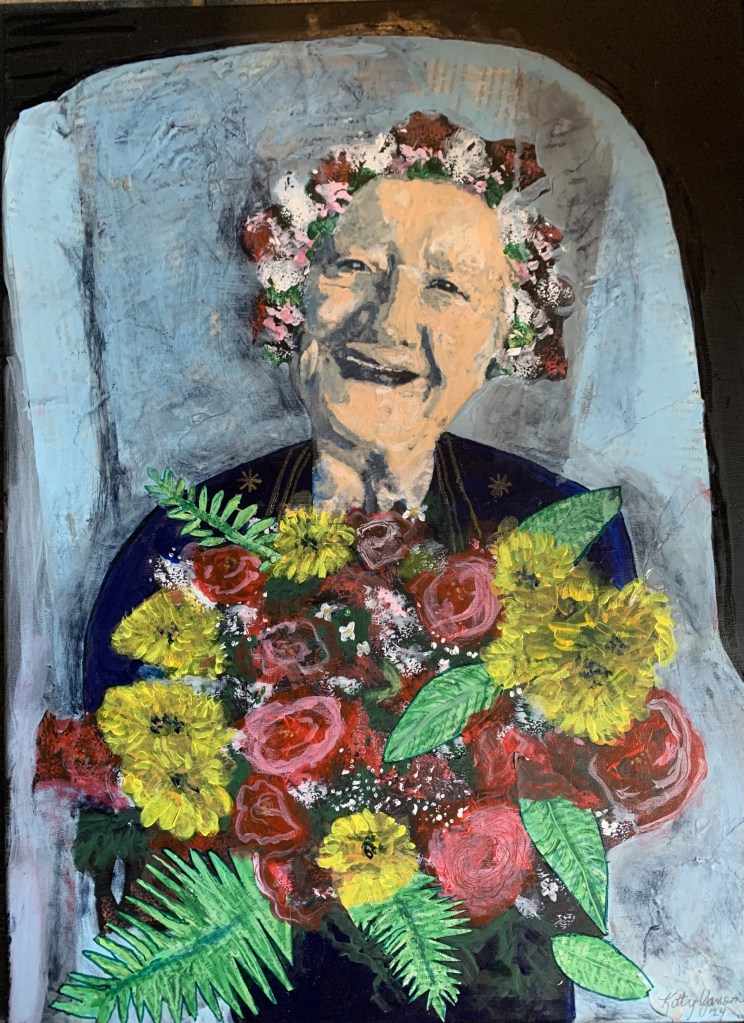
Lady Wisdom sometimes visits me there, more often nowadays because both of us have old bones that slow us down, especially when it rains. She has become a good friend, and we chuckle at my younger self who wrote her off as a silly old lady. That’s the way the young are, she tells me, but she knows I loved her even then. Some days we just sit in silence weeping for the latest school shooting or the latest civil injustice or my latest blindness to another person’s pain or my own loneliness. But most days we weep with this beauty of the healing cycle and the gift of the waters as we sit quietly drinking coffee from Styrofoam cups, watching sunsets through the willow’s rain. I say the word Bethesda, my wings awaken, and I am once again borne upon the warm pillars of love rising from people of the earth and the God who lives in the love we share.
The angel stirs the waters here for everyone.
All are welcome. Bring your bathing suits: Coffee will be served: The Great Work Begins. -Kitty Yanson 7/20/22
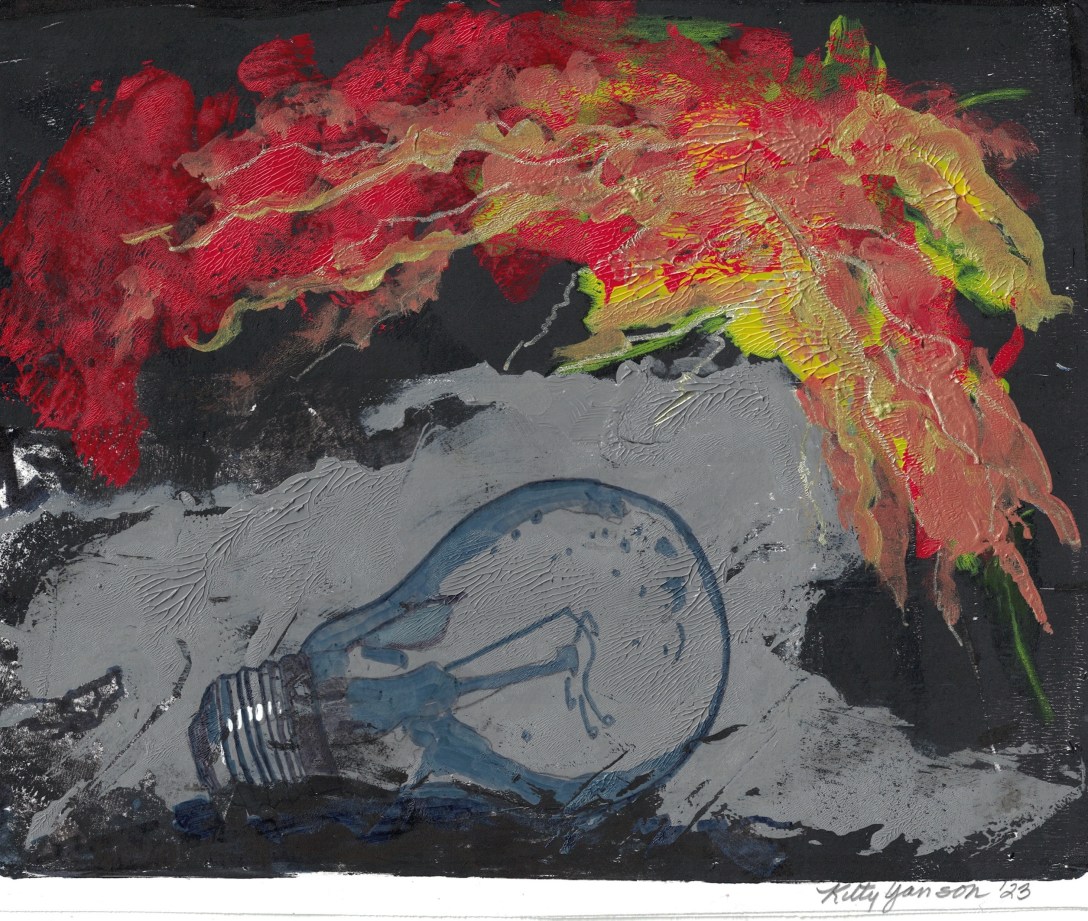
“…Divinity is found in the current that generates the light and not the container of the light….No one I know collects light bulbs after the luminous capacity has left them. We are briefly illumed, and then what is left is the glass receptacle not light.”
-James Hollis. The Broken Mirror: Refracted Visions of Ourselves
A pyracantha bush, burning, by the side of the road, collects in its thorny, painful love, tossed liquor bottles and cellophane wrappers tucked together with incendiary berries like the abandoned resolutions of not-quite-evil sinners. No wonder God gave Moses two stone tablets; it takes a hard head or downright idolatry to break them. Poor calf, shining in the valley like investment accounts in a bull market. Va vitello d’oro!
Or the Old Man River Deity on the Sistine ceiling touching Adam’s outstretched finger, a guy after a guy’s own heart. Yup, you’ll follow Him through the just-cleaned kitchen and litter it with stinky sports clothes and bloody Crusader armor. But he kisses you on the cheek and says he loves you! All is forgiven. Why aren’t there any kitchen lady gods? No Santa jolly either, He, without the toys and Christmas lights unless we include the burning bushes of underwatered pines, the too-dry catastrophic tinder.
And why do we never see a God who laughs? I’m not saying a slapstick guffaw; that would be mean. But maybe a raucous hoot while rocking a hip-hop tukus or conga line kick at a Pascal celebration. God must have a sense of humor, you know, to put up with the rest of us. I mean what does He do when we do the equivalent of peeing on the floor behind the bookcase because the ants need watering?
But seriously now, it’s more convenient to believe in the skinny one who hangs upon the cross than the skinny one we see on Calvert Street with his sign that reads: Homeless Vet, Hungry, with hand outstretched whom we choose to believe …or not.
Yet no one pictures a female God. Her sense is touch. We feel her deep down in subtle skin below our skin, Hidden in the unlit corners of souls. She is the heartbeat that trained your heart to beat, The unmet longing that threads your pulses, a string of perpetual beads, of never-ending feeding. She rocked us into breathing, then retired to the primitive good that lives in ancient parts of the brain, the body’s memory, escaping awareness through cracks in useless concepts. She calls us to love as she did in the early tales of loving, even when we act like an ass and sin. I imagine that she covers her nonexistent mouth with a nonexistent hand to keep from laughing. But, anyway, we hear.
It’s time to ditch the stash of burned-out light bulbs, and look for God in other places: in the jagged fissure of a broken heart, in the untold stories of a dark night’s stars in the purple halleluiah of the Lenten Rose. If Rumi is right, that what you seek seeks you, be still. Wait to be caught. Wait for God to sneak in secretly Between, perhaps, two mundane moments. Or maybe wait for the shock of God, a jolting bolt of love to run joyfully amok through the firing filaments of your longing.
Prologue: This began with a dream: I am teaching a class in a sunken atrium-like classroom. On the way to class I think that I will assign a research project: what is the most important book ever written? When I get there, however, I assign a group research project: what is most important in life? The class breaks into two groups: one says water, and the other says wisdom.
It was clear to me that I should invite Lady Wisdom to speak.
I. I’ve known you. I’ve watched you consume a library book by book, as if it were a pound of chocolates to savor all alone, licking each melted passage off the roof of your mind. You danced with each new idea until its shoes wore out and it clanged back onto its flat metal home. New partners always awaited your curtsy and admiration for a well-argued waltz, a syllogistic samba, a polka for persuasion, a non-fallacious foxtrot, or even the a priori bunny hop hop hop on to the next one. Knowledge is power, you thought, over what you never were sure. Real power, you found out, was not getting what you wanted but getting what you wanted that you had not known you wanted. And there you saw me: The step beyond. The perspective of wait.
II. I am the pattern seer, staring at disparity until I see its sameness, like your forehead’s wide span of skin curling in a wrinkle, given time. Love has a billion forms, each one unique, as does hate and courage and fear and all things human, but I see chords and echoes everywhere in the meter of beating hearts. Listen to the lives of uncountable souls, all taking one breath, then another and another and hear the rhyme of living: people are a boundless poem– neither sonnet nor sestina–pulsing meaning in the rhythm with the kindling stroke of love. In images of un-love even, the daily news, love throbs on, made loud and louder by its absence, the volta between octave and sestet, the midline’s caesura, the stanza break, the punctuation in the verse of being human, created by a poet God.
III. I speak this poem by heart. It is the way to the gem in the lotos, distilled by age and the concentrated sun of close inspection that burns off fluff, excuses, broken resolutions, a crystal rendered from sleep, from loss, from the unbearable borne, hard-pressed by the weight of waiting: Bright diamond! Hagia Sophia! I am not the source or word or spirit. I am she with whom they sit, prudent and still as a mountain.
If you would see me, build a home for your soul of light and glass, warm the stones of your suffering with meaning, attend the stars when you wake at night’s center, find a face for me in your teachers and elders, then look in your mirror. I will be there with your books and your darkness, admiring the fugitive beauty of purple chrysanthemums and the faces of children against a blue morning sky.
-Kitty Yanson 1/2022
To the reader: Thank you for taking the time to read what I have been writing (and now painting). Your time is a generosity! If you are so inclined, I invite you to follow this blog and to comment on what is here. When I was teaching creative writing at Mercy High School, we would read one another’s works and comment on them. A reader’s reactions are the most valuable guide for improvement, and I would value any of yours about content or technique or its affect on you. Even if you hated this piece, knowing why you hated it would help me a lot. So blessings, all!
May you be happy and know the root of happiness. May you be free of suffering and the root of suffering. May you dwell in peace.







 Memorizing the Laws of Gravity