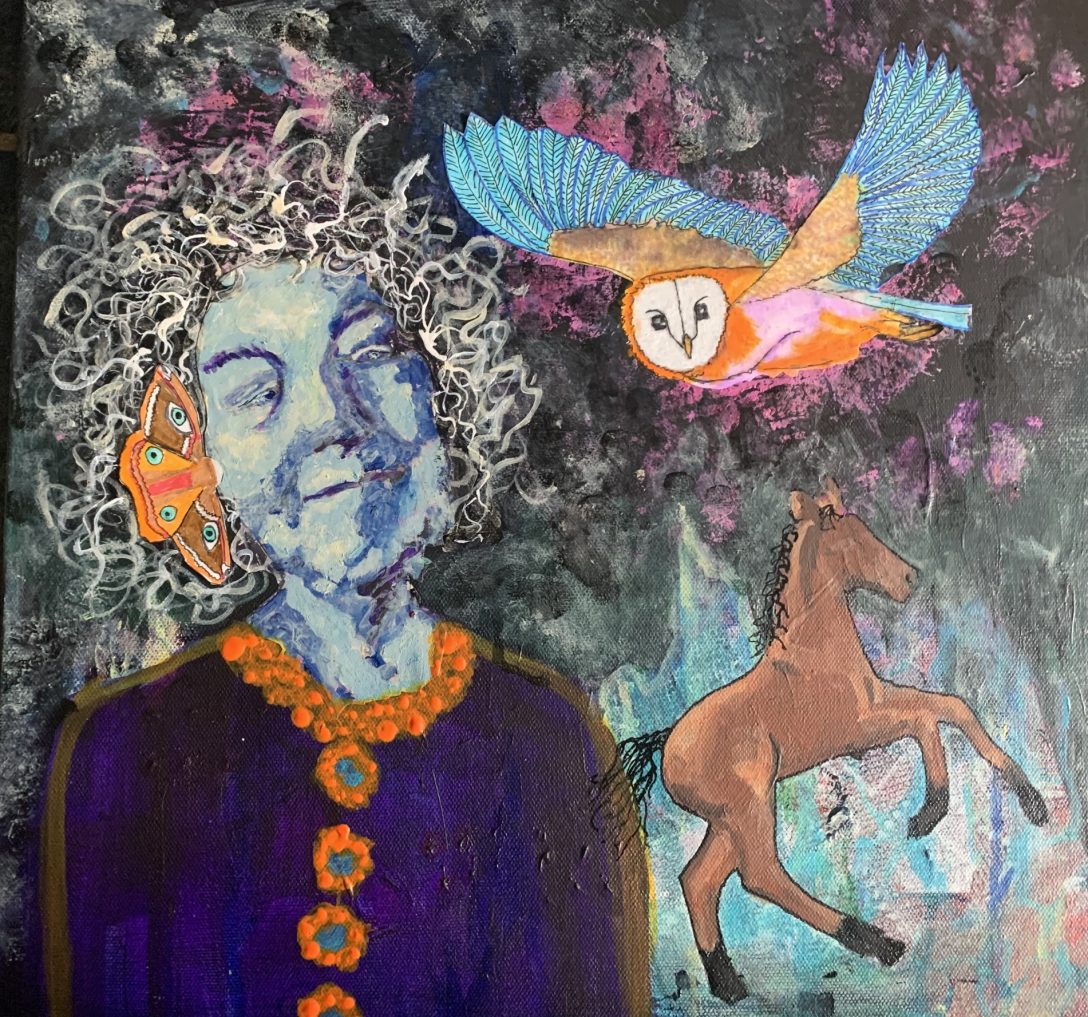


This series of paintings came from two sources: a lifelong love of classical mythology and the longings of my soul. Over the years they have merged to produce images that eventually call out to me to paint. I still have the textbook from my undergraduate mythology classes with Dr. Carrie May Zintl in my days at Mt. St. Agnes College and leafed through it many times to research allusions in the literature I was teaching to my own students at Mercy High School.
Stories, particularly ones as ancient as these, have layers of meaning when read as symbolic of the workings of psyche. In particular, James Hillman, a student of Jungian psychology and founder of its offshoot Archetypal Psychology, held that the polytheism of classical mythology represented in metaphor the multiplicity of selves that exist in all of us, the ones who are rageful, loving, jealous, power-hungry, or grieving, the full circus of what it means to be human.
I have always been looking for God but used to believe that God was “out there” and I had to prove myself somehow to be worthy. But a line attributed to the Sufi poet Rumi expresses what I have come to know: “What you seek is seeking you.” The desire is not one sided; it is mutual. And that is what started this series of paintings about Zeus and his pursuit of mortal women. If the feminine in these stories represents the human soul, then Zeus could be a metaphor for the power and majesty of the divine endlessly chasing her.
Now Zeus was a perpetually lustful god and could be a real jerk when trying to seduce those mortal women he was taken with, all the while hiding his pursuits from his jealous wife Hera. The first painting is “Zeus and Europa.” Zeus enticed this Phoenician princess who was picking flowers by the sea by turning into a gentle, sweet-smelling bull. Europa was smitten with this giant beast and got on his back to ride him, whereupon Zeus the Bull plunged into the ocean and spirited her off to the island of Crete. Thus began the mythic foundation the Minoan civilization founded by their offspring King Minos.

This next painting (and my first oil painting) is “Zeus and Danae.” Danae was the only daughter of King Acrisius of Argos who had been warned by an oracle that he would die at the hand of his grandson. To prevent any conception, Acrisius locked his daughter high up in an impenetrable tower. But Zeus became enamored with her and was able to reach her as she slept, becoming a shower of gold that filtered through the lofty window. The child of this union was the hero Perseus of Medusa slaying fame.

Finally, “Leda and the Swan” is a myth that W. B. Yeats used is his poem by that same name (included at the end). Leda was the Queen of Sparta when Zeus fell in love with her. Taking the form of a swan, he pretended to be fleeing from an eagle to gain her sympathy and “protection.” Of course, the double twin progeny of Zeus and Tyndarius, the King of Sparta were Helen of Troy (Zeus) and Klytemnestra (Tyndarius) and Castor (Tyndarius) and Pollus (Zeus). Each set of twins had one semi-immortal and one mortal child. In this painting I used as a reference photo for Zeus/Swan a photo from Sir Matthew Bourne’s production of Swan Lake that flipped genders, replacing the female dancers with an all-male corps of dancers. The final scene of the film Billy Elliot has a grown-up Billy getting ready to leap onto the stage in his swan costume. I never tire of seeing the look of astonished love on Billy’s father’s face as he watches from the audience!
All three of these paintings echo the art that God creates in souls: With Europa, the foundation of community; with Danae in her vulnerable acceptance, the hero who slays the maker of stone hearts, Medusa; with Leda, the twin natures, mortal and immortal, in us giving birth to great beauty out of incompleteness, touching the face of the divine with cracked fingers and oil paints that I am still learning to use.
…………………………………
Leda and the Swan
by W. B. Yeats
A sudden blow: the great wings beating still
Above the staggering girl, her thighs caressed
By the dark webs, her nape caught in his bill,
He holds her helpless breast upon his breast.
How can those terrified vague fingers push
The feathered glory from her loosening thighs?
And how can body, laid in that white rush,
But feel the strange heart beating where it lies?
A shudder in the loins engenders there
The broken wall, the burning roof and tower
And Agamemnon dead.
Being so caught up,
So mastered by the brute blood of the air,
Did she put on his knowledge with his power
Before the indifferent beak could let her drop?


