Above, the forsythia arced, its vigil done, its yellow childhood yielded. Green held all in a network snood: July’s blue air, the calls of yesterday’s friends. I lay on my back; above me branched a basket; the alleyway a Nile. I waited, a female Moses-child among the reeds for Pharaoh’s daughter. My people must go free from this fertile land, this silent mind.
Above, the forsythia arced. In that tunnel that smelled of tomcat and earthwork trenches freshly dug for plastic Cossacks, stalls for the horses of Tsars of Russia, their forelegs insouciant, ever-enthralled in prance—and never did they sleep—in that cave I hid to practice different voices as boys would load and cock toy rifles, I said the name of God: as the groan of a glacier’s thaw; as the melt of cherry ice on a picnic bench in June; as the cube that rings against the glass; as the sear of snow in winter, hot upon my cheek; as a sudden snow hoards first things in its heart. My finger drew an ache around my breast. A ladybug crawled from beneath my hiked-up shirt, unshelled her wings in a fizz, was born to air.
My childhood lives eternal, an always still an always moving promise silent and said, a covenant that lets me ride toy horses into psychic darkness, calling me to say the name of God: as the squirrel’s plea for longer summers; as the revel of gnats around the kitchen sink; as the certainty of death; as the failure of words. My hand against my thigh supports my aging bones upstairs to sleep. Again a child, and borne by breath, to dream that when I die, I write again each time some soul exploring reads this paper scrap, I’ll meet with them, recalling meaning shared in God’s forever, past the arc of time.
A young father takes his small daughter’s picture against a bank of floribunda roses that lines the labyrinth called Thanksgiving Place. Portrait done, she grabs handfuls of petals to form balls of floral snow that promptly fall apart; they will not stick as she wishes, falling to the ground, an apricot carpet.
Her father walks away, calling her to follow. She refuses, grabbing another then another handful of petals, squeezing, dropping them, thickening the blanket’s loft, leaving not an inch of ground uncovered.
I walk this circle as my morning prayer along its switchback path to my center, turning, and moving outward from my beginning. I imagine this child walking the labyrinth of life many years hence.
I want to be her and stamp my foot, ignoring again my father’s call as he stands just beyond the vanishing point at the end of my breathing’s path. Stubbornly planted near a bank of flowers, first, I demand, first, this rough earth made deep with beauty.
When Mnemosyne and Zeus got it on, they made daughters who played along edges of streams. Muses. Memory mixed with majesty. From the clear water currents that bubble up through layers of leaf mold, through rocks, through muddy soil and sand, the girls splashed art and science and a soul’s hunger for a glimpse of god in its singular self. Creation rises through the grime of experience and the rot of time, like groundwater for richness of soul.
But I wonder now: will the currents that drive an AI world run electric, the strike of lightning alone from a sky ungrounded in mud, fortify an imitation soul? Will it live in its machine mind ever impatient of contemplation, its pleasure a conflagration that burns a forest down?
Today, my words outdate before they dry upon the page. An eagle shrieks and dives to talon a white perch in a Choptank creek. It will shred this fish into bleeding ribbons to feed its young in the wide nest I cannot see high up in some loblolly pine. This cry is my cry, as is the beauty of the lightning dive, as is the bloody feeding of my gape-beaked longing.
When the Dalai Lama sits in meditation opening his inward eye to blue-sky mind, does a trap door swing open in the clouds for his green-eyed kitty to butt his head through blankness, insisting on being fed? Each passing present brings louder meows: he is, after all, the true ruler of Tibet, refusing exile.
I wonder: for a moment, does the Dalai Lama think about turning this cat into feline art against the purified white of temple walls? Strangely beautiful. Strangely satisfying!
But then, there’s that bodhisattva vow: compassion to all the sentient beings trapped in the stuck door of existence, soothing the bottomless hunger that comes with breathing.
(Even those whom you’ve just fed before you sat to meditate. Always for them who bust the bounds of heaven ever crying more.)
The morning calls, the star, smack dab in my face. Yellow and wide, it drips across the sky like my deepest wound or a broken yolk on a pink china plate. I break my dark fast from joy today.
Today I have no mind for philosophy for dasein or ontology, interstitial sentences, prohibitory fences set up against the sun. I’d rather play with angels AWOL from their allotted choirs. They show me squirrels on the backyard electric wires, their rodent toes embracing the hum, outrunning death. Today. They show me the front-yard oak trees, fast toward and slow from acorns. They show me the counterclockwise morning glory turning in quarter circles toward the sun. One day, its bloom will bond with August light releasing all the hoarded hopes of its assent in one audacious boom of blue.
But today, I live at the center of this same sun: there is nothing I can do to make God love me more; there is nothing I can do to make God love me less.
I imagine because you walked in here through this title, because you are reading this, that even though you don’t know me, you know me. We meet in this place of words of shared longing for something we can’t quite name.
Let the finger that touches this pencil touch the eyes that read these words, gently salving your eyelids with their meanings freed and liquid. We’ll crack open the O of wonder and let the air escape for both of us to breathe. I am reaching out to you right now: can you feel me touching the face that no one knows (even you) in this bright right now?
Together we can enter through the door of our yearning the endless room of love that is built by God, the room of humanhood pooled, so frail and so full of might. Here we might embrace the world and together hold it close as one would to calm an agitated child whose limbs thrash out against fear-of-many-names like the sudden arms of lightning in an April storm.
If you do not want this, stop reading now.
But if you do, follow this line of words into silence, into the stillness of the space of our sameness. (Even though I do not know you/I do. And even though you do not know me/you do.) We live in the might of our longing and hang curtains red in open windows to dance like flames in the wind that fills our room with All with flashing wings or fire or in a quiet sun.
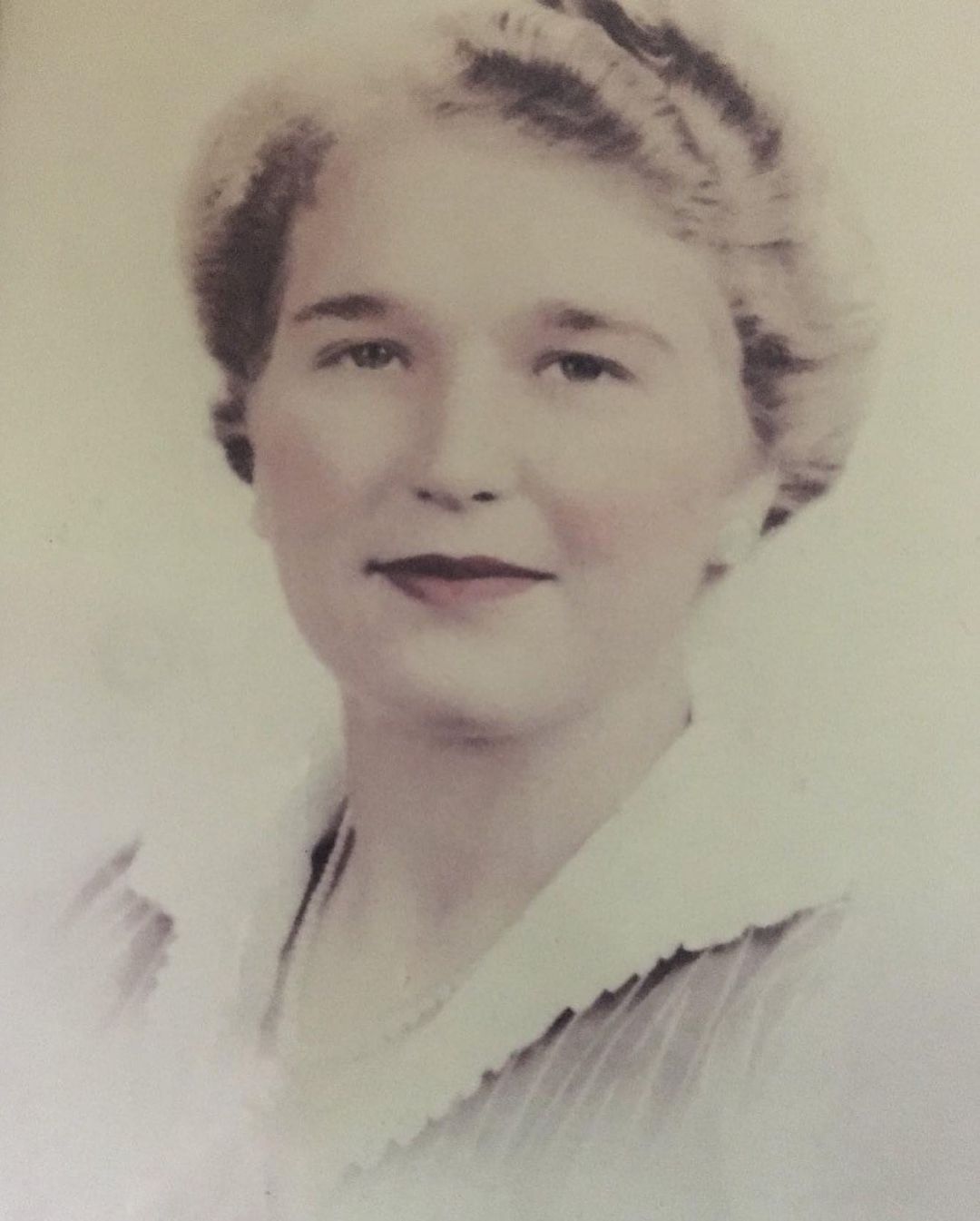
My mother would have been 100 today. Two, two two two two two she tittered when asked her birthday. Back then, all eight of us misbehaved in all directions: Peter tortured Claudia’s hair with scissors; Frogs from the creek found their way into bedsheets; Strangers, reading dog tags momma made Jack wear, returned our wanderer from the last remaining barn In Northwood. Sometimes, strap in hand, face pink as our backyard peonies, she’d grab the nearest, perhaps one with fanny prophylactically padded with philosophy books from the living room shelves. She laughed, trying not to, yet sometimes happy thunder struck, and she could not stop, her laughter winding up like an outboard motor, round and round the circular pond of threadbare chairs until no voice remained, only her breath, like Precious Pup the cartoon dog we watched on Saturday mornings, her laugh went round and round until we were all whirled up in a tornado of mirth, all of us thrown to the floor and holding bellies aching with joy, my brothers rolling around like pups in their punishment of glee.
I got that way too, caught by fun, laughing so hard I lost the sound or, worse yet, sent out waves of cackle that pulled my students into a merry whirlwind. Out of control, I imagined the other teachers said of my class, out of control, such a frivolous fit. I know mom sat with me then, her laughing ghost in my teachers’ chair, as close to me as breathing.
I like to think that some child I taught grows up and laughs so hard that she, in turn, catches her children in a lasso of merriment and all fall out of control for the good of joy.
And in the years ahead, another all-grown-up child releases her always-ready laughter two hundred years after my mother’s two two two two two birth.
She will be there, and I with her, in our legacy of laughter, now nameless and faceless, moving through the years like love.
My first AA job forty years ago was to make coffee, hauling plastic pitchers of water to the silver coffee maker that wheezed when it got going like a bad asthma attack or dry heaves after a bad drunk. I set out the sugar packets and jars of powdered creamer filled with trans-fat that would get us eventually but maybe slower than the alcohol, the stirrers, the napkins the tin foil tart shells to serve as ash trays. We were all on the water wagon, striking up our agency a day at a time. Our lives had been paralyzed by addiction, but here we were, laughing our shared shame away in a bubbling pool of humor sweetened with the intensity of metanoia. The chalices were Styrofoam, the coffee sacramental, celebrating the shift in perspective when “I drink because of my problems” becomes “my problem is that I drink.” If I had lacked power over my addiction and needed to find a power greater than myself to recover, then sharing this communion of caffeine helped to show me how to heal.
After the meeting, we could walk outside in the evening cool and look into the sky to watch the constellations line up in different forms: There was the horse that Mac had talked of when he spoke of horses that have more sense than humans; when one of their herd was ill, the others gathered and pressed their warm bodies against it, to heal and give strength. There was Hermione the Trashcan talked about by a delicately made woman with pinch-nose glasses who spoke of taking her empty bottles to her neighbor’s trash can because she didn’t want the trash men to know how much she drank. To its right in the autumn sky was the Forest of Words which kept our minds occupied while the real healing of propinquity took place. Finally, where the Big Dipper transformed into the coffee cup in its imaginary clouds of Styrofoam pointing in the heavens to the North Star, Polaris, the navigational beacon that we could rediscover if we lost our way and kept our sight sober and true. This North Star, the power greater than ourselves, the God of our understanding that some saw in the religion of their upbringing, some saw in whatever…a doorknob, and some saw in the group.
Many an evening, our cars filed the familiar path up Charles Street to go the meeting after the meeting at the Towson Howard Johnsons, the orange-roofed HoJos that some may remember, where we cemented our friendships and dedication to the 12 steps with French fries, and hot fudge sundaes washed down with even more coffee. On the way home, I passed a familiar friend, a beautiful, old weeping willow across the street from the entrance to Sheppard Pratt Psychiatric Hospital with its fairytale stone Gate House. This willow took one’s breath in the spring when it leafed out before any of the other trees, weeping gold first, then green. It reminded me of the willow my father had planted in the backyard of our Northwood row house that that grew with the vigor that only proximity to the sewer lines could give it in its incredible thirst for water
Weeping willows are greedy flora. Their roots spread fast and far to suck up any form of water in the nearby soil. God help the homeowner who plants one in a backyard that also holds the water and sewer pipes in terra cotta pipes. Well, my father did, and after many plumber visits and roto-rooterings, he finally had to admit defeat and take the darned beautiful tree down, digging up any remaining roots that could sprout a sapling to begin its cycle of destruction all over again while it leafed out toward the sun in beauty. I loved that tree. I loved the way the hanging branches stirred in the breeze to tickle your face. I loved how you could cut a long branch and tie your brothers’ hands together, an older sister torture technique. I loved how the fully leafed curtain of withes made all the weather theatrical: the August lightening, wind whipping from the west, the curtain parting for the curtains of rain, the air thundering with anticipation, my grandmother, afraid of lightning , calling us away from the willow to go into the basement to pray the rosary until the storm passed. But I had already been struck…with wonder as this tree grew more beautiful by day, its roots sucking in the dirty bath water and stinking excrement from the sewer pipe, converting our waste into juices of life for new leaves burgeoning like our ever-expanding family, this tree, itself a meditation on living, the tree growing taller and taller with each inhalation and then raining to the ground an exhalation of branches.
Early in my sobriety, my sponsor suggested that I begin a meditation practice, I think because my mind in post-acute withdrawal was racing around in circles like clothes in the spin cycle, only with peanut butter (of course, all that coffee didn’t help). My beginning practice was sporadic; only in the last 20 years or so have I settled into a regular sitting routine. Recently, however, I have been studying the Christian mystics because I’ve come to understand that this longing for something, for something more that I have felt all my life is really a longing for God. One practice is that of Centering Prayer, a method of contemplation named and popularized by the late Trappist monk and priest, Thomas Keating. In this, the prayer is instructed to choose a word meaningful to them to repeat as an anchor, much like a mantra or breath counting in Zazen, to help still the mind enough to hear the breath of God in the inward ear. I am particularly fond of the way James Finley in the podcast Turning to the Mystics describes the use of the word: look at the birds, he says, the eagles, vultures, even gulls that ride motionlessly upon the pillars of heat that rise from the earth called thermals.
They just fly. And then every so often, as they lose a little altitude, they flap their wings a few times. So, you’re sitting in this presence, and you realize there’s distractions. And so, you say “Jesus, Jesus, Jesus[your word],” like you flap your wings a few times to maintain altitude, but you’re really trying to use the word to get beyond all words. And I think it comes full circle. We use the word to get beyond words to discover the holiness of words, how God’s present, and the way we talk to each other and so forth. (Finley)
The word I chose is Bethesda.
There is a story that many, many years ago, an angel came to Jerusalem. Where its heel struck the ground, a fountain sprang and the pool that formed from it healed all those who bathed in it. This healing pool became know as Bethesda a name that means House of Mercy or House of Grace for the healing that occurred. Yet the place also became called the Place of Shame or Disgrace for the people who hung out at the pool, all suffering the shame and disgrace of disease-wracked bodies, a multi-denominational leper colony, so to speak, unspeakingly shouting, “Unclean! Unclean!” to those who came near.
But this is just the kind of place that always attracts Jesus. Traveling to Jerusalem for some sabbath or another, Jesus passes the crowd of those waiting by the pool, waiting for the angel to stir the waters, waiting to be the first in the pool and get healed. He sees a man who had been paralyzed for thirty-eight years. Jesus asks him if he wants to get well, and the man answers that he has no one to help him into the healing waters. Jesus then tells him to take up his mat and walk. Which he does. And is healed. Later Jesus tells the guy to go and sin no more so he doesn’t have worse things happen to him. Of course, no good gesture ever goes unpunished, and our man J catches grief for healing on the sabbath and the healed guy also is hassled for working on the sabbath by carrying his mat. Apparently, there were legal hair-splitters then too who enforced the old Blue Laws in Jerusalem (am I dating myself talking about Blue Laws when one couldn’t buy or sell stuff on Sundays?).
But the part of the story that interests me is the answer that Jesus gets when he asks the man, do you want to get well. The guy says that there is nobody to get his ass into the water. Jesus ignores his declared lack of agency and tells him YOU get up off the mat and walk as if he is making the man aware that the healing is already hiding within him. No one can do it for him. But someone can do it with him by reminding him of who he truly is, or, as the Zen koan suggests, showing the man his original face before he was born, his Buddha nature, his child of God-ness. I think the man sees this in Jesus’ face. So the man, made pliant as a willow by his thirty-eight years of suffering, chooses to take up his mat and to walk into his life.
That’s kind of the way healing worked for me in AA. I got sober at a meeting place called Agape that was held in an old classroom out-building on the grounds of the motherhouse for the School Sisters of Notre Dame. I met the woman who had answered the phone at AA, and we walked into the building with the words Alcoholics Anonymous shamelessly painted on the wall with an arrow pointing to the two rooms where the meetings were held. To me, that sign could have read, Disgusting People’s Entrance or Weird Wackos’ Cattle Call, so great was my apprehension. But after a few meetings, I took my last drink and I picked up my metaphorical mat and walked (well, drove, actually, in a falling-apart Honda) to more meetings where the folks there showed me that there was a true self beyond the person who drank and got drunk, whose life was filled with the waste and whose marriage was crumbling. And I picked up my agency by not picking up a first drink. A few meetings later, someone asked if I would help make the coffee.
That angel who stirred the waters in Jerusalem, the Bethesda Angel has a central place in Tony Kushner’s Angels in America, a play set during the AIDS scourge in the 1980s gay community in New York. It’s an extraordinary commentary on disease and healing, grace and shame, paralysis and agency, as the protagonist Prior Walter discovers the lesions that herald the infection and loses his lover and his belief in certainty. An Angel, hallucinatory or not, crashes through his ceiling at the end of the first play to tell him that he is called to be the prophet of paralysis, of stasis of the way things used to be even though they are crumbling in decay. God has walked out on them and taken the force of Creation with him. In the end, Prior, refuses this role by becoming, instead, the herald of creative energy, by declaring desire to the Angels of Immobility sitting in a derelict heaven. “We just can’t stop. We’re not rocks—progress, migration, motion is modernity. It’s animate, it’s what living things do. We desire. Even if all we desire is stillness, it’s still desire for. Even if we go faster than we should. We can’t wait” (Kushner 264). And Prior takes up his desire and walks into the final scene of the play, set five years later at the Bethesda statue of the Angel of the Waters. He and his friends, all of whose character arcs reveal healing and action and transformation, talk about Peristroika, the fall of the Soviet state and the thaw of the cold war into a spring of uncertainty. Prior, leaves their conversation to deliver his final words to the audience: “The world only spins forward. We will be citizens. The time has come. Bye now. You are fabulous creatures, each and every one. And I bless you: More life. The Great Work Begins” (Kushner 280). And the four walk up the stairs from the fountain. In the excellent HBO adaptation of the play (starring the likes of Meryl Streep, Al Pacino, and Emma Thompson in multiple roles), one hears their animated conversation into the fade-out. But in the movie remake that lives in my head, I imagine them drinking coffee from white Styrofoam cups.
The year I got sober was 1983, and as I’ve said before, my life was a mess, as was my marriage. I was running to AA meetings as many times as I could and reconciling and re-reconciling with my husband, moving out, moving in. During the summer of that year, we decided that I would move back into the big cedar-shake house that we had been living in and try again. Ten days after, he told me that he just didn’t think he could do it, and we decided that we would remain together through the summer and then get legally separated. I am not going to get into why we broke up because I’ve found that most relationship ruptures are overdetermined in causality and much too complicated to explain simply, and now I count my ex-husband as a dear friend. Yet there I was for the rest of that summer, mourning the end of the marriage while living it still together and mourning the end of dependence on alcohol.
The backyard of that house had a spot in it where the drainage was just terrible. Every time it rained, one could feel the lawn get soft and spongy making the squishing, sucking sound where your tennis shoe hit the grass. For years I had suggested that we plant a weeping willow there because that area was a place so soggy a willow could weep for joy in it. But that summer, my husband suggested we do it then, the summer we were splitting up, and I found myself sinking into an emotional morass: planting a tree is about the future and for him and me, there seemed none, so we never planted that tree. But I did. Inside.
We all have inner worlds, landscapes that we have built and gardened, a place to go where the soul can breathe and rest especially when the world is unraveling which it always seems to be doing a lot of now. This inner space is a place for stillness and reflection to pull back into awareness with the massive help of faith that things come apart so that they can be put together anew. Like the constellations in the night changing shapes and meanings. Like the seeming death in winter. Like the creation of new metaphor from cliches that lie around in one’s writing, worn out and drained of energy. Inside in my imagination I built a house of light to live in a towering a-frame with two storied windows that rise to a peak piercing the sun that warmed the slate tiles of its living room. There I watched the sun rise and fall and the stars at night. One day I found a high ladder and climbed to the top to pour translucent paints down the window’s face. Red and blue and gold and green washes of tear-like color. My inner living room became glass stained with the palette of the earth and sky: sea and forest and sun and moon. I have lived in that house for many years now, and just outside my inner house of light, I planted a weeping willow that has been nourished by the things that have hurt me, the shame and guilts that I have brought to this ground. It lives next to my Bethesda pool, the lake of forgiveness, that deep reservoir for compassion that living has carved into my heart.
Lady Wisdom sometimes visits me there, more often nowadays because both of us have old bones that slow us down, especially when it rains. She has become a good friend, and we chuckle at my younger self who wrote her off as a silly old lady. That’s the way the young are, she tells me, but she knows I loved her even then. Some days we just sit in silence weeping for the latest school shooting or the latest civil injustice or my latest blindness to another person’s pain or my own loneliness. But most days we weep with this beauty of the healing cycle and the gift of the waters as we sit quietly drinking coffee from Styrofoam cups, watching sunsets through the willow’s rain. I say the word Bethesda, my wings awaken, and I am once again borne upon the warm pillars of love rising from people of the earth and the God who lives in the love we share.
The angel stirs the waters here for everyone.
All are welcome. Bring your bathing suits: Coffee will be served: The Great Work Begins. -Kitty Yanson 7/20/22
“Nunc fluens facit tempus, nunc stans facit aeternitatum.” (The now that passes makes time, the now that remains makes eternity.) ― Boethius, The Consolation of Philosophy
I This is the city of air and foam where heat from dunes and metal hoods of cars dulls vision, and lights at night steam up the heavens, and block the stars; where daylight’s ocean muffles cries of children running from moms to sea-froth filagree. When I was young in time, rows of women, lay on beaches, Venuses unearthed and vandalized, with purple scrawl across the backs of thighs in the pre-sun-screen sheen of baby oil and iodine. The nacreous slick of yellow hair dammed the flow of backs, bared and browning in the sun. When I was young in time, I sat at the ocean’s edge in the incoming tide and watched the sea throw itself upon dry sand, again and again and asked it: why life? why death? and why again until the waves and existential whys were one.
II If I spoke to the sea, would it answer? Am I nothing but a minnow in the night, galling the ocean in its vastness, a scratchy sound, like a tin can on its shore rubbing against a rock? Water, I know you, I know you not, hidden in my depths, as invisible as air. You are baptism and blood. I drink you, I wash with you. With your brother wind you can blot out cities yet sing us to sleep in our matching language the throbbing of my heart, the throbbing of your waves as the dumb moon with its tongue-tied force calls me to collude with you in surges of internal tides. Water I know you, I know you not.
III I lecture to this mystery. But like Proteus who counts his flock of seals at night, shifting his shape at every human touch, each concept I pour sea into explodes, becomes another: bearded lion to boar to fountain to towering tree: it will not stay still. Concepts are levees against the unknowable that break and push us under leaving the land inundated with unknowing, becoming rich with dark silt, rife with enigma, pregnant with our hopes. Watching my dreams in combers come, I swim to capture one, to ride it into shore where surf meets text. Most I miss. Most remain in the ineffable turning of waves and the questing whys.
IV One day when I was young in time, my mother woke up early to sit upon the porch that faced the westward bay, waiting for the sunrise to set alight the sea. We sat with her laughing and inhaling coffee. Time right, place wrong.
Now when I am old in time, my sister sits and faces westward waiting for sunsets and eagles, the moment of rightness to snap a pic and applaud each spectacle of eros: each singular repeat of passion in light’s affair with flood. She posts these paparazzi snaps to tack across her Facebook timeline from spring with its spreading arms to grey-eyed winter.
Now when I am old in time, the blowing sand combines with breath to cloud the sky as coldness sharpens sight enough to recognize the final chill. As ice, the sea sets skin on fire; as foam, it is my christ’ning lace, that dressed my birthright carrion carried ever closer even closer in the flowing now.
Yet here nunc stans: Never mind why life, why death. They both live in a single sun that rises each day and sets in an ever-widening circles. It only asks that I be here now: with the taste of the god in the salty air with the roaring of the ocean’s exhalations with the gulls that plead for invisible bread with the mystery, the many fathomed mystery, of love that lives, timeless and deep in my opened heart, more boundless than the sea.
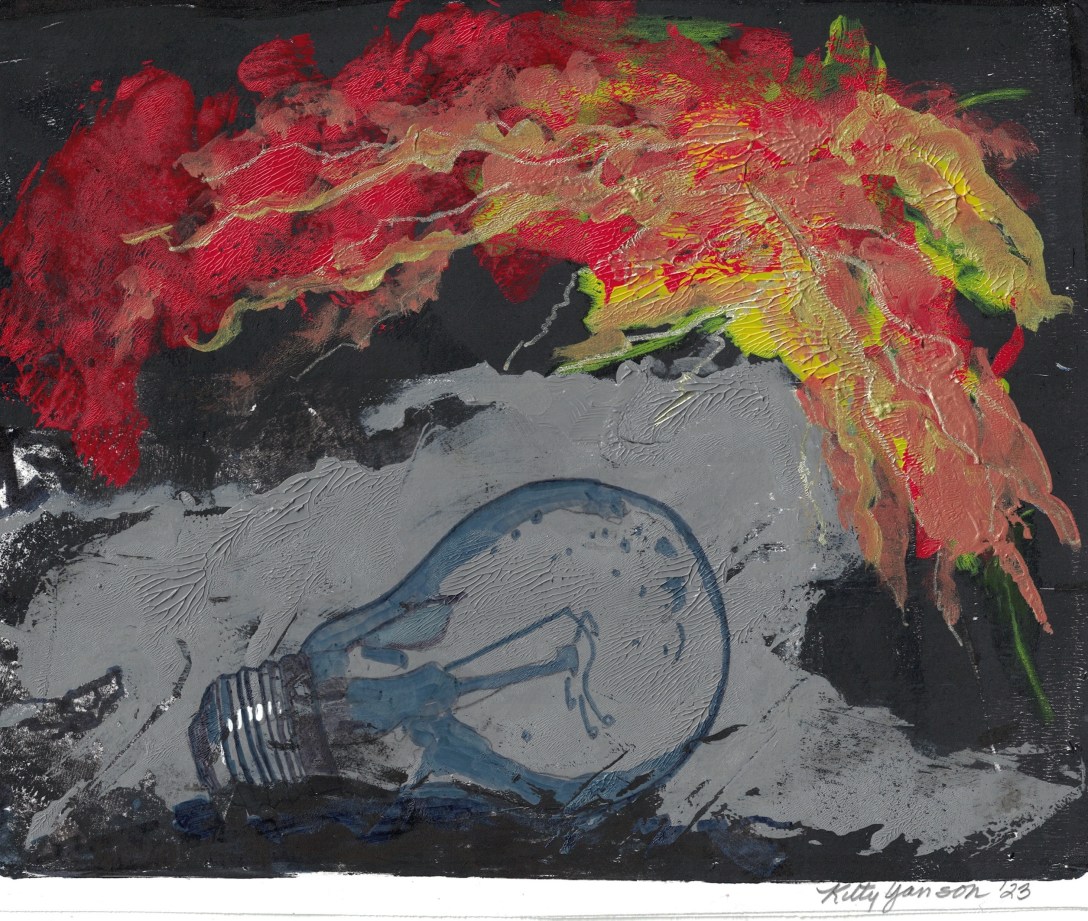
“…Divinity is found in the current that generates the light and not the container of the light….No one I know collects light bulbs after the luminous capacity has left them. We are briefly illumed, and then what is left is the glass receptacle not light.”
-James Hollis. The Broken Mirror: Refracted Visions of Ourselves
A pyracantha bush, burning, by the side of the road, collects in its thorny, painful love, tossed liquor bottles and cellophane wrappers tucked together with incendiary berries like the abandoned resolutions of not-quite-evil sinners. No wonder God gave Moses two stone tablets; it takes a hard head or downright idolatry to break them. Poor calf, shining in the valley like investment accounts in a bull market. Va vitello d’oro!
Or the Old Man River Deity on the Sistine ceiling touching Adam’s outstretched finger, a guy after a guy’s own heart. Yup, you’ll follow Him through the just-cleaned kitchen and litter it with stinky sports clothes and bloody Crusader armor. But he kisses you on the cheek and says he loves you! All is forgiven. Why aren’t there any kitchen lady gods? No Santa jolly either, He, without the toys and Christmas lights unless we include the burning bushes of underwatered pines, the too-dry catastrophic tinder.
And why do we never see a God who laughs? I’m not saying a slapstick guffaw; that would be mean. But maybe a raucous hoot while rocking a hip-hop tukus or conga line kick at a Pascal celebration. God must have a sense of humor, you know, to put up with the rest of us. I mean what does He do when we do the equivalent of peeing on the floor behind the bookcase because the ants need watering?
But seriously now, it’s more convenient to believe in the skinny one who hangs upon the cross than the skinny one we see on Calvert Street with his sign that reads: Homeless Vet, Hungry, with hand outstretched whom we choose to believe …or not.
Yet no one pictures a female God. Her sense is touch. We feel her deep down in subtle skin below our skin, Hidden in the unlit corners of souls. She is the heartbeat that trained your heart to beat, The unmet longing that threads your pulses, a string of perpetual beads, of never-ending feeding. She rocked us into breathing, then retired to the primitive good that lives in ancient parts of the brain, the body’s memory, escaping awareness through cracks in useless concepts. She calls us to love as she did in the early tales of loving, even when we act like an ass and sin. I imagine that she covers her nonexistent mouth with a nonexistent hand to keep from laughing. But, anyway, we hear.
It’s time to ditch the stash of burned-out light bulbs, and look for God in other places: in the jagged fissure of a broken heart, in the untold stories of a dark night’s stars in the purple halleluiah of the Lenten Rose. If Rumi is right, that what you seek seeks you, be still. Wait to be caught. Wait for God to sneak in secretly Between, perhaps, two mundane moments. Or maybe wait for the shock of God, a jolting bolt of love to run joyfully amok through the firing filaments of your longing.
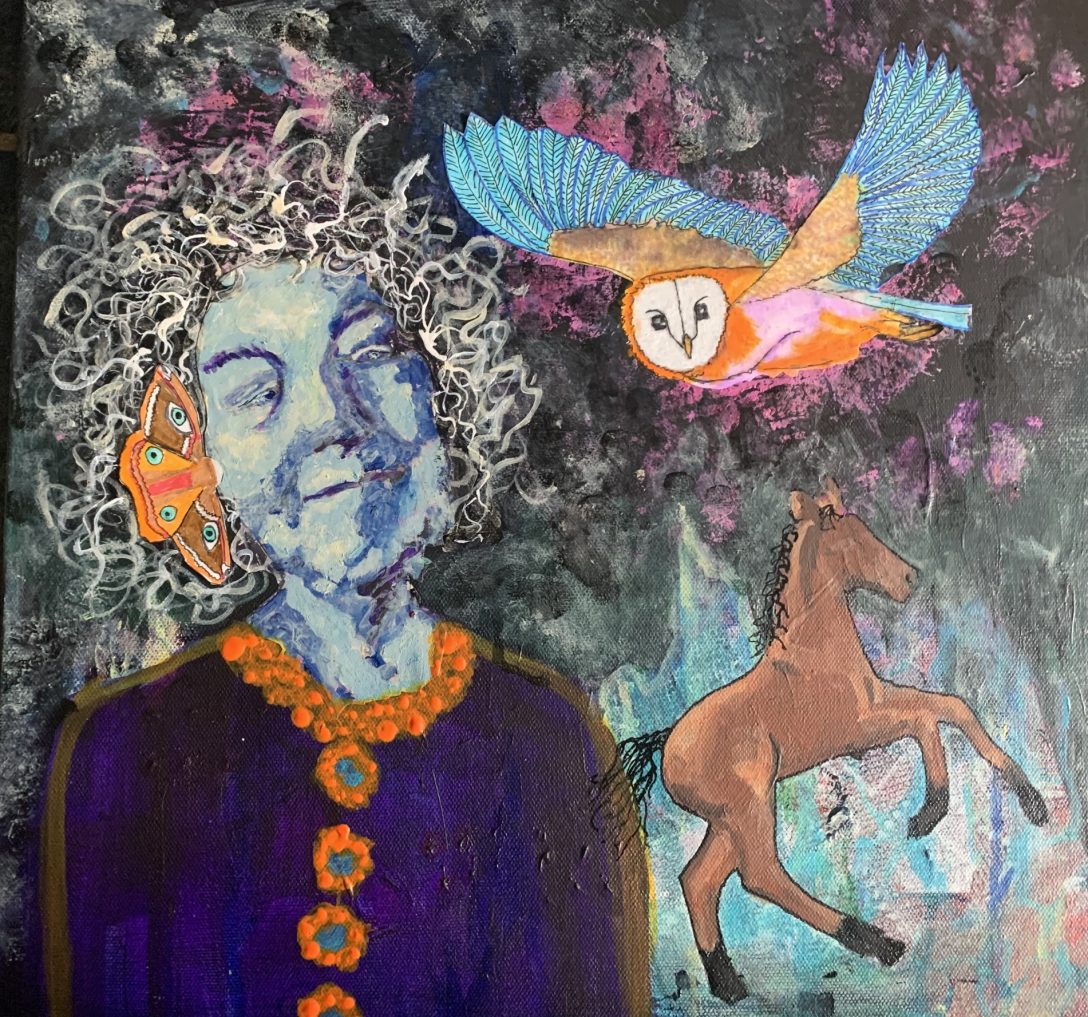




 Memorizing the Laws of Gravity